War, huh, yeah-
What is it good for?-
Absolutely nothing, uh-huh, uh-huh-
War, huh, yeah-
What is it good for?-
Absolutely nothing, say it again, y’all-
Listen to me;
Oh war, I despise,
‘Cause it means destruction of innocent lives
War means tears to thousands of mothers’ eyes
When their sons go off to fight and lose their lives
I said, war, huh, good god, y’all
What is it good for?
Absolutely nothing, say it again
War, huh, whoa-oh-whoa-oh, Lord
What is it good for?
Absolutely nothing, listen to me
War, it ain’t nothing but a heartbreak
War, friend only to the undertaker
Oh, war, is an enemy to all mankind
The thought of war blows my mind
War has caused unrest within the younger generation
Induction then destruction, who wants to die?
Oh, war, huh, good god, y’all
What is it good for?
Absolutely nothing, say it, say it, say it
War, huh, uh-huh, yeah, uh
What is it good for?
Absolutely nothing, listen to me
War, it ain’t nothing but a heartbreaker
War, it got one friend, that’s the undertaker
Oh, war has shattered many a young man’s dreams
Made him disabled, bitter and mean
Life is much too short and precious to spend fighting wars these days
War can’t give life, it can only take it away
Oh, war, huh, good god, y’all
What is it good for?
Absolutely nothing, say it again
War, huh, whoa-oh-whoa-oh, Lord
What is it good for?
Absolutely nothing, listen to me
War, it ain’t nothing but a heartbreaker
War, friend only to the undertaker
Peace, love and understanding, tell me
Is there no place for them today?
They say we must fight to keep our freedom
But lord knows there’s got to be a better way
Oh, war, huh, good god, y’all
What is it good for?
You tell me, (nothing) say it, say it, say it, say it
War, huh, good god, yeah, huh
What is it good for?
Stand up and shout it (nothing)
It’s interesting to see how a new type of addiction develops. And how it evolves. Pinball machines were a physical prelude to the current online multi-billion dollar gaming business, which is played by approximately two-thirds of American people. It’s noteworthy to observe that among gamers, some display symptoms that are typically associated with addictive behavior.
Divide to conquer
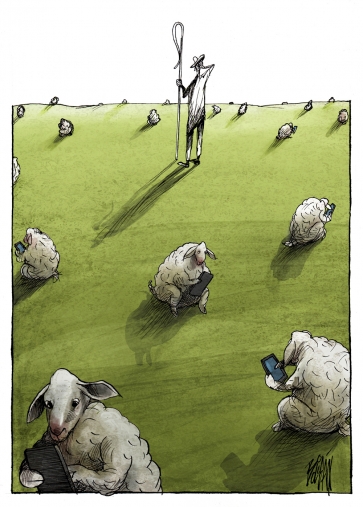
The widespread use of computers and handheld devices prompted a major shift in people’s allocation of time to rely on the World Wide Web to conduct their personal and business activities. A swift change of behavior that is unprecedented in human history. A move that favors online dependence on an all-knowing, otherworldly source of interaction and influence. A transformation that is having an inconspicuous impact on the behavior of a captive audience.
Compulsive browsing makes individuals literally turn their backs on their physical environment. To ignore a world that is essential to human spiritual, emotional and economic well-being. An isolation that is a common trait among addicts suffering from drug abuse, alcoholism, sex addiction, money fixation/greed and compulsive gambling.
A Big Tech online dependency exposes a more pervasive and insidious condition among people who are hooked on the world-wide spying/spider web. A system that puts profits ahead of people by confining them into their sphere of influence: By spying on consumers’ buying habits to direct purchases and with data collection on searches to sway political action.
There is no consensus among mental health professionals that online video game fixation is an “impulsive control disorder” similar to other known addictions. Yet, online dependence displays similar symptoms like; fear, aloofness, loneliness, anxiety, depression, identity confusion and an individual’s alienation from their social environment. Users with these symptoms are trapped in a global containment, captive of an invisible sphere of influence.
Whereas global, from the word globe, implies a self-contained sphere with a well defined border. A globe embraces the totality of items within the confines of its circle. Hence, it is totalitarian by design. A globe is oblivious to reality that lies outside its perimeters. It separates and shields a monopolistic doctrine from the outer world/reality of an ever-expansive universe.
The more pernicious symptom of online confinement is the separation of individuals from their human physical environment, mostly family, friends, local associations and the grassroots economy. A cult-like power “that shapes and controls the scale and form of human association and action” that promotes a global corporate doctrine over the economy, culture and politics.
This fact merely underlines the point that “the medium is the message” because it is the medium that shapes and controls the scale and form of human association and action. Marshall McLuhan
The Internet and the WWW have transcended traditional forms of communication. The web has ushered innovations and economic benefits unparalleled in human history. Unfortunately, Tim Berners-Lee’s vision of the web as a universal tool for good has been altered by greedy billionaire who are intoxicated by the power of the world-wide spying/spider web has over the globe.
The Internet still has valuable qualities for all of us if we take the necessary precautions to protect ourselves from predatory indoctrination and control. Some steps should be taken to preserve our personal freedom, destiny and humanity.
Restore your privacy
Bypass the spying/spider web with email activism
Use a browser like Brave
Support your local grassroots economy, local small businesses and restaurants
Support independent journalism and podcasts
Use an open-source operating system for your personal use like Ubuntu, or Tails
Use privacy friendly email account like Protonmail.com or Tutanota.com
Support your local church, temple, mosque or synagogue or any other spiritual community:
Love your neighbor as yourself
Here’s another must watch podcast: America this Week with Matt Taibbi and Walter Kern “Oligarchy in the UK”. Have we reach peak consolidation of power of an UN-Democratic political ingroup also referred to as “the party”? Led by an alienated junta of inbred apparatchiks at the head of surveillance, legal and enforcement government institutions. As a result, the cancer in the body politic is focalizing and is more visible as it exerts its tyranny, triggering an inevitable cure, albeit a painful one for the whole body. A cure that will only be completed if the supply of blood and sugar that feeds its existence is cut off.
We have come a long way since the first Olympic Games were held in ancient Greece. The original Olympiads were essentially a religious ceremony created in honor of Zeus, the dominant god of the Greek pantheon. Today the Olympics have become an international sporting event involving most countries on the planet and is perceived as a secular athletic competition, no longer a religious festival. But a closer look at the global celebration suggests otherwise. With the introduction of corporate media, the sacred narrative has shifted elsewhere and perhaps the Olympics did retain some of its religious function it had in the past.
* * *
The first official Olympiads were held in 776 BC in the sacred plains of Olympia. Later events were also celebrated in Delphi and Corinth. The original festivity were in honor of Zeus. Successive games were dedicated to the Apollo and Poseidon, each god representing a specific location. Like today they took place every four years.
According to Greek mythology, Olympia is where Pelops inaugurated the Olympic Games. A sacred site where religious ceremonies and symposiums took place as early as the 10th century BC. The location was dominated by the great temples of Zeus and Hera. It included sacred shrines mixed with sporting facilities, all surrounded by natural beauty. The festivities consisted of rituals, processions and banquets dedicated for religious purposes.
The first Olympics consisted only of running. By the15th Olympiad several sporting events were added; wrestling, boxing, pentathlon, chariot racing and a variety of long distance running. Athletes competed nude, reflecting Greek’s fascination with human anatomy, amply represented in art, especially sculptures depicting the gods and goddesses in perfect human form. The Games were more than a celebration of human physical beauty. They centered on competition and performance. Competition was a feature of Greek culture from its earliest times. And the Olympiads were an occasion to foster good relationship between rival cities within Greece.
Women, foreigners and slaves could not participate. Married women could only watch the chariot race. In the 6th century women held their own games called the Heraea at Argos in honor of the goddess Hera, the wife and sister of Zeus.
Competition involved individuals rather than teams. Each participant represented his city. The winner was viewed as a national idol, regarded more highly than a war hero. The award ceremony took place on the last day of the Olympiads in front of the monumental temple of Zeus inside which stood a 42 feet gold statue of the god, considered one of seven the wonders of the world. The names of the winner and of the athletes’ father, as well as the athlete’s hometown were announced. And finally the sacred olive tree wreath, or kotinos, was placed on the winner’s head.
The Olympiads were celebrated for nearly 12 centuries until Emperor Theodosius I of Rome banned the Games in 393 AD. He decried the spectacle as a pagan cult. Although Emperor Constantine was the first Roman Emperor to convert to Christianity, it is Theodosius I that decreed Christianity as the state religion of the Roman Empire. Following his decree, he encouraged the destruction of the temple of Apollo at Delphi and the Vestal Virgins in Rome. The latter was occupied by priestesses who studied the correct observance of Rome’s rituals known as religio.
During the development of the Empire, Romans had adopted many of the gods of the Greek pantheon and gave them Latin names. Greek’s highest deities consisted of Zeus, Hera and Poseidon. They were renamed Jupiter, Juno and Neptune in Rome. They were also honored at the Olympiads. Zeus was described as king and father of all gods and men. So was Jupiter, who was depicted as an elderly man with a long beard sitting on a throne. Following Theodosius I’s decree that banned the dominant Roman religio, in the course of history the Fathers of the Church consecrated the doctrine of the Holy Trinity.
What happened in Rome at the end of the 4th century reveals that sacred devotion transferred from one set of deities to another upholding the same religious function in society. The lower set of gods and goddesses of the pantheons were replaced by veneration of the Virgin Mary and of a growing number of Saints. What was once the sacred location of Roman temples, its gods and the Empire morphed into the Roman Catholic Church.
It took close to fifteen centuries before the Olympic Games were celebrated again. Pierre Baron de Coubertin, a French aristocrat, was one of the leading players behind the reinstatement of the Olympics held in Athens in 1896. It happened at the end of the century that fostered the industrial revolution, urbanism, modernism and the apotheosis of the nation-state. The rebirth of the Olympiads took place seven years after the Paris World Fair and the completion of the Eiffel tower, the architectural representation of modernism. Pierre de Coubertin embodied a period in which France’s influence in art and culture was predominant. The country was also a champion of universal principles of competition. This was epitomized a few years later by the promotion of the first Olympic Games.
With the rebirth of the Olympics, the religious significance of the ancient Olympiads was not completely lost. To this day, weeks prior to the opening of the Olympic Games, a ceremony is performed by priestesses at the ancient site of Olympia in front of the ruins of the Temple of Hera. The reenactment consists of dances mixed with chants in honor of the gods. A central role is played by the high priestess who performs the ritual of capturing the fire from the sun by using a mirror to direct the sunlight into a bowl to ignite a flame.
For the ancient Greeks fire was believed to be sacred since it had been stolen from the gods by Prometheus. The sacred fire is then used to light the torch for the relay to the selected city. The Games officially begin once the flame reaches the giant torch inside the stadium. The relay from Greece to the host country originated during the 1936 Olympic games in Germany. It was created to promote Nazi cultural legitimacy and used for propaganda purposes.
A Sporting Competition and a Media Event
Today the Olympics are the occasion for the finest athletes from all over the planet to congregate and compete, mingling in an atmosphere of international jubilation. The selected city is temporarily filled with athletes who have dedicated years to hard training. Many are animated by an unquenchable drive to win.
The whole organization of the Games begins with the International Olympic Committee (IOC). A vast commercial enterprise dominated by a small group of sport executives and representatives from major global corporations. The IOC’s responsibilities consist in the selection of the city where the Games are held. It is in charge of allocating broadcasting rights given to the highest bidder among major American TV networks. And it selects the official sponsors among the biggest multinational corporations in the world.
The mediated event is a giant commercial enterprise designed to reach the largest audience possible. The location for the Olympic games is picked to match a favorable time zone for prime-time TV. To reach the most economically dominant countries like the US and Europe. The goal is to generate the highest corporate visibility and monetary returns. The sporting events are carefully selected to gratify national pride. Showing local athletes most favored to win in order to produce the highest possible ratings. Winning athletes who are meant to inspire national pride are but mediated images that display corporate control over the Games. The broadcast in effect becomes a tool that sanctions a veiled model of globalization.
The premise that sports constitute a form of popular religion. Sports today play an unintended yet similar function as religion. Namely, to establish order, provide meaning, integrate individuals to a group and create a separate space and time dedicated for euphoria. This separate space/time is considered sacred, a suspension from ordinary space and time.
Games are held in stadiums purposely designed for their specific functions. The fans are separated from the field where only players are allowed to play. Games are played with a unique set of rules, unfolding in its own time frame and regulation pauses. Foremost the play integrates the individual to a group, wrapped around the team’s identity that is dramatically enhanced by the competition of opposing sides. Every game begins with the singing of the national anthem consecrating the event as a civil ritual. One has only to observe the fans’ adulation for a sport star or a favorite team to acknowledge the level of devotion they inspire.
Sports fans typically support their local teams. When the games reach the finals like the World Cup, the World Series or the Super Bowl the rivalry spreads to the entire world/nation. The dynamic of competition and the interaction between the fans produce a form of cultural osmosis that reinforces a sense of national identity. Sport establishes a well orchestrated order, manages rivalry and conflict, provides meaning and creates a consensus that is not readily perceptible.
I believe in the Church of Baseball. I’ve tried all of the major religions and most of the minor ones. I’ve worshipped Buddha, Allah Brahma, Vishnu, Siva, trees, mushrooms, and Isadora Duncan.
I know things. For instance, there are 108 beads in a Catholic rosary and there are 108 stitches in a baseball. When I learned that I gave Jesus a chance. But it just didn’t work between us. The Lord laid too much guilt on me.
I prefer metaphysics to theology. You see, there’s no guilt in baseball, and it’s never boring…
“I’ve tried ‘em all, I really have. And the only church that truly feeds the soul day in and day out is the Church of Baseball.” *
Annie Savoy, in Bull Durham
A distinction is made between religion and quasi-religion. The first is defined as being grasped by an ultimate concern. One that supersedes all other concerns. The term religion is typically used to describe institutional religions and is recognized by its followers as religious. Whereas quasi-religion shares basic characteristics with religion although it is not perceived as being religious by its devotees. Sport aficionados more likely than not will decry any connection between their favorite sport and quasi-religion.
For the competing athlete winning a game or a gold medal is the ultimate concern. There is no other concern than victory. To stand on the podium to receive the highest prize and praise, while the event is recorded and rendered immortal by the medium. Among the benefits of winning is media visibility and the corporate endorsement that will assure the winner’s economic future long after the games are over. As it happens, athletes today no longer compete in honor of gods, but in honor of the corporate sponsors and their respective trademarks.
Nike, the Goddess of Victory
In Greek mythology Nike was depicted as the winged goddess of victory in battle as well as in peaceful competition. The goddess was renamed Victoria by the Romans, hence the word victory. Nike was Zeus’ charioteer. She was also described as a guard standing beside his throne. Today the name represents a global corporation. The religious cultural legacy of ancient Greece having been corporatized, its religious meaning eclipsed by the conversion. The brand name and its logo commanding more instant recognition than its original mythological representation.
Logos are a postmodern version of emblems. The term is short for logogram −Greek; logos-gram− meaning a letter, symbol or sign used to represent a brand. A logo is a graphic symbol commonly used by corporations and organizations to promote instant public recognition. For corporations the logo can have a substantial financial value called goodwill. It can either be a graphic representation or made up of the name of the organization. Logos of the biggest corporations are registered trademarks highly protected by law. They are sheltered from misuse and abuse and share a similar sacred quality previously reserved for religious symbols.
The Greek term logos originally meant word, speech, an account, a plea, an opinion, etc. In philosophy it evolved into a concept representing a principle of order and knowledge. For Christians Logos has a specific religious meaning, it signifies the Word of God. In the Gospel of John, Logos is identified with Jesus Christ. Although both terms don’t share the same pronunciation, one can nonetheless debate the significance of the conversion of logos into logo(s).
The pantheon of Mount Olympus consisted of the twelve deities. The current makeup of the Worldwide Olympic Partners is one shy of twelve corporations. The deities of ancient Greece and Rome played different functions in society including; sovereignty, childbirth, healing, celebration, war, messenger, growth, security, etc. Whereas the biggest corporations who have control over their respective market share have different functions in the economy like; food, drink, security, defense, technology, health, etc.
Furthermore, the corporation is defined by law as an artificial person. It is invisible, intangible and immortal. As such it supersedes ordinary human attributes. This artificial person is larger than its constituent parts, with a power greater than the individuals comprising it. Although corporations are identified with a variety of brands they nonetheless share a similar legal definition, structure, accounting standard and doctrine. The body of corporations as we know it today surpasses many countries in power and wealth.
This artificial person is endowed with qualities above and beyond the ordinary qualities found in a human being. It has attributes that are typically associated with supernatural beings. In our so-called secularized world, this supernatural person shares similar functions and powers as did deities in the management of the world.
The Olympics of 1896 were not only a display of international cooperation but also the coming of age of the nation-state in Europe and elsewhere. The nation-state was viewed as a welcome development in respect to city-states, empires, Christendom and revolutions. Later nationalist outbursts that erupted in Nazi Germany and fascist Italy somehow tarnished these ideals. In the second half of the twentieth century a new supra-national system emerged that began to erode the sovereignty of the nation-state. The new system was implemented with the help of international agreements like NAFTA that favored non-state corporate entities. And the addition of a new and obscure player like the Investor State. In time this supra-national body evolved into a global corporate system of which the Worldwide Official Olympic Sponsors is an example.
The opening and closing parades are the only events seen by world viewers in a seemingly uniform fashion. Whereas the sporting events are broadcasted in a fragmented and mediated way, substituting internationalism and competition among nations into a quasi-religious consecration of globalization.
_________
*Joseph L. Price, An American Apotheosis, Sports as Popular Religion, in Religion and Popular Culture in America, p. 212
Debbie W., Richmond, CA
Extremely Interesting Read. Deeply researched account of the symbols om the US dollar.
I’ve always been curious about the symbols on the one dollar bill and the little book explains them well. Highly recommend this read.
Peter O., Santa Fe, NM
Good and entertaining… This book is full of historical facts about the symbols on the dollar. You won’t be bored reading it. The author keeps delivering relevant info till the end. And once you’re done reading the book, you’ll never look at the dollar the same way again.
L. K. M., Seattle, WA
Great read! Extremely well researched writing of the history, symbols and makeup of the US currency.
After reading the book you will love the tender you exchange everyday. Highly recommend.
R. S., Santa Monica, CA
Well researched book on the symbols of our currency. Very interesting and revealing aspects behind the history of our currency.
Joanne A., Novato, CA
Everything you ever wanted to know about the one dollar bill. This book explains all the symbols on the one dollar. Who knew it was so detailed? Very interesting!
M.J.B., San Diego, CA
Great Read! Well researched, packed with interesting facts about the US dollar. Quick read.
Highly recommend.
Carl L., San Francisco, CA
If you’re curious as to how the symbols found on the US dollar came to be, look no further than
Michael Rizzotti’s well researched book. In addition to providing the reader with the history and context, the author expands on related subjects such as the Federal Reserve and the dollar’ s evolution to becoming the reserve currency of the world. All in all, a good, well written read.
Ricky I., Palm Desert, CA
Interesting and Detailed. A unique and well researched explanation and interpretation of the symbols we have all seen on ou US dollar. Mr. Rizzotti vividly introduces us to the history of the symbols; and quite interesting interpretations on how and or why these symbols were included on the dollar.