Emmanuel Macron and Oedipus King
As a lifelong researcher of comparative religion and mythology, I can’t help write about the similarities between President Emmanuel Macron and the main character in the myth Oedipus. His personal life and his rise to power reveal many traits akin to Sophocles’ Oedipus King.
President Macron is commonly known by his political detractors as presi-roi or petit Napoleon. The first term is a play on words meaning “president-king”, while the second expression implies “little emperor”.
In the play, Oedipus leaves his native city of Corinth to avoid a prophesy that he is destined to kill his father and marry his mother. The prophesy and his rise to power are the reason for a plague that ravages the city of Thebes which he rules as king.
 There are many interpretations of the play by literary critics. Some argue it’s about fear and compensation for a lowly birth. Others contend it’s the story of a scapegoat who is singled out for a city’s social ills. Most surmise it’s about a journey to avoid the truth about oneself and the inevitable tragic course of destiny.
My perspective is centered on the self-destructive quest for power. It’s about imposture portrayed by a hero who takes over the position of king. The impersonation ends in the demise of the hero who is held responsible for a plague that ravages his kingdom. Ultimately, Oedipus is an impostor who usurps his father’s identity and marries his mother to be king.
President King
Emmanuel Macron was born in 1977 in Amiens, France. A city located halfway between Paris to the south and the Belgium border to the north. Emmanuel met Brigitte Trogneux in 1993, a drama instructor at the Lycée La Providence, where he was a student. Macron at the time was ~15 years old. Brigitte was 25 years his senior, old enough to be his mother.
When Macron’s parents learned their 15 year-old son was having a romantic liaison with his drama teacher, they transferred him to Paris to save him from a relationship that could potentially harm his future and seal his fate. Nonetheless, Emmanuel and Brigitte eventually marry in Paris in 2007.
In Paris, he enrolls at the Institute of Political Studies in Paris and obtains a diploma in political science in 2001. Macron simultaneously undertakes a philosophy course at the Paris-Nanterre University with a focus on Machiavelli and Hegel.
After his graduation he is granted a one-year banking apprenticeship in the US sponsored by Rothschild & Cie.
In 2002 Macron enrolls at Ecole Nationale d’Administration (ENA). A prestigious postgraduate school to form senior government administrators. The degree is a prerequisite for a high-level civil servant career. He graduates in 2004 and lands a job at the Ministry of Finance.
In 2008 Macron quits his position at the ministry and accepts a job at Rothschild & Cie. Former students at the ENA are bound by an agreement to provide 10 years of civil service to the state. Due to his breach of the agreement, Macron paid 54,000 euros, equivalent to ~$72,000, of penalty to the institution.
In his new position at Rothschild & Cie. he is put in charge of refinancing the debt of Le Monde newspaper. He is later assigned the sale of Pfizer’s Wyeth Nutrition baby formula to Nestlé. A transaction that makes him a millionaire.
In 2016 Macron creates a political party called en Marche. The party’s platform is a shift away from established parties focused on a pro-European platform. The party’s launch unexpectedly benefits from huge corporate media coverage. And it comes under criticism for its obscure source of financial backing.
During his first presidential campaign he was referred to as the “media candidate”. Francois Fillion, a Gaullist, his main opponent and a favorite candidate to win, dropped out of the race as a result of a corruption media blitz against him. Macron finally ran against Marine Le Pen in the runoff and won the presidency.
Emmanuel Macron won a second term in 2022 against Marine Le Pen who was derided by corporate media as a “far right” and “hard right” candidate. A term widely used by Euro-centric trans-nationalist backers to describe patriotic and populist candidates and supporters; namely denigrate the French Constitution, the people and the nation as Sovereign.
During the 2024 European Parliamentary Election, Macron’s party got only 14.6% of the votes, 17 points behind Marine Le Pen’s party causing a loss of confidence in Macron and the National Assembly. As a result, Macron called for an early legislative election. His political coalition received only 20% of the votes landing in third place well behind Marine Le Pen’s Rassemblement National (RN).
France: A Model Nation-State
The French Revolution severed ties with the king and removed him as sovereign. The 1789 Preamble and the French Constitution of 1791 replaced the people and the nation as sovereign. Both texts were inspired by the American Declaration of Independence of 1776 that also cut ties with the British Crown.
From the nineteen century through the First World War, France stood at the height of its political, technological, cultural and economic power, a model nation-state of the world.
In 1880 French engineer Ferdinand de Lesseps began the construction of the Panama Canal. Lesseps was also responsible for another international breakthrough with the completion of the Suez Canal in 1869 that enhanced the global economy. The Panama project however, encountered a series of obstacles that hindered its completion: Financial mismanagement, delays due to constant rainfall, recurring landslides, and disease that resulted in labor shortages.
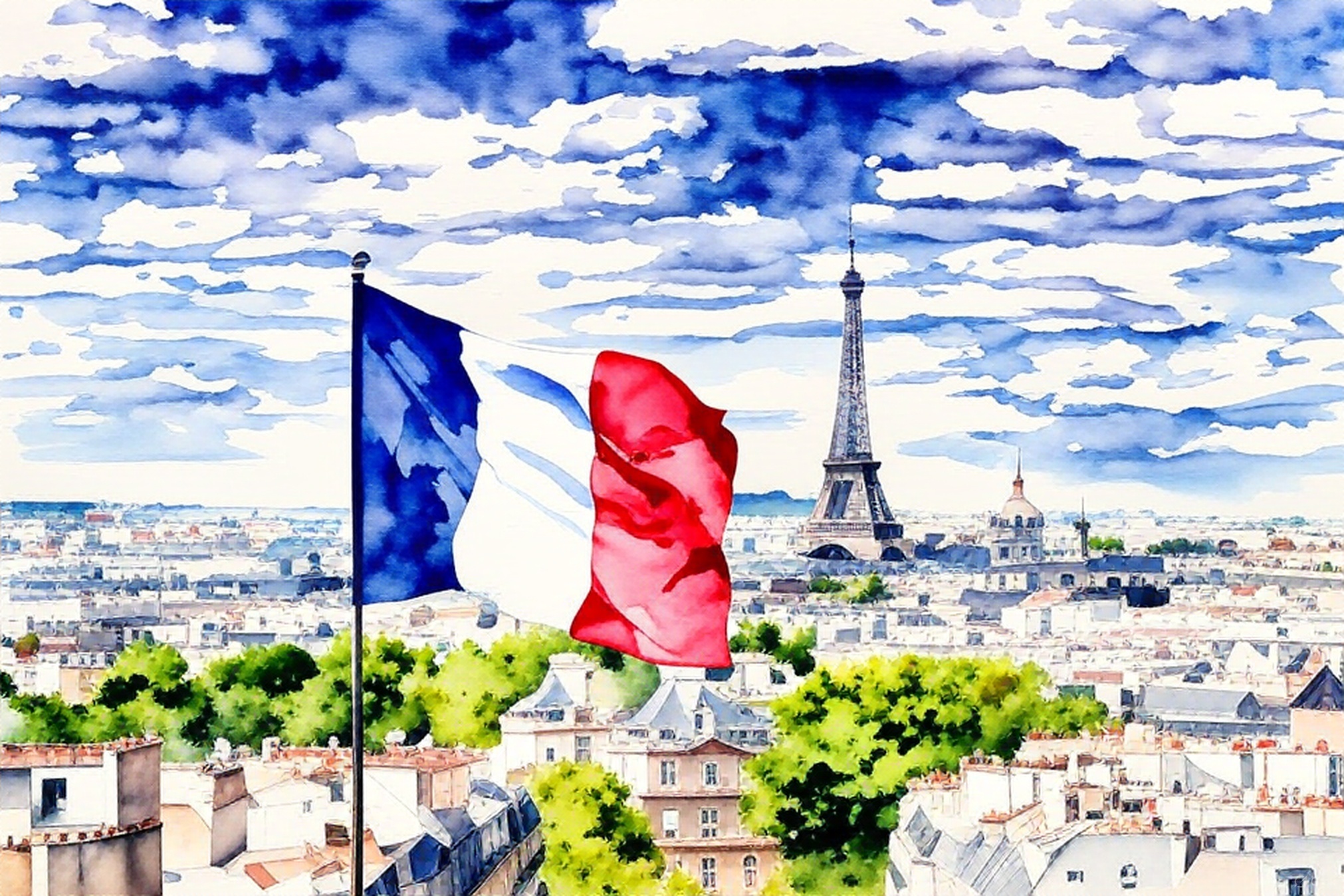
In 1889 Paris held its Exposition Universelle. The fair coincided with the centennial celebration of the French Revolution. On that occasion the organizers rejected a proposal to erect a 900 foot replica of the guillotine. A symbol that evoked shivers among the aristocracy of Europe. Instead, the Eiffel Tower was inaugurated showing off to the world a giant feat of French engineering
.
In 1896 Pierre Baron de Coubertin was a prime promoter of the reinstatement of the Olympic Games to celebrate individual competition among nation-states of the world. A celebration that originally took place in Athens, Greece, the birthplace of the first Olympic Games ~2,800 years ago.
France stood center stage in terms of world diplomacy. Leon Bourgeois, a politician and a Nobel Prize winner (1899), referred to as the “spiritual father” of the League of Nations, introduced the legal concept of Droit International. During his stay as Chairman of the French delegation at the Hague Peace Conference, he was responsible for the adoption of the Permanent Court of Arbitration that made agreements between nations legally binding in the court of law.
The Panama Canal was not completed as expected. The business project ran into financial and funding problems. The Compagnie Universelle du Canal Interocéanique filed for bankruptcy in 1889 amid a political scandal that shook the French establishment. The collapse revealed high-level corruption among politicians, administrators and promoters, resulting in vast amounts of money lost by ordinary investors.
The Panama Canal scandal was a forewarning about France’s political integrity and its future standing in the world. The talented yet controversial poet Charles Péguy, a non-practicing Christian, echoed citizens’ loss of confidence with the French ruling elite. He articulated a betrayal of a social republic upon which the nation was created. And lamented the loss of sovereignty of the people in favor of money interests that took over the Republic.
Charle Péguy died on September 5th, 1914, at the age of 41, at the Battle of Marnes. He sacrificed his life for his country and God. His life was cut short at the beginning of a war that would be devastating and eventually trigger World War II. His poems to this day are a longing for La Mystique Republicaine; a mystical body representing the sovereignty of the people as prescribed in the Constitution.
In 1904, under Theodore Roosevelt’s presidency, the US took over the Panama Canal. The project was completed in 1914, linking the Atlantic and Pacific oceans and reducing the cost of worldwide commercial shipping between east and west. The takeover introduced the US as the leading nation-state of the world.
France did not reclaim its international role in geopolitics until General de Gaulle’s 5th Republic in 1958 which reestablished the nation’s sovereignty by forging ahead as an independent country and made it a nuclear power. Under his leadership France was not formally part of NATO and moved away from the dominant Anglo-sphere of Washington DC and the Incorporated City of London.
The Constitution
Preambule Article 2
The aim of every political association is the preservation of the natural and imprescriptible rights of Man. These rights are Liberty, Property, Safety and Resistance to Oppression.
Préambule: Article 3
The principle of any Sovereignty lies primarily in the Nation. No corporate body, no individual may exercise any authority that does not expressly emanate from it.
5th Republic: On Sovereignty – Title 1
Article 2
The maxim of the Republic shall be “Liberty, Equality, Fraternity”.
The principle of the Republic shall be: government of the people, by the people and for the people.
Article 3
National sovereignty shall vest in the people, who shall exercise it through their representatives and by means of referendum.
No section of the people nor any individual may arrogate to itself, or to himself, the exercise thereof.
The initial point of contention about Macron’s imposture consist of his breach of contract he had as a civil servant in order to join a trans-national banking institution. A move that is duplicitous and a violation of Préambule article 3; “no corporate body, no individual may exercise any authority” other than to represent the sovereignty of the nation and the people.
Among other contentions is Macron’s party’s meteoric rise to power. His political party began with the name en marche (EM) standing for the first two letters of the candidate’s name. It was later renamed la République en marche and finally replaced with Renaissance. The name change implies a republic marching forward and away from the sovereignty of the nation toward a European Union comprised of a Commission with a non-elected president.
Some critics claimed the party was created out of nothing, “ex nihilo” following a corporate managerial model referred to as a “business firm party”. A party run in a cult-like, top-down manner, enforced by state control of corporate media, communication technologies and social media.
It is exemplified by the extraordinary media blitz surrounding the party’s creation and the obscure source of its financial backing. During the political campaign of 2017, a massive telemarketing campaign was undertaken that reached 6 million people by phone days before the elections, resulting in the most expensive French presidential campaign ever.
During his two terms, President Macron has shown a disregard for the constitutional rights of citizens. Displayed by the use of hi-tech surveillance of citizens’ communications and social media to control French people’s expression of legitimate grievances. And by how he forcibly dealt with the yellow jackets’ protests of legitimate concerns.
A former senior security aide to President Macron named Alexander Benalla was caught on camera disguised as a police officer beating a protester during a Paris demonstration in May 2018. Benalla had shaved his beard for the occasion in order to hide/disguise his identity. An investigations later revealed he received support from high-level government officials in the surveillance of protesters.
The label prési-roi given to Emmanuel Macron represents a blurry impersonation he plays in French politics. One role, as an elected representative of the people. The other role, as a wannabe king who stands above the constitution he has sworn to support and uphold. And finally as a petit-Napoleon as a politician who virtually projects himself as the imperial leader of the European Union.
Current conspiracy theories regarding his personal life, if proven correct, will likely reveal the full extent of the imposture. Of a man who metaphorically killed la patrie, the French word for fatherland, the nation and its Constitution.
* * *
Prior to being a play, the story was known in ancient Greece as a poem. And prior to its poetic format it was likely a myth recounted by storytellers to a gathering of devoted listeners.
The play setting: A man leaves his hometown of Corinth to escape a prophecy that predicts Oedipus will kill his father and marry his mother. His journey leads him to Thebes, where he outsmarts the Sphinx by correctly solving a riddle. His prowess saves the city from disaster. And the people of Thebes acclaim him as a hero. He marries widowed Jocasta, whose husband Laius has been murdered. Oedipus becomes king of Thebes.
*
The play begins with a high priest asking Oedipus to save Thebes from a ravaging plague. An investigation led by Jocasta’s brother, Creon, reveals the plague is the punishment for King Laius’ murder. Upon hearing the report from Creon, Oedipus swears he will seek out and kill the murderer.
To find the identity of the culprit he summons Tiresias, a famous seer. At first he refuses to reveal the name of the murderer. Then he yields and finally confesses that the killer is none other than Oedipus himself. Both the king and his court refuse to believe the seer. Outraged, Oedipus accuses Creon and Tiresias of corruption and of fomenting a plot against him.
Oedipus becomes alarmed and suspicious. He begins to ask questions. A messenger from Corinth informs him his father is dead and he was adopted. He should not worry.
Jocasta finally realizes that Oedipus is her son and her husband. She tells him to stop the search for truth. Oedipus does not listen. A herdsman appears on stage. He confirms Oedipus is Laius and Jocasta’s son, and he killed his father.
A servant announces to Oedipus that Jocasta killed herself. Oedipus appears on stage blinded by his own hands. He wanders in exile and mourns with his daughters. Creon takes over Thebes.