I’m turning 41, but I don’t feel like celebrating.
Our generation is running out of time to save the free Internet built for us by our fathers.
What was once the promise of the free exchange of information is being turned into the ultimate tool of control.
Once-free countries are introducing dystopian measures such as digital IDs (UK), online age checks (Australia), and mass scanning of private messages (EU).
Germany is persecuting anyone who dares to criticize officials on the Internet. The UK is imprisoning thousands for their tweets. France is criminally investigating tech leaders who defend freedom and privacy.
A dark, dystopian world is approaching fast — while we’re asleep. Our generation risks going down in history as the last one that had freedoms — and allowed them to be taken away.
We’ve been fed a lie.
We’ve been made to believe that the greatest fight of our generation is to destroy everything our forefathers left us: tradition, privacy, sovereignty, the free market, and free speech.
By betraying the legacy of our ancestors, we’ve set ourselves on a path toward self-destruction — moral, intellectual, economic, and ultimately biological.
So no, I’m not going to celebrate today. I’m running out of time. We are running out of time.
Benito Mussolini, the founder of Fascism, was a man of the left not of the right. He was a journalist and a member of the Socialist International in Switzerland. He organized communist insurrections during World War I. He later was expelled from the socialist party for abandoning the party’s position on war neutrality.
In Italy, the former journalist and career politician, abandoned the idea of unions in favor of guilds. By doing so he got the support of the Church in Rome and the backing of Italian major corporate industries. As a result he was elected Prime Minister of Italy in 1922. Once in power he promoted a merger between state and corporate interests. His misguided alliance with Hitler eventually triggered the Second World War.
What we have today is an implicit alliance between entrenched political elites, NGOs, and bureaucratic institutions that have been captured by domestic and transnational corporate interests. They have joined hands to propagate a globalist agenda to undermine the sovereignty of nation-states of the world, including the United States.
Of all the enemies to public liberty war is, perhaps, the most to be dreaded because it comprises and develops the germ of every other. War is the parent of armies; from these proceed debts and taxes. And armies, and debts, and taxes are the known instruments for bringing the many under the domination of the few.
James Madison
Many articles have been written about the growing similarities between the rise of Italian fascism ─corporatismo─ and the current corporate capture of republics around the world. I propose some observations on a prevailing corporatist doctrine behind a global takeover by the Investor State.
The word fascism comes from the Italian fascio meaning bundle. Mussolini was attracted to this ancient Roman symbol representing strength and authority. It was meant to symbolize the different regions of Italy bound together to create a unified nation.
In order to understand fascism one has to keep in mind that Italy has been a country only since 1861 following what is known as il Risorgimento. Prior to the unification, Italy had been ruled by a dominant Church in Rome, by kingdoms and powerful city states and finally by foreign powers.Today Italy is made up of 20 regions, five of which have autonomous status. Each of these regions have their own dialect and distinct foods. They are different in many respects except Italian as their official language. Which was imposed to the whole country by banning the teaching of dialects in schools.
These dialects could very well be considered languages as they are incomprehensible to the inhabitants of other regions. Friuly, where I come from, is part of a n autonomous region that speaks Furlan that is recognized as a distinct language. Friulani for instance, don’t understand Sicilian and vise versa. You could say that Italy was, and still is, a cauldron of multiculturalism. This agglomeration of regional rivalries prompted Mussolini to remark: “It is not difficult to rule Italy, it is useless.”
Mussolini was born in 1883 in Dovia di Predappio in the northern region of Emilia-Romagna, famous for its Ferraris, Parmigiano and and its famed prosciutto. He was a turbulent student but got good grades. His father was a socialist and his son was too. In 1902 Mussolini emigrated to Switzerland in order to escape his military service. Not an uncommon trait among our more bellicose leaders. During his stay in Switzerland he became an active member of the socialist movement of the country. Benito later came back to Italy and dabbled in journalism and eventually founded a newspaper, Il Popolo d’Italia ─The Italian People. In 1917 he was called up for military service and was wounded in a grenade accident during a training exercise. The incident allowed him return to editing his newspaper and avoid the service.
Mussolini made his early mark in the world of politics mostly by fighting anarchists and communists allied with the Soviet Union. He eventually became prime minister with the help of King Victor Emmanuel III. The King was fearful that if he did not choose the fascist leader, Italy which was prone to regional discord, would end up in a civil war. Mussolini was quickly able to consolidate his power by exploiting fears of division in an environment of postwar depression and a general feeling of anxiety among the middle class.
Mussolini had been an active socialist member until he abandoned the idea of class struggle in favor of stati corporativi. A similar concept was promulgated by Pope Leo XIII in his encyclical Rerum Novarum in 1891. It was issued to counter the growing influence of socialism, communism and class struggle. Instead the Church promoted its own Catholic associations managed by “corporate bodies” as an alternative to class struggle. Mussolini’s change of heart made him appealing to a greater number of voters and powerful institutions. Under his leadership business owners, workers, trade unions, professionals, and other economic groups were organized into 22 associations—or guilds. They were given representation in a legislative body known as Camera dei Fasci e delle Corporazioni.
The symbol of the fascio (bundle) was meant to indicate the unifying strength of all the guilds and of corporations, most of whom had a non-profit charter. The unifying body also integrated a geographically fragmented and diverse Italy into a greater market area. This idealistic union led to a totalitarian political system that became known as fascism.
Prior to Italy’s move to fascism, the country had been a liberal democracy. Mussolini’s claim to be a compassionate leader helped him get the backing of liberals in parliament. With their support Mussolini introduced strict censorship laws and changed the rules of elections in 1925 and 1926. His victory helped him seize dictatorial powers and proceeded to discredit all his political opponents. With the support of his allies he skillfully used his control over the press to create the myth of Il Duce . The Leader who demanded total loyalty from his subjects. Any resistance was dealt with his fascist militia called the Brownshirts. With his alliance with Hitler and the unfolding WWII, he eventually succeeded in securing complete power. However, under his regime his government became too centralized, incompetent and corrupt.
In 1929 Mussolini signed a concordat with the Vatican that recognized Vatican City as a state. In return the Church recognized Italy as a sovereign nation. The name Benito, meaning “blessed”, is an appropriate depiction of a mutual anointment by the Church and State. Il Duce then promoted the idea of a new Roman Empire that made him increasingly popular. However, dreams of a grand empire did not extend farther than the bombing of Corfu, the invasion of Albania and later Ethiopia.
In June 1940 Mussolini declared war on Britain and France. He attacked Greece in October and as a result lost a great portion of Albania. Undeterred, he declared war on the Soviet Union in June 1941. Shortly after in December, he declared war on the United States. An act that would eventually seal his downfall.
Meanwhile, the US was fostering a deal with the mafia allowing the 1943 invasion of Sicily by an Anglo-American coalition to be met without resistance. Il Duce might have forgotten that in 1866, Palermo revolted against the political power of Italy. And to this day they do not consider themselves Italian but Sicilian.
Il Duce’s policies included subsidizing of big corporate business by the government: Most of it at the expense of small business, self employed entrepreneurs and the poor. As a point of reference, Mussolini consistently demanded wage reductions from labor. The one-time socialist leader also abolished the inheritance tax, a measure that resulted in further subsidizing of the wealthy by the poor. Eventually wages and living standards for the average Italian dropped sharply.
Mussolini allowed huge amount of money to be spent on public works and toward heavy industry and a growing “military industrial complex”. However, Mussolini who at the onset privatized a great number of state owned assets, later began reverting these policies and demanded strict centralized control over the country’s industries.
We owe the term corporatism to an Italian philosopher named Giovanni Gentile who defined it as the “the merger of state and corporate power”. In retrospect fascist era can be summarized as an alliance of corporate interests represented by old money and aristocracy who had shifted its wealth from feudal to corporate shareholding. And by the rise of industrial corporate leaders who endorsed Mussolini to unify a country and benefit from a bigger economic market.
Bundled Inc.
Laws enacted by Congress in the past three decades have been substantially more valuable to big business. The gradual erosion of antitrust legislation resulted in mergers and acquisitions resulting in the consolidation of corporate power. Ironically President Bill Clinton repealed federal antitrust laws that had been in place since the Great Depression.
Near zero interest rate policy has seen a transfer of savings into the stock market, excessive consumption and an unhealthy accumulation of debt. Leaving investors chasing bubble after bubble in an illusive speculation. This erosion of savings was compounded by relentless tax cuts in favor of the rich. With the nefarious effect that the bulk of the country’s economy was diverted in the hands of a growing number of wealthy billionaires, fund managers and CEO’s.
In the beginning of the US’ Republic, only men who owned property could vote. Today the rulers of the “ownership society” determine the outcome of an election. The process of cartelization and concentration of power is such that both parties are subservient to a corporatist agenda. And even if the majority of Congressmen and women are honest people, and we believe they are, only a minority of controlled swing votes can determine the outcome of important legislation favorable to special interests or big business.
In the US, the corporation is considered a legal person. All corporations have a similar legal structure, abide by the same accounting rules and practices. Corporations may sell or produce different things but in respect to their legal structure, they are one similar legal entity defined as an artificial person.
This legal person is not a full human being. Although a company is comprised shareholders that are human beings, each stockholder abdicates his or her individual humanity and submit to the corporation’s charter to be strictly profitable. And while corporations have the same rights as a citizens, their responsibilities toward society can be deferred indefinitely by putting their enormous financial resources into endless litigation or by declaring bankruptcy and morphing into another corporate entity.
The growing association of varied transnational corporations is depicted here as a bundle of one global incorporated body. This foreign body is exemplified by the emergence of the World Economic Forum (WEF) that has made public its goal to challenge and takeover the sovereignty of the individual and the nation-sate.
It should be made clear that the corporation plays an essential role in our economic development and is beneficial to society as a whole. However, there is a distinction between the role of domestic corporation and malignant corporatism. When the corporation becomes bloated through mergers and acquisitions and eliminates competition then becomes counter productive. When these corporations align themselves together with the government and the war industry, they can become a malignant threat to human civilization.
Since the Reagan years the process of cartelization of big business has been steady and relentless. The citizen is loosing more and more of his political representation and relegated as a mere consumer. Many political leaders are wearing a disposable mask of the corporate body.
One must remember that corporatism is made possible by a growing bureaucracy paid for by citizens’ tax money controlled by corporate lobbyists. And a population that is spied on by big tech and the deep state in order to expand its control over the population.
Furthermore, the great leaps of technological innovation made over the past few decades are now being used to promote a transnational corporate messianism. This new type of corporatism is defined by a doctrine that society should be organized in the image of the an artificial person known as a “corporation”. In order to convert human beings into trans-persons known as shareholders. With the ultimate goal to replace the sovereignty of citizens and the nation-state with the sovereignty of the Investor State.
I didn’t expect a religious topic like the Antichrist to make headlines, especially when raised by figures like podcaster Alex Jones or wealthy technocrat Peter Thiel. Their comments reignited my interest in a subject I had set aside years ago.
This essay, the first of a three-part series, begins with Martin Luther’s use of the term “Antichrist.” The second part will explore the theological interpretation of the Antichrist as described in 1 John 2:18–23, 4:2–6, and 2 John 7. The final part will offer a philosophy of religion perspective on the elusive Deceiver.
When I began researching this topic, I struggled to connect John’s Antichrist to any contemporary evildoer. That changed with the COVID-19 government mandates, which allowed businesses, including liquor stores, to remain open while prohibiting Christians from congregating in churches. Church, meaning the assembly or congregation of believers, IS the mystical Body of Christ.
Martin Luther’s Antichrist
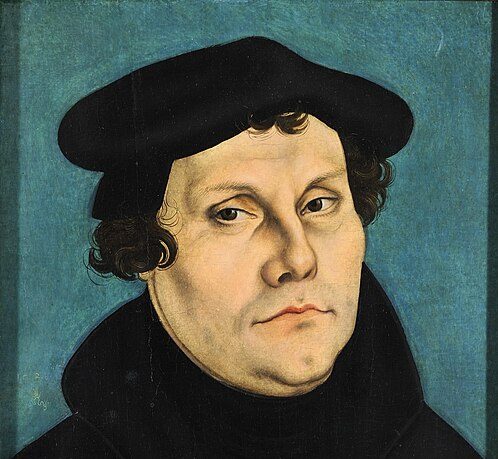
Several factors sparked the Protestant Reformation, including the invention of the printing press and the religious activism of Martin Luther (1483–1546). The printing press reduced costs and sped up the distribution of documents like Luther’s 95 Theses across northern Europe, playing a pivotal role in the Reformation’s spread. Other factors included ongoing conflicts among potentates within the Holy Roman Empire and the corruption of religious institutions.
Luther’s path to labeling the leader of the Papal States as Antichrist began with his objection to the sale of indulgences by Johannes Tetzel. His outrage flared when he learned that a Church emissary was collecting payments on behalf of sinners who died without completing penance in purgatory, as a prerequisite for entering heaven.
Born in Eisleben, a northern German town about 100 miles southeast of Berlin, Martin Luther was raised by hardworking parents who were strict disciplinarians. His father was a leaseholder of mines and smelters, intended for Martin to become a lawyer to support the family’s business. Luther enrolled in legal studies, but his life changed when he was jolted by thunderstorm and lightning that struck nearby. Martin later confessed he was terrified of dying without confessing his sins and spend eternal damnation in hell.
When I was terror-stricken and overwhelmed by the fear of impending death, I made an involuntary and forced vow. Help me St. Ann… I will become a Monk.
Soon after, Luther abandoned law school and joined an Augustinian monastery, much to his father’s disappointment. He later described his years of prayer, meditation, and Bible study at the monastery as the happiest of his life.
Like many Germans, Luther strictly adhered to rules. He had little tolerance for dishonesty or duplicity. Wholly devoted to Jesus Christ and His teachings. Luther in the course of his life was ordained a priest, learned Greek and Hebrew in addition to his fluency in Latin ‒the language of Europe’s religious and political elites. He subsequently earned an honorary doctorate in biblical studies. He also translated the entire Septuagint Bible into German.
When Luther learned of the indulgence sales, he publicly voiced his objections in his 95 Theses, which he nailed to the door of the Castle Church in Wittenberg. The 95 Theses, or observations, were intended to spark a theological debate with Church officials about the justification of paying a fee rather than making penance. The document unexpectedly ignited a movement that contributed to the disintegration of the Holy Roman Empire.
Theses 28
It is certain that when money clinks in the chest, avarice and greed increase, but the intercession of the Church depends on the will of God alone.
Like many of his countrymen Martin had a frank way of expressing his opinion. He held the view that being straightforward and honest was a quality to be proud of. However, some of the wording of his 95 Theses was perceived as an insult by the Church’s curia and an affront to the Pope’s authority. Luther had valid reasons to question the moral justification of indulgences, but his blunt language provoked indignation among clerics, who demanded action be taken against the arrogant monk. The Church invited Luther to Rome to defend his claims. He wisely declined, fearing arrest.
Instead, a Pope’s emissary was sent to Wittenberg, Germany, to set up a disputation with the religious apostate. Johannes Eck was a skilled and polished debater. He had the backing of Church leaders that held as true the Pope ruled by divine right. Luther, who couldn’t match his opponent rhetorical skill, fared poorly in the debate.
Upon returning to Rome, Eck urged Pope Leo X to take decisive action against the German heretic. Luther’s refusal to recant his writings prompted the Pope to issue a Papal Bull threatening excommunication. On December 10, 1520, Luther publicly burned the document at the gates of Wittenberg, leading to his excommunication in January 1521.
I am at a loss to know whether the Pope be Antichrist or his apostle.
His resolve strengthened when the Church burned two young Augustinian monks at the stake in Brussels. In defiance, Luther left the priesthood, married, and abandoned monastic attire for common or academic clothing. He began identifying himself as an Evangelical, no longer loyal to the Holy See.
He and his mission had the support of his mentor, Johann von Staupitz, as well as a good portion of the German population. And he gained the backing of the powerful Frederick the Wise. Many Germans resented the Papal States for collecting indulgences to fund the costly construction of St. Peter’s Basilica in Rome.
History portrays Johannes Tetzel as the main culprit in the indulgence controversy. As a matter of fact he was merely an emissary acting on behalf of Cardinal Albert of Brandenburg. The Cardinal had borrowed money to bribe his way into controlling more dioceses in Saxony, splitting the indulgence proceeds to repay his debt to the banking house of Fugger. The other half of the money to fund St. Peter’s Basilica in Rome.
Pope Leo X (1513–1521), born Giovanni di Lorenzo dè Medici, was the second son of Lorenzo the Magnificent, ruler of Florence. He was made a cardinal at early age of thirteen, his family ensured their influence in Rome and the Holy Roman Empire. After Leo’s death, his cousin Giulio dè Medici was a contender for the papacy, but Adrian VI (1522–1523), a Dutch humanist dedicated to Church reform, was elected Pope instead. His short reign was unpopular among Romans, who resented him as an outsider. He was the last non-Italian pope until John Paul II in 1978.
Clement VII (1523–1534), born Giulio dè Medici, became the second Medici pope. Orphaned after his father’s murder, he was raised by Lorenzo the Magnificent ,and subsequently declared legitimate by the Church. Both Leo X and Clement VII transformed Rome into a cultural and political center of Europe. Critics remarked they neglected the spiritual and moral duties of the papacy, contributing to the Holy Roman Empire’s decline.
Antichrist
In 1545, Luther published Papacy Institution of the Devil, linking the Antichrist to the Apocalypse. Although Revelation to John does not mention the Antichrist, Luther identified Satan as the chief agent at the End of Times. Throughout his struggle with Rome, Luther was preoccupied with an imminent end of the world. His battle with the Church arguably hastened the end of the Holy Roman Imperial world.
Theses 86
Why does not the Pope, whose riches today are ampler than those of the wealthiest of wealthy, build this one Basilica of St. Peter with his own money, rather than with that of poor people?
Luther associated Antichrist with greed and the pursuit of political power. He criticized the leader of the Papal States for prioritizing materialism—specifically the construction of St. Peter’s Basilica—over the spiritual salvation of Christians. He condemned pontiffs for their ties to Florence’s political and banking elites, who adorned the basilica with Renaissance art while neglecting spiritual duties.
Luther argued that the love of money had displaced a direct communication between individuals and God. Many Church sacraments, he believed, had become barriers to a personal relationship with Jesus Christ. Arguing that Christians are saved by faith alone. God’s presence being celebrated by the freedom of individual Christians to congregate as the mystical Body of Christ: And objecting to the confusion between to power of money and the power of the Word of God.
Bibliography:
Martin E. Marty, Martin Luther (Penguin Books, 2004)
Martin E. Marty, October 31 1517: Martin Luther and the Day that Change the World
(Paraclete Press, 2016)
Rudolf Pesch, Antichrist (Sacamentum Mundi, Palm Publishers, 1968)
Quasi means sharing similar attributes even though at the outset any similarity was not intended.
A smart phone is a quasi totalitarian device, meaning its primary role is to accomplish a totality of functions for the user. Functions that were previously segregated in the past.
With a smart phone a user can make a phone call, take a photo, surf the Internet, buy groceries, book a flight, make a payment, write, send and receive mail, watch the news or view a movie, read a book, check the time, the weather, check various elements of your health, use your phone as credit card or use it as a GPS navigational app, etc.
A few decades ago you needed a separatemedium or source/venue to accomplish any of the tasks enumerated above. An individual used a telephone to make a call, a camera to a take photo, a TV to watch a program, a book to read a novel, a newspaper to read the news, a computer to surf the Net, and go to different stores to buy food or goods, etc…
The fact merely underlines the point that “the medium is the message” because it is the medium that shapes and controls the scale and form of human association and action.
Marshall McLuhan
If Marshall McLuhan’s analysis is right about the role of a medium in shaping and controlling “the scale and form of human association and action”, then a smart phone is potentially creating a totalitarian mindset with the user who is unknowingly submitting to a single medium, like Google, which is a global corporate entity, to control and manipulate all functions for an individual, generating a totalitarian system.
To what extent did a device like a smart phone become instrumental in creating what Michael Rectenwald describes as a totalitarian threat hovering our democratic institutions and government?
The most pressing matter facing advocates of liberty today is the prospect of the political and economic establishment completing the institution of a totalitarian state. There is no other way to read the multipronged approach and the political maneuverings that political operatives are taking to rule under “Biden.” I put “Biden” in quotation marks here because the current president of the United States is not a singular person named Joe Biden. It is a politburo consisting of party rulers and advisers, ruling by executive fiat, plus, as I’ll discuss, corporate-state apparatuses. Make no mistake, the power grab that is underway poses the most grievous threat to liberty in recent history.
The signals could not be any clearer. In addition to the swath of executive orders, clearly composed by politburo members and aimed at extending federal power, the political establishment has initiated a growing body of laws which would, if passed, consolidate uniparty rule for the foreseeable future…
Debbie W., Richmond, CA
Extremely Interesting Read. Deeply researched account of the symbols om the US dollar.
I’ve always been curious about the symbols on the one dollar bill and the little book explains them well. Highly recommend this read.
Peter O., Santa Fe, NM
Good and entertaining… This book is full of historical facts about the symbols on the dollar. You won’t be bored reading it. The author keeps delivering relevant info till the end. And once you’re done reading the book, you’ll never look at the dollar the same way again.
L. K. M., Seattle, WA
Great read! Extremely well researched writing of the history, symbols and makeup of the US currency.
After reading the book you will love the tender you exchange everyday. Highly recommend.
R. S., Santa Monica, CA
Well researched book on the symbols of our currency. Very interesting and revealing aspects behind the history of our currency.
Joanne A., Novato, CA
Everything you ever wanted to know about the one dollar bill. This book explains all the symbols on the one dollar. Who knew it was so detailed? Very interesting!
M.J.B., San Diego, CA
Great Read! Well researched, packed with interesting facts about the US dollar. Quick read.
Highly recommend.
Carl L., San Francisco, CA
If you’re curious as to how the symbols found on the US dollar came to be, look no further than
Michael Rizzotti’s well researched book. In addition to providing the reader with the history and context, the author expands on related subjects such as the Federal Reserve and the dollar’ s evolution to becoming the reserve currency of the world. All in all, a good, well written read.
Ricky I., Palm Desert, CA
Interesting and Detailed. A unique and well researched explanation and interpretation of the symbols we have all seen on ou US dollar. Mr. Rizzotti vividly introduces us to the history of the symbols; and quite interesting interpretations on how and or why these symbols were included on the dollar.

 What was once the promise of the free exchange of information is being turned into the ultimate tool of control.