by netage | Old Testament Tradition, Spiritual Heritage |
Michael A Rizzotti
The oldest biblical divinity is that of God of the Father(s). With this essay we will summarize some of the appellations of God used in the Old Testament.
El, Elohim
One of the oldest Semitic appellatives of God is ‘el.1 The designation has been widely used in ancient Israel and Babylonia. It is also found in the oldest names as a component of: Ishma-el, Bethu-el, and Isra-el. 2 The original meaning of the word ‘el is still uncertain, but a probable origin may stem from the root ‘lh, which conveys the sense of “to be strong and powerful”, “direction”, or even “a sphere of control”. We also find the root alongside the proper name of deities such as: El-Shaddai (God Almighty), El-Elyon (God Most High), and El-Roi (“El sees me”, “God Seeing”).3
Among the most appropriate epithets of El are “Mighty”, “Leader”, or “Governor”. Its most forceful significance was meant to stress an attribute of majesty, with the intent to inspire fear in the face of God’s “mighty” presence.
Another important feature in the Scriptures is the frequent use of the appellative El in connection with the patriarchs’ names. The “God of Abraham” for instance, is the “El of Abraham”, the “Fear of Isaac” is the “El of Isaac”, and the “Mighty One of Jacob” is the “El of Jacob”. The designation was also used to describe the “God of the fathers”; i.e. the “El of the Fathers”.4 This feature indicates a special relation between the deity and the individual leader. The God of the leader became, henceforth, the God of the family and of the tribe. As such it also established a tribal bond between the God and the group.
Gen. 33:18 And Jacob came safely to the city of Shechem, which is the land of Canaan, on his way from Paddanaram; and he camped before the city. And from the sons of Hamor, Shechem’s father, he bought for a hundred pieces of money the piece of land on which he had pitched his tent. There he erected an altar and called it El-Elo’he-Israel (that is God, the God of Israel).
*
Several divinities of the ancient Near East in the second millennium BCE were for the most part assigned to a specific cultic place. The more stable kingdoms living during that period were constantly threatened by wandering nomadic tribes. War was an ongoing reality, especially among the emerging powers seeking to expand their dominion. The survival of the smaller semi-nomadic tribes depended on the initiative of their leader.
The pervasive use of magic in connection to their tribal gods was common as a way to inspire confidence, strength, and protection against rival enemies. The religious life of the group was closely intertwined into the nuclear social structure. Herdsmen, clans, and tribes, most of them semi-nomadic, were constantly in search of new ways to provide for their own subsistence and that of their flock in a harsh environment. The best fertile lands were already occupied by the powerful rulers of the city-states.5
The text of Genesis reveals that the worship of El among the early Hebrew migrant tribes had the same specific function of social cohesion and protection. Consequently, the random contact with other tribes and cultures brought about spontaneous opposition to rival cultic deities which endangered the integrity and cohesion of the group. This is especially the case of El and its opposition to Baal, the warrior storm-god, the King of the Gods.6
*
Another word commonly used for God in the Old Testament is ‘elohim.7 Etymologically it is connected to El. It is used mostly as an “abstract plural” or a “plural of intensity”. Elohim can best be translated into the Godhead. It is mostly used as a superlative to elevate the rank of the divinity above the pantheon of the other gods. This expression was utilized primarily in Babylonia and in pre-Israelite times to express the unity of individual gods that combined the totality of the higher divine reality. The plural form became recognized as an expression of superiority. In that sense, the narrative uses the plural form of ‘elohim to glorify the God of Sinai as the supreme divinity, and to express the superiority of God -‘elohim- to other gods.
The name Elohim is also an appellation for God which is used to replace the name Yahweh. Among other epithets used in the Bible to replace the unspeakable name of God -YHWH- is Adonai, or the Lord.
Yahweh
 El, in all likelihood, is linked etymologically to ilu, a widely popular high-god of ancient Mesopotamia and the most prominent deity in the Canaanite religion. El, which we have identified with the God worshiped by the fathers, was also a prevalent God in Canaan, what was commonly known as Palestine.8
Ex: 6.2 And God said to Moses, “I am the lord. I appeared to Abraham, to Isaac, and to Jacob, as God Almighty, but by my name the lord I did not make myself known to them. I also established my covenant with them, to give them the land of Canaan, the land in which they dwelt as sojourners.”
P, who wrote the quote above, makes it quite clear that the identity of the gods worshiped by the forefathers are not to be mistaken with Yahweh, who disclosed himself to Moses for the first time. In the text, Yahweh informs Moses that he was known by the forefathers as El Shaddai; i.e., the God Almighty. The account also reveals the whole new reality of Yahweh who links the promise he made to Abraham, Isaac, and Jacob, and finally to Moses.
Yahweh’s promise links his presence to the enduring existence of his people’s posterity; ie, the descendants. A promise which is revived again and again through the kings and prophets in whom Yahweh chooses to inspire his authority.
Ex. 3:14 God said to Moses, “I am who I am”. And he said, “Say this to the people of Israel, `I am has sent me to you.'”
In the quote above J links God’s name with the verb “to be”, or “to exist”.
Ehyeh-asher-ehyeh 9
I am who I am
The significance of the tautology ehyeh-asher-ehyeh, with the emphasis on the redundancy of the verb ehyeh, “to be”, is meant to enforce the idea of vitality and presence. The context in which God speaks, and to whom he speaks, implies an apperception of the divine presence which is linked with the promise made by God to the forefathers.10
The essence of the being of God is portrayed in terms of presence and of relationship. All the attributes are closely related to the twofold relationship between Yahweh and Moses and the realization of the promise to free the people from Egypt.11 The closeness is explained when God says to Moses, “But I will be with you”.12
When God tells Moses to go to the people and tell them that “I am has sent me to you”, he implies that when the hero utters the words “I am”, Moses will assume and ultimately embody God’s divine authority. Yahweh’s personal presence and existence is, shall we say, determined by Moses’ acquiescence of his mission. Yet it is the ongoing quality of the promise that is eternal, not God’s spokesmen. As such, the promise transcends Moses’ historicity.
Individuality is also stressed by the pronoun “I” which can only exist in the act of speaking to others or to oneself.13 Yet the first person singular indicates the presence of the image-less individuum vaguum. In the narrative the “I” exists -or stands out- as an individual being since God’s words are audible and comprehensible to the hero even though God’s reality is image-less. As God introduces himself, a distance is set between Yahweh and Moses. The alienation stems from the mystery of the distant promise that God had made to the forefathers. But as soon as Moses realizes the scope of his destiny, the hero finally understands the message and goal of the revelation. Then, the separation narrows. As Moses accepts God’s mission, he eventually identifies with the promise. More so when Yahweh reassures Moses that he will be with him and that his mouth will be God’s mouth. At the outset, Yahweh is an wholly other alterity to Moses yet he becomes one with God and wholly other entirety with the acceptance of his mission and the covenant.
*
Although God forbids the use of any graven images to portray or to identify him, the text is full of metaphors to suggest that his identity is accessible to us:
Ex. 33:11 “Thus the lord used to speak to Moses face to face, as a man speaks to his friend”.
God here is depicted as a friend, and the intimacy of the relationship is further symbolized by its anthropomorphic and metaphorical nature.
Throughout the Bible, the narrative uses the anthropomorphic to reveal God.
Gen. 1:3 > God speaks
Gen. 1:26 > God created man in his image
Gen. 3:8 > God walks in the garden
Gen. 32:24 > God wrestles with Jacob
Exod. 15:8 > God has a nose
Deut. 11:12 > God has eyes
1 Sam. 8:21 > God has ears
Ps. 2:4 > God laughs
Isa. 42:14 > God pants and groans
We have seen in Genesis how God speaks to the world. He speaks to his prophets, to his people and to the reader/hearer. This ability to communicate is essential in order for his will to be known.
God was present in the beginning. He was present with Abraham, Jacob, Isaac, and Moses. God is always present in his promise. Therefore, God transcends the personal relationship to encompass the people and their progeny in order that the promise be safeguarded.
The historical: Yahweh is the God of the Patriarchs, of Moses, of the anointed Kings, of the Prophets, and the priests etc…
The eternal: God’s promise to his people from which he chooses his spokesman
______________________
1 The term Semitic is used here to represent the family of languages of which Hebrew, Aramaic, Ethiopic and ancient Assyrian are a part.
2 Ilumma-ila and Ibni-ilu, in Babylonia; IlL-awwas and Jasma`-ilu in Southern Arabia.
3 El-Shaddai (Gen. 17:1); El-Elyon (Gen. 14:18f); and El-Roi (Gen. 22:14).
4 El of Abraham (Gen. 31:53); El of Isaac (Gen. 31:42); El of Jacob (Gen. 49:24).
5 See Max Weber, Ancient Judaism, New York, The Free Press, 1952.
6 See M. Weber, Ibid., 154. Also Walther Eichrodt, Theology of the Old Testament, London, SCM Press, 1969, 180, Gerhard von Rad, Old Testament Theology, London, Oliver and Boyd, 1965, and Edmond Jacob, Old testament Theology, New York, Harper and Brothers, 1955, 56.
7 Gen.1: 26; 20:13; etc.
8 Ronald E. Clements, The God of Israel, Atlanta, John Knox Press, 1979, 64.
9 Torah, Philadelphia, The Jewish Publication Society of America, 1982, Ex. 3:14.
10 One interesting hypothesis on the origin of YHWH -called the tetragrammaton- relates to an extension of the prehistoric word hu rendered “He”, the god. Another similarity points to the Dervish cry Ya-hu which can be translated into “O He”. The original expression may have been Ya-huva, if the Arabic pronoun huwa is taken to mean “he”. It is possible that the name Ya-huva could have meant “O-He” also. Such an expression could easily have evolved into Yahu and finally Yahweh. It is also interesting to note the rhetorical character in the original use of the word. M. Buber, Moses, Oxford, Phaidon Press Ltd, 49f.
11 See Martin Buber, Moses, Oxford, Phaidon Press Ltd, 192-195.
12 Ex. 3:12.
13 See Ivan Illich and Barry Sanders’, ABC: The Alphabetization of the Popular Mind, San Francisco, North Point Press, 1988, 70f.
by netage | Old Testament Tradition, Spiritual Heritage |
Michael A Rizzotti
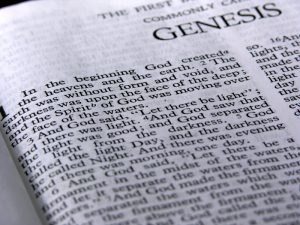 The creation narrative of Genesis is similar in certain respects to creation myths that describe the beginning of a new cultural, religious, and cosmological reality. These accounts show how the divinity uses his word to articulate a new world. The word, and consequently language, is the medium that allows God to communicate to “man” his creation. This spoken aspect of creation can also be found in Egyptian, Akkadian, Babylonian, and Persian cosmogonies.1
the setting…………the beginning of the “world”
the hero…………….God
the quest………….. order and meaning
the obstacle……….void, darkness, and chaos
the mentor…………speech
the outcome……….the Genesis ─beginning─ of the Bible
The first book of the Bible is appropriately called Genesis, which is the Greek translation of the Hebrew in the beginning. As such, it is the introductory setting for the story of the people of Israel as recounted in the first five books of the Bible: namely, Genesis, Exodus, Leviticus, Numbers, and Deuteronomy. These books are also called the Pentateuch and the Torah.
God did not physically write these words. Several unknown priests/scribes did. Extensive biblical studies show that several versions of similar stories were compiled together by a redactor called “R” into one single narrative. His final compilation shows how important his role has been in creating the Bible. He was responsible for putting together into one narrative several versions of often contradictory accounts that, until recently, were believed to have been written by Moses.2
Genesis 1 thru 3, which is the subject of this chapter, is divided according to three sources of composition:
verses 1:1 to 2:3 are accredited to P
verse 2:4a is attributed to R
verses 2:4b to 3:24 are written by J
P refers to the priestly source, who is also the largest contributor to the Pentateuch. He has been given this designation because his accounts are mainly concerned in securing priestly interests. The second source, which is a single phrase, is written by R, the Redactor. This single verse links the two sources into one uniform account of the creation. J, the writer of the second version of the creation of “man”, as well as the fall, is called the Yahwist because in his accounts he refers to God as Yahweh.
P
Gen. 1:1 In the beginning God created the heavens and the earth. The earth was without form and void, and darkness was upon the face of the deep; and the Spirit of God was moving over the face of the waters. And God said, “Let there be light”; and there was light. And God saw that the light was good; and God separated the light from darkness. God called the light Day, and the darkness he called Night. And there was evening and there was morning, one day.
The first paragraph above is more of an introduction to God’s as the subject of His creative activity which really begins with:3
Gen. 1:3 And God said…
God literally uses his speech to create the world. Language is God’s primordial tool. Without it he could not reveal his existence, neither could he describe his creation.
If we make a parallel with the first verses of the Gospel of John we find that the Evangelist also identifies Christ with the Word in the beginning. The example is in itself an important clue to the nature of the “Word” in God’s creative endeavor.4
John. 1:1 In the beginning was the Word, and the Word was with God, and the Word was God. He was in the beginning with God; all things were made through him, and without him was not anything made that was made.
Similar ancient Babylonian, Egyptian, and Indian cosmogonies also imply a divine power inherent in the word itself which when uttered brings out order. Numerous ancient myths provide a good example of the likeness of the creative power of the divine word. In ancient Egypt the god Ptah of Memphis, in a comparable fashion, created the world through his spoken word.5 While Sumerian myths describe how divinities first plan their creation by thinking, and then the world comes into being through the power of speech.
Based on the content of the biblical text above, it appears that speech is one of God’s primordial activities.6 Language allows the divinity to reveal his creation to us. We might say that before the first words of Genesis are spoken there is nothingness, and before the order of syntax is put forth there is chaos. The Bible -from the Latin ta biblia which means the little books- is sacred precisely because the God’s inspired words have been recorded, but mostly because they have been preserved for posterity by the Priests and scribes.
Hence, God’s rhetoric describes the beginning of a reality which is the Bible itself. As such, the Bible is foremost a literary creation, albeit a sacred and holy one for the believers.7
The narrative does not explain to whom God speaks, nor from where. God here is an individuum vaguum; i.e., a vague and imageless individual. He nevertheless uses speech, which is a human characteristic. He does so without using the configuration of an individuum certum, in other words, without assuming the identity -or the image- of a person. Consequently, the creative powers of the word supersedes any other human attribute.
Furthermore, the way the narrative reports God’s words is analogous to the way lords or sovereigns dictated their will to the scribes. As the account reveals, the Lord speaks and his will is being transcribed. In this context, the account links the ancient oral tradition to the written.8
Moreover, the biblical Hebrew alphabet is made up primarily of consonants. In the un-vocalized Hebrew alphabet, speech is necessary to give meaning to the un-vocalized words, otherwise the letters are a meaningless and chaotic code. Only with the spoken word are the vowels uttered. By exhaling one’s breath into the letters, the alphabet miraculously takes on a life and Spirit of its own, and words finally become meaningful.
As the text shows, God speaks from nowhere and to nobody in particular. Yet he becomes preoccupied with the order and plan of things to which he is about to give names. He also becomes involved in the separation of the world into a set order of categories; most obvious of which is the division of time into seven days and the classification of his creation by name.9
The name giving activity in creation is not exclusive to the Bible either. It is also prevalent in the ancient Near Eastern mythology where it was seen as an exercise of sovereignty, especially in terms of property and dominion.10
The act of separating and naming reveals another important facet of the divine creative activity. This classification of words and names can be appropriately referred to as a biblical glossary.11 This order becomes in effect a description of God’s identifiable creation; i.e., the inventory of the property to which “man” can “have dominion”. The definition of things and beings is setting the stage for the world of the Bible.
Numerous studies made on primitive classification reveal how this complex display of symbolic representations and relationships is meant to represent the grounds of social organization.
In the 6th day, his last day of activity, God ultimately utters the concept of his most important creation.
Gen. 1:26 Then God said, “Let us make man in our image, after our likeness…” So God created man in his own image, in the image of God he created him; male and female he created them.
God speaks in the first person until verse 26, but as he gets closer to the pinnacle of his creation he finally opts for the plural form. The change is fundamental, especially in view of its underlining message.
The first and obvious sense of “Let us” could be taken as “abstract plural” or “plural of intensity”. In Hebrew, for instance, the word for man –‘adam– also has a collective meaning and may be used here in the sense of “mankind”.
There may be yet another connotation implied by the plurality. Before the people of Israel adopted Yahweh as their only God, they worshiped El, which was also the God of the neighboring Canaanites.
El, which means literally the Lord, shared his title with his consort Asherah. Both had the epithets of the “creator” and the “creatress”. Archaeological findings at Quntillet cAjrud show that not only El, but also Yahweh was associated with a divine consort named Asherah.13
J
Gen. 2:7 then the lord God formed man of the dust from the ground, and breathed into his nostrils the breath of life; and man became a living being. And the lord God planted a garden in Eden, in the east; and there he put the man whom he had formed. And out of the ground the lord God made to grow every tree that is pleasant to the sight and good for food, the tree of life also in the midst of the garden, and the tree of the knowledge of good and evil.
In Hebrew, the words genesis, beginning, and birth are all synonyms. So are the words Spirit, wind, breath. The first point to pro-creation as the genesis of life itself.
In the narrative God proceeds to mold from the soil ‘adam -man- which is taken from ‘adamah -the ground- and like a potter he molds his creation. Adam finally becomes a living being when God breaths into it the breath of life.
Although in the first account man, the only creation that is able to understand God’s words, is created on the last day, all that was created prior to him was created specifically for him. In chapter two, however, man is the center of attention, everything evolves around him.
In chapter one, the creation is spoken out of chaos and nothingness into an orderly syntax. Whereas in the second version God creates man to put him in the center of a tree garden called Eden. Man is purposefully created by God as a tiller and keeper of his garden. At the outset, the relationship between God and man is established as one of land-lord and keeper. J marks a clear distinction between the sovereignty of God over his garden and man; i.e., the separation between the creator and his creation, between the master and his servant.
Unlike in the former version, God enables man to call and name every living creature; an important role he had kept for himself before. In doing so he allows man to share his divine power of speech and appropriation.
Gardens, particularly fertile fields, were the marked possession of great kings. And as we see in verses 2:4b-6 the writer uses words like plant, field, earth, herb, sprung up, rain, till the ground, and soil from which man was made. All these terms have an agricultural connotation and expose the fertility symbolism of the passage.
Finally, in the midst of this garden God planted the tree of life and the tree of knowledge of good and evil. And God commanded man not to eat from the tree of knowledge of good and evil or else he will die. The center is a primordial theme in mythology.14 Here, the narrative describes both trees of life and of good and evil as being in the middle of the garden.15
Popular misconception still associates the forbidden fruit with an apple. There is no mention of an apple tree in the text. The confusion stemmed from the Latin word malum, meaning “evil” also meaning “apple”. The two terms were apparently confused in the course of history.
Concerned about man’s solitude God decides to give him a helper. The narrative goes on to describe a shift in the normal role of procreation. Ironically, God and man appropriate the function of begetting: God takes the woman out of the man. Then the man called his companion woman because she was taken out of him. This inversion reveals an appropriation of woman’s fecundity and may allude to the strict opposition to the fertility cults associated with the fertility goddesses. Any implicit allusion to a goddess Asherah, has been obliterated from the narrative. The first commandment given by Yahweh is clear: he opposes any other divinity including that of the goddess.16
Deut. 16:21 You shall not plant any tree as an Ashe’rah beside the altar of the lord your God which you shall make. And you shall not set up a pillar, which the lord your God hates.
The first Commandment is explicit and categorical, any worship of or reference to any other god is prohibited. The ethos implemented by the priests through the ages reinforced this belief. The narrative of Genesis implicitly overshadows the fact that the tree is a also symbol of genealogy and a metaphor of Asherah.
The fundamental point to be made about biblical patriarchy is related to genealogy as a tribal social constituent of Jewish people. Only with strict ethical laws and prohibitions could men control women’s fertility and their progeny. In addition, these laws legally reinforced the fact that women were a closely supervised property of men who became their controlling agents of fecundity.17
Gen. 2:24 Therefore a man leaves his father and his mother and cleaves to his wife, and they become one flesh.
The above verse of Genesis, which may be a reference to matriarchy, is in plain contradiction with the patriarchal customs of Judaism. According to ancient Jewish customs, it is not the man who leaves his parents but the woman.18
*
Gen. 3:1 Now the serpent was more subtle than any other wild creature that the lord God had made. He said to the woman, “Did God say, `You shall not eat of any tree of the garden’?” And the woman said to the serpent, “We may eat of the fruit of the trees of the garden; but God said, `You shall not eat of the fruit of the tree which is in the midst of the garden, neither shall you touch it, lest you die'”. But the serpent said to the woman, “You will not die. For God knows that when you eat of it your eyes will be opened, and you will be like God, knowing good and evil.”
the setting…………the tree garden of Eden
the quest…………..knowledge of good and evil
the hero……………woman
the obstacle……….God’s ban
the mentor…………the serpent
the outcome……….Eve: the mother of all living
In The Fall, the events that describe the beginning of the relationship between the protagonists are doomed at the outset. The narrative depicts the characters entangled in a situation in which the quest for knowledge and the emulation of God are greater than the fear of punishment. The crux of the narrative reveals that the desire to be like God prevails.19 But because of their deliberate disobedience, Adam and Eve are thrown out of the garden. As a consequence, they will be excluded from God’s presence and property. In theological terms this exclusion from God’s presence implies the death of Adam and Eve and their progeny, hence mankind. The narrative makes it explicitly clear that the woman is to be held responsible for man’s alienation from his God.
As we have suggested earlier, the garden of Eden is full of fertility symbols. The four rivers that flow in the garden allude to it. The trees bearing the most alluring of fruits denote it. And the presence of the serpent confirms it.
The serpent, a Canaanite symbol of life, health, and fecundity, simply strengthens the fertility theme of the whole narrative. Not to mention that the tree of life is obviously another prominent symbol of genealogy and fertility.20 But the most stunning aspect about these verses is that the tree as well as the serpent are both symbols of Asherah.21 There is even an etymological connection between the Hebrew name Eve, hawwah, and the name Asherah.22 In addition, there is also a similarity between the name hawwah and the Aramaic word hewya’ for serpent.23
Gen. 3:20 The man called his wife’s name Eve, because she was the mother of all living.
The meaning of Eve as the mother of all living is a further allusion to fertility connected to the mother goddess Asherah as the nurse to the gods. Moreover, the explicit consequence of the woman’s disobedience is described as the pains of childbearing emphasizing even further the fertility theme of the narrative.
The serpent is a major protagonist in the creation myths of the ancient Near East where he is a celebrated symbol of wisdom.
Mt. 10:16 So be wise as serpents and innocent as doves.
Many of the oldest Egyptian goddesses were thought of as serpents, mostly as cobras. In fact, the symbol of the serpent preceded the name of most of the goddesses and is the hieroglyphic symbol for the word goddess. The Sumerian goddess Nidaba, the patron deity of writing, was also depicted as a snake, while the Sumerian goddess was referred to as the Great Mother Serpent of Heaven. Furthermore, symbols of numerous goddesses of Old European, Indian, Akkadian, and Babylonian mythologies were also portrayed as serpents. Most of them represented a common symbol of fertility and immortality.24
The presence of the snake among God, Adam, and Eve represents the alien, which from the outset is excluded from God’s design. As such, he is the visible cause of the fall. Furthermore, the narrative correlates the woman to the reptile as both outsiders. They are portrayed as the rebellious prototypes who ignore God’s command.
As the account shows, the serpent offers Eve much more than the knowledge of good and evil; he tells her she could be God’s equal. That suggestion even implies that she would forsake her rank of tiller.
The narrative makes it quite clear that the serpent and the woman are both responsible for man’s alienation from God. It is no coincidence that so early in the biblical texts the writers portray the woman and the serpent as being condemned by God. As we mentioned earlier, both are linked to symbols of pagan cults that are radically opposed by Yahweh.
1 Kings 16:32 He erected an altar for Ba’al in the house of Ba’al, which he built in Samar’ia. And Ahab made an Ashe’rah. Ahab did more to provoke the lord, the God of Israel, to anger than all the Kings of Israel who were before him.
*
Gen. 3:21 And the lord God made for Adam and for his wife garments of skins, and clothed them. Then the lord God said, “Behold, the man has become like one of us , knowing good and evil; and now, lest he put forth his hand and take also of the tree of life, and eat, and live for ever”- therefore the lord God sent him forth from the garden of Eden, to till the ground from which he was taken. He drove out the man; and at the east of the garden of Eden he placed the cherubim, and a flaming sword which turned every way, to guard the way to the tree of life.
As a result of the transgression, the couple’s eyes were opened and they perceived their nakedness.25 Too much emphasis has been placed on the sexual connotation of the narrative. It is rather the theme of fertility and the nature of perception itself that should be more readily stressed. Their eyes are opened to a new condition which is closely tied to the transgression. Especially in the awareness of transition from:
nakedness/nature to clothing/culture26
The narrative explains that the reason why the woman was enticed to eat the fruit in the first place was to be like God. But as they both ate from the fruit they soon realized that God is the sole ruler of the garden and that they, as tillers, are naked and destitute. As a result, Adam and Eve covered themselves with readily accessible leaves while afterward God clothed them with garments made of skins, denoting the property of cattle. The difference in clothing also marks a distinction between:
leaves/nature and skins/domestication
leaves/agriculture and skins/herdsman-ship.
Exodus is also closely tied to the idea of herdsman-ship and grazing. God himself favored sheep herding, a predominantly a tribal occupation, over agriculture which was closely connected with the fertility cults of the goddess which he opposed.
Adam and Eve were living in the garden surrounded by God’s overwhelming dominion. Eve, nevertheless, chose to challenge God’s authority. She refused to be at the center of God’s providential benevolence, preferring independence instead. Perhaps the serpent’s assertion that the eating of the fruit would not bring her death may have convinced her. In fact, the serpent’s assertion turns out to be right as the impending physical death does not materialize. It engendered a metaphysical death as an alienation from God’s presence and providence.
Contrary to popular belief, it is not hard work that is the unfortunate consequence of the fall -man tilled and kept the garden before his expulsion- it is the exclusion of man from God’s realm. It is an exclusion from the presence of the holy.
Finally, God is concerned that the couple might also eat from the tree of life and live forever. To eliminate such a prospect he quickly evicts them. The act of disobedience also brought forth suspicion and distrust, another consequence of the fall. Promptly, God places a cherubim to guard the garden’s entrance. The angel becomes a symbol of man’s alienation from God.27
As the story shows, the cherub’s duty is to guard the boundaries of the sacred and to protect the tree of life located at its center.
Contrary to popular belief, the cherub -or cherubim- is not a cute and chubby winged child flying about the clouds of heavens. Biblical tradition describes the cherub as a sphinx: a four legged animal often depicted with the body of a lion, the wings of a bird, and the head of a human, frequently with the face of a woman. The cherub was usually carved out of olive wood and plated with gold.28
The symbol of the cherub is part of another sacred Jewish tradition. The sphinx was also present inside the first Temple of Jerusalem.29 Two of these carved creatures were placed side by side with their wings stretched to form the tabernacle. Between their protective custody lay the ark. The ark, which is Israel’s most sacred relic, was a golden box which contained the tablets of the ten commandments, and, according to different sources, also contained a sample of the manna; i.e., the food sent from heaven to sustain the life of the God’s chosen people during the exodus.30
The symbolic cherub is used as a guardian of both sacred places: the garden of Eden and the ark. At the center of the garden are the tree of knowledge of good and evil, and the tree of life. In the midst of the Jerusalem temple, which according to Jewish beliefs is also located at the center of the world, is the ark with the ten commandments and the manna.
Furthermore, the knowledge of good and evil is connected to the law embodied by the ten commandments. One who knows and interprets the law knows the difference between good and evil. The priesthood who also act as scribes, are the legitimate medium between God and the people to interpret the law. It is surmised that the symbol of the tree in the narrative represents the genealogy of the priesthood describing the way to protect and guard against the intrusion of any alien/profane person among its rank or progenitors.
God’s immediate concern in placing the cherub is stopping Adam and Eve from eating from the tree of life. Yet the tree of life is also connected to another content of the ark. Both, the tree of life and the manna, are symbols of a sustenance of mysterious origin.
The cherub is put in both places to protect and guard the garden and the ark from the profane man and woman. Henceforth, only God is permitted to enter the garden, and only the high priest can enter the Holy of Holies. Jewish law forbids anyone but the high priest to enter the Holy of Holies, and whoever does must die.
The symbolic analogy between the garden and the ark is interesting. It shows that J, who wrote the account, was preoccupied with preserving the priestly dominion over the divine law and its interpretation. The texts also suggest that the fall brought forth the separation between the sacred/holy center which God rules and the outside boundaries of the common, the impure and the profane.
_____________________________________
Post-scriptum
In the book of Genesis, language, defined as a communication system, should not be confused with speech: A human capacity to re-produce a spiritual experience and presence.
When a person reads the Bible, he or she brings to life the inspired Word of God. This process involves the reader’s utterance of God’s creative activity in the beginning of the Bible.
Emile Benveniste pointed out, language re-produces reality. In Genesis, God’s creation and existence is re-produced by human speech. It transcends time/space of words that were written in the beginning.
God’s inspiration
writer/editor
˅
word/text
˅
reader/speaker/God’s spoken words
A spiritual experience is illustrated in these terms: A copy of the Bible sits on a table. The book is an external and non-existent object without a reader. A person appears and picks up the Bible. He or she opens the book and begins to read Genesis. Words become alive as the reader utters the order of syntax and re-produces God’s creative activity. What was at the outset an external reality becomes inspirational and a wholly external/internal spiritual experience linking past and present with human speech.
Gen 1:1 In the beginning God created the heaven and the earth. 2 Now the earth was a formless void, there was darkness over the deep, with a divine wind sweeping over the waters.
1:3 And God said, “Let there be light,” and there was light.
God is a noun. What defines God or a deity is its attribute or verb. In Genesis 1:3 God speaks…
God’s creation consists of words/symbols like light and darkness, day and night, days of the week, the naming of animals, of man and woman, etc. words without which the world of the Bible and the cultural heritage it created would not exist. These are words and symbols we still use today.
In this sense creationists are right. God did create the world of the Bible. Yet, Genesis does not allude to particles, molecules, biological and astronomical evolution that also exists. A reality that is described by science and by scientists. Nonetheless, the Bible re-produces a reality distinct from the language of science.
Keep in mind that at the time of Genesis’ writing only priests/scribes were able to read or write. It was a closely guarded family skill. As it happens at the center of the garden stands a prominent symbol of genealogy; a tree.
Only priests had the ability/authority (note that the word authority comes from author) to read the Torah to the faithful. By reading/speaking God’s words to an audience they acted as a medium between God and the assembly of believers.
The advent of the printing press altered this authority by allowing any reader to become a medium. It promoted individualism, contemplation, prayer, meditation and self-communication of God’s presence.
John 1:1 In the beginning was the Word, and the Word was with God, and the Word was God.
The emphasis of John’s quote is not the Word as text but the verb in terms of speech. A dynamic that re-creates the presence/existence of God to oneself by being/speaking the Word of God. A speaker embodies the essence of life, the presence of God and the power of human communication.
The original meaning of inspiration is the action of inhaling or breathing in. Its also means the act of inspiring and enlighten the mind/soul. In a metaphysical and mystical sense, this means the human soul is a recipient God’s Spirit. And expiring, breathing out (using the vocal cords), or human speech is the ultimate means of communication. Keep in mind that in Hebrew the words Spirit, breath and wind are synonymous.
I am the writer of this essay. You as the reader bring to life what I’m trying to convey. You transcend the time/space of when I wrote these words. I the writer and you the reader connect spiritually. Without you the reader, I am non-existent.
Ironically it’s hard to convey this dynamic with words.
_____________________
1 Hermann Gunkel, The Legends of Genesis, Chicago, Open Court, 1901.
2 See Richard Elliott Friedman, Who Wrote the Bible?, New York, Summit Books, 1987.
3 The first verse can also be rendered “in the beginning of” which also allows the translation: “When God began to create the heavens and earth”. The Torah, The Jewish Publication Society of America, Philadelphia, 1962.
4 Yet orthodox interpretation of the significance of the “word” is commonly understood as being an expression of God’s will. See Gerhard von Rad, on the Word of God in “Old Testament Theology”, London, Oliver and Boyd Ltd, 1966.
5 Siegfried Morenz, Egyptian Religion, New York, Cornell University Press, 1973, 159 f. Another interesting aspect about ancient Egyptian creation myths is God Khnum’s creative ability as craftsman and procreator compared to the biblical God who molded man from the ground and created woman from man.
6 The noted Old Testament scholar Gerhard von Rad explains: “This naming is thus both an act of copying and an act of appropriative ordering, by which man intellectually objectifies the creatures for himself. Thus one may say that something is said here about the origin of language, so long as one does not emphasize the discovery of external words but rather that inner appropriation of recognizing and interpreting which happens in language.” in, Genesis, London, SCM Press, 1963, 81.
7 Northrop Frye, The Great Code, Toronto, Academic Press Canada, 1982, XVI.
8 And as we have already mentioned writing and recording were the monopoly of the scribes.
9 Paul Ricoeur has suggested that there is something to be said about the “metaphorical” as being at the origin of logical thought; Paul Ricoeur, The Rule of Metaphor, Toronto, University of Toronto Press, 1977.
10 As Gerhard von Rad puts it; “let us remind ourselves once more that name-giving in the ancient Orient was primarily an exercise of sovereignty, of command.” in Genesis, Ibid., 81.
11 Emile Durkheim and Marcel Mauss, Primitive Classification, Chicago, University of Chicago Press, 1963.
12 Emile Durkheim, Ibid.
13 See article by David Noel Freedman, Yahweh of Samaria and his Asherah, in, Biblical Archeologist, December 1987, 241-249.
14 Mircea Eliade, Cosmos and History, New York, Harper And Row, 1959, 12 ff.
15 The word midst could be translated as the center or middle. The Torah uses the word “bad” instead of evil, which gives a more pragmatic significance, see The Torah, Ibid.
16 Asherah was also known as Athirat, Astarte, which is a dialectical variant. She is also referred to in the Bible as Ashtoreth, Ashteroth, Astoreth, Astaroth, Ashterathite, Anath, Beeshterah, Elath, and Baalath. The title “holy one”, is also believed to be one of her epithets. See Merlin Stone, When God Was a Woman, San Diego, A Harvest Book/HBJ Book, 1976, 163-170.
17 Denise L. Carmody, Judaism, in, Women and World Religions, ed. by Arvind Sharma, Albany, State University of New York Press, 1987. I cannot help thinking, whenever I come across similar examples, of how men are fascinated and also envious of women’s fertility. It seems that men had to compensate for their sense of inadequacy in this regard by a propensity to dominate religion and mythology, since they are unable to control nature. The powerful God depicted as the male creator figure is just one example.
18 “Curiously, the statement about forsaking father and mother does not quite correspond to the patriarchal family customs of Ancient Israel, for after the marriage the wife breaks loose from her family much more than the man does from his. Does this tendentious statement perhaps preserve something from a time of matriarchal culture?” Gerhard von Rad, Genesis, a Commentary, London, SCM Press, 1963, 83.
19 See the role that desire and vanity play in Rene Girard’s, Mensonge Romantique et Verite Romanesque, Paris, Grasset, 1961.
20 “Thus we can see that there is an association between Asherah and trees or symbols related to trees although the full details of this association are unknown. Since Asherah herself is the great mother-goddess, chief consort of the Canaanite high god El, it stands to reason that the cultic symbols of the goddess could be associated with fertility or the gift of life in some manner.” See Howard N. Wallace’s dissertation, The Eden Narrative, Atlanta, Scholars Press, 114.
21 Howard N. Wallace, Ibid., 163
22 “The possible etymologies for hawwah suggest that the name and the connection with Asherah are part of a long tradition.” Howard N. Wallace, Ibid., 157-158.
23 Howard N. Wallace, Ibid., 148.
24 Barbara G. Walker, The Woman’s Encyclopedia of Myths and Secrets, San Francisco, Harper & Row, 1983, 903-909.
25 Torah, Idid.
26 Claude Levi-Strauss, The Raw and the Cooked, New York, Harper & Row, 1969.
27 The angel, throughout the Bible, is depicted as God’s messenger; as such, he is depicted as the symbol of an obstacle to the direct communication between God and man.
28 R. E. Friedman, Ibid., 86-87.
29 J, who wrote the account, was from the southern kingdom of Judah where Solomon built the first
Jerusalem temple. A strict Yahwist, J was outraged by the idolatries of King Jeroboam who ruled the northern kingdom of Israel. The King had built in the cities of Beth-El and Dan two shrines for the worship of the golden calf associated with the fertility cults of Asherah.
30 Ex. 16:31f.
by netage | New Testament Tradition, Spiritual Heritage |
Michael A Rizzotti
 The Holy Trinity is the most fascinating but also the most misunderstood of all theological doctrines. It’s an unfortunate situation, because the Trinity may hold the key to understanding an important facet of the dynamic dimension inherent in all religious experience.1
The first principle of the doctrine stipulates that the Trinity is an absolute mystery. Its revelation is only possible with the help of two spiritual activities: love and knowledge. With love, one is open to the fullest to life’s mystery. Through love, we may live the Trinity, although we may not be able to express its mystery. With knowledge, life could be experienced with the greatest of insight. Yet words and symbols may be inadequate to describe the whole reality of the Trinity. Its mystery is only accessible through God’s self-communication, which is a process of everlasting realization; herein lies the mystery.2
The Old Testament does not contain a doctrine of the Trinity per se, even though, in retrospect, it may appear to confirm it. For instance, the name Elohim implies a divine plurality. Furthermore, the Lord appears to Abraham under the guise of three men who tell the skeptical patriarch that his wife Sarah will bear a son despite her advanced age.3
The Bible says that there is one God, yet God is not alone. He created man in his image in order to communicate his creation to him. In the same fashion, he created woman so that man would not be solitary. Therefore, God needs an interlocutor with whom to talk. As the narratives show, God chose to speak to Moses and his prophets. Yahweh reveals himself to whomever he chooses in order to establish a relationship with his people throughout history.
With the Gospels, the Trinity is inaugurated. The narratives recount the story of Jesus who speaks of his Father, but also of the Holy Spirit. This development introduced an alternate dimension to the reality of God.
Throughout the centuries, the Church developed the doctrine apologetically. Most of it has been developed during the first fifteen centuries of the Church’s history. It has remained basically the same for the last five hundred years.
Not until late in the fourth century did the Church’s teaching begin to take shape.4 The fundamental tenets developed by the magisterium define the Trinity as an absolute mystery and believe that one God exists in three persons: they are equal, co-eternal and omnipotent.5 God is one divine nature, one essence, and one substance. In the Trinity, the three persons are distinct from one another. The Father has no principle of origin. The Son is born from the substance of the Father. The Spirit is not begotten, but proceeds from the Father and the Son, from one principle, in one single spiration; e.g., action of breathing.
As the definition above shows, the Trinity is a complex doctrine, rendered even more difficult by the elaborate lexicon developed by the magisterium over the ages. Yet, in order to understand any of its basic tenets, one must first comprehend a fundamental concept, that of person.
In the Old Testament, the word person -nepes in Hebrew- has a broad range of meanings which includes: living being, soul, breath. In several instances, it is similar to adam.6 The New Testament uses the Greek translation of the word anthropos which has basically the same meaning. In the course of history, the Church developed the concept of person gradually to reflect the more complex definitions of the Incarnation and the Trinity.
Foremost, the word person is not used in the psychological sense of independent center of consciousness or personal center of action.7 The persons of the Trinity, in these terms, would imply three states of consciousness with three free wills, which is not only misleading but incorrect. The persons of the Trinity are not three different centers of activity.
Person is not understood as a separate physical entity, but more as Karl Rahner describes it, as a “distinct manner of being”. Therefore, each of the three persons is not separate, they are selfless and complementary, where God is one essence and one absolute self-presence. There are not three consciousness either, but rather one spiritual and absolute reality that subsists in a threefold manner of being.8
The concept of person, although somewhat confusing and vague, is nevertheless necessary. It is useful because it allows us to fathom the idea of relationship, from which communication stems. More precisely God’s dynamic self-communication. In this sense, the three persons are fully and totally open to each other as a unity, as One God.
If we replace the word person by modes of being, as suggested by Karl Barth, or, distinct manners of being, as proposed by Karl Rahner, we gain clarity in respect to the three-ness of God, but lose in terms of the dynamic tri-unity inherent in one God. The image of person is retained because it is easier to envision God in terms of a person rather than a mode of being or a distinct manner of being.9
Therefore, the person exists only in terms of relationships. Personality exists only as inter-personality. In the Old Testament, the person exists foremost in relations of the I-Thou-we kind.10 The case in point is the relationship between God, Moses, and the people of Israel as revealed in the Bible. However, the relationship expounded by Martin Buber is characteristic of the Old Testament’s theological tradition of God’s paternal majesty, emphasizing the otherness of God, whereas the concept of the Trinity, as expounded in the New Testament, is Christological. It presents the relation as of the me-you-we type. Jesus, as the God incarnate, reached out to the profane realm: the here and now. His relationship with the world is transformed into a more mundane kind. As a result, he breaks the master/servant relationship between God and his creation, between the land-lord and his servant.11
*
Jn. 1:1 In the beginning was the Word,
and the Word was with God,
and the Word was God.
He was in the beginning with God;
all things were made through him,
and without him was not anything made that was made.
In him was life,
and the life was the light of men.
The light shines in the darkness,
and the darkness has not overcome it. 12
In the New Testament, communication of the Word is only possible through a medium of which Jesus is the prototype. The unfathomable presence of God’s spoken Word in Genesis becomes incarnate in the Son through the life given by the Spirit in Mary.
God literally spoke the world into existence. Without the Word, God could not be heard or known. Man and woman are created in his image and bear witness to his Word and creation, emphasizing the possibility of a relationship between the Word and the hearer.13
Furthermore, God shares his knowledge and his love through the Word in a twofold manner. God reveals himself through the “economic” Trinity, which discloses itself in history, and through the “immanent” Trinity, which inspires the Spirit of the Word to the hearer.14
In essence, the “economic” and “immanent” Trinity are one dynamic reality breathing life into each other. The “immanent” Trinity could not subsist without the “economic” Trinity, and vice versa. Similar in fashion to the Spirit, as the breath and the wind that is breathed in and out, reflecting the inner and outer mystery of God.
Mt. 28:19 “Go therefore and make disciples of all nations, baptizing them in the name of the Father and and of the Son and of the Holy Spirit…”15
The sacred triad: the sacred
We have already outlined the three principles of the religious experience in terms of the sacred, the profane, and the wholly other. At this point, we will parallel their definitions in analogy to the Trinity.
It is practically impossible to talk about the sacred without referring to the profane, since the identity of the first depends on its dynamic opposition/relation to the second.
sacred vs profane
God vs Satan
holy vs common
pure vs impure
clean vs unclean
This dynamic opposition is the realm of religion. At this point, we must clarify that the lived experience of the religious must be distinguished from the interpretation of the experience. While the experience of the sacred is unique, the expression of that experience belongs to the field of language that relates the experience with the use of words and symbols, either spoken or written.16
Individuals experience the sacred everyday in varied forms: through the ecstasy of love, a revelation, nirvana, or even a UFO sighting. Although we may not understand or agree with a person’s interpretation of his or her sacred experience, we cannot deny that he or she lived an extra-ordinary happening. His or her personal experience is unique, unfathomable, and even ineffable; i.e., language may not be an adequate medium to communicate that experience.
An example may be helpful. Everybody has experienced a dream at one time or another in their sleep. And each person’s dream is unique. When the dreamer relates his or her dream, he or she does so with the help of language. However, language cannot accurately translate the dream which involves the total visual and participative experience of the dreamer. Consequently, it would be better to say that a person lives a dream. In relating his or her dream, the dreamer makes a linguistic account which is different than the original experience itself. In linguistics, the language of the dream is the object-language, whereas the account is a metalanguage. If a psychoanalyst, for instance, becomes involved with the interpretation of the dream, he or she is left only with an account of the dream of which the dreamer is the mediator. As such, the interpretation rendered through language is an obstacle to the full experience and full content of the dream.
In the study of the sacred, we are faced with a similar problem. We can only interpret the expression of the sacred, never its unique experience since we deal only with words and symbols that relate to the sacred. Language only reveals one aspect of religious experience, albeit an important one. Nevertheless, by exploring the manifestations of the sacred, we gain insight into the fundamental composition of the religion phenomenon as it manifests itself in language.
*
The word sacred is the Latin translation of the term sacer. The Romans used the word to describe what was under their gods’ jurisdiction. When they referred to the sacrum, it implied the location where a ritual was performed; namely, the temple. The sacred place was also intrinsically tied to the cult. Both, place and cult, were closely circumscribed and distinct from the outside space called the profanum. The profane literally means the space outside the temple. Hence, profanare meant to bring the object of sacrifice out of the temple, transgressing the boundary between the sacred and the profane.
The Bible uses mostly the word holy -in Hebrew qadosh– instead of sacred which has a similar meaning.17 The temple, but especially the Holy of Holies, is separate from the common space. Similarly, the ritual performed in the temple distinguishes the sacred from the profane activity outside it.
Priests are especially privileged persons who can be designated as sacred. Jerusalem, but more specifically, the temple of Jerusalem, was the sacred place par excellence and the center of the world, as the Holy of Holies was at the center of the temple and the ark was at the center of the Holy of Holies.18
*
Ex. 3:1 Now Moses was keeping the flock of his father-in-law, Jethro, the priest of Mid’ian; and he led his flock to the west side of the wilderness, and came to Horeb, the mountain of God. And the angel of the lord appeared to him in a flame of fire out of the midst of a bush; and he looked, and lo, the bush was burning, yet it was not consumed. And Moses said, “I will turn aside and see this great sight, why the bush is not burnt.” When the lord saw that he turned aside to see, God called to him out of the bush , “Moses, Moses !” And he said, “Here am I.” Then he said, “Do not come near; put off your shoes from your feet, for the place on which you are standing is holy ground.” And he said. “I am the God of your father, the God of Abraham, the God of Isaac, and the God of Jacob.” And Moses hid his face, for he was afraid to look at God.
The passage above reveals a central aspect of the sacred. The place where the hierophany occurs is described as the mountain of God. As we have outlined, the mountain is a privileged place where the sacred appears. It is a universal symbol found in the most important mythologies of the world. It is where heaven and earth meets.
The appearance of the angel of the Lord announces the coming of a hierophany. Moses’ sighting confirms a mysterious event, although it is yet without meaning. God’s words finally reveal the purpose of the apparition. At the outset, God sets the boundaries between the holy and the common ground. The holy imposes a distance, a buffer zone if you will, that separates the divine from the human, the extra-ordinary from the ordinary, the sacred from the profane.
the holy vs the common
Israel vs outsiders 19
priests vs ordinary men
The power of the holy, which is Yahweh’s exclusivity, is bestowed upon Moses, his spokesman. Moses is the only one to whom Yahweh reveals his name. Yet, by the same token, the people of Israel are also consecrated by Yahweh as a holy people and a holy nation.20 Yahweh’s identity and the identity of his people are consecrated and set apart from other gods and other people.
Lev. 20:26 You shall be holy to me; for I the lord am holy, and have separated you from the peoples, that you should be mine.
The origin of the sacred is described in the text as stemming from the center flowing toward its periphery.21 The whole process emanates around the holy at the center of which Yahweh’s words are the source of everything. In order of importance, Yahweh is the holy one, followed by Moses as the prophet, then the priests, and finally the people, all into one single entity: Israel. The holy people becomes a social and religious entity which is set apart by Yahweh. He is holy, and so is Israel. God is separated from other gods and Israel is set apart from other people to become the matrix of their religious identity.
Hence, only Yahweh’s words enable him to reveal the holy. Without his words, his will could not be known. It goes without saying that the spoken word cannot be separated from the written word, since the Bible is a literary work. Without the written word the experience of the holy would not have been preserved. The Bible is the medium that is used to propagate the story of Israel. Without the priests and scribes that have written and preserved the sacred heritage it would have been lost forever.
*
Mt. 17:1 And after six days Jesus took with him Peter and James and John his brother, and led them up a high mountain apart. And he was transfigured before them, and his face shone like the sun, and his garments became white as light. And behold, there appeared to them Moses and Eli’jah, talking with him. And Peter said to Jesus, “Lord, it is well that we are here; if you wish, I will make three booths here, one for you and one for Moses and one for Eli’jah”. He was still speaking, when lo, a bright cloud overshadowed them, and a voice from the cloud said, “This is my beloved Son, with whom I am well pleased; listen to him.” When the disciples heard this, they fell on their faces, and were filled with awe. But Jesus came and touched them saying, “Rise, and have no fear.” And when they lifted up their eyes, they saw no one but Jesus only.
In Matthew, Mark, and Luke the account of the transfiguration is almost identical.22 The parallels with the text in Exodus are striking. The similarities are abundant: the mountain as a sacred place, the holy ground that sets boundaries apart, Jesus’ face that shines like the sun, the voice of God which is heard from nowhere, the awe, and the fear. Similar also is God’s manifestations of power displayed in the thundering, the lightning, and the fire shared with the hierophanies on Mount Sinai and on Mount Carmel. 23
Furthermore, Jesus is seen talking with Moses and Elijah. His association with the two biblical heroes is presumably meant to associate and connect Jesus with two of the most powerful and charismatic personalities of the Old Testament.
As we go further, the similarities begin to fade. The most notable difference being the appellation of Jesus as the Son of God. This affiliation shatters and redefines the biblical concept of the holy.
Except where Moses is Yahweh’s mouth, none of the Patriarchs are identified with the Word of God. They are significantly his prophets, his people, in other words, they are God’s instruments. None of them were called his sons. And although the idea of affiliation is prominent in the Old Testament, as typified by the title God of your fathers, the relation is meant to confer the idea of the sovereignty and authority of the patriarchal lineage rather than that of son-ship. Furthermore, the Gospels inaugurate the Son of God as the holy.
Ex. 3:14: (Yahweh) I am who I am
Jn. 8:58: (Jesus) Before Abraham was, I am 24
Therefore, Jesus shares the exclusivity of God’s sacred identity/presence. As a human being he becomes a visible and identifiable image of God. As such, he transcends the first and second commandments given by Yahweh. And, by performing miracles on the Sabbath, he transgresses yet another commandment. As a result, Jesus becomes a law onto himself. He breaks the boundaries of the sacred’s exclusivity.25
Jn. 17:19 And for their sake I consecrate myself, that they also may be consecrated in truth.
The profane
As we have mentioned earlier, the profane is closely related to the sacred. The very existence of the sacred thrives on it.
The Latin word profane literally means pro, outside, and fanum, temple. The sacred and the profane are separated into two distinct arenas. Foremost, the sacred protects its own exclusive area of control from which the profane is excluded. This exclusion is the essential characteristic of the profane. Hence the profane is described as the other reality. It is a vague and common reality outside the realm of the sacred in sharp contrast to its compelling and powerful identity.
In the Old Testament narratives the word profane shares some similarities with the Latin etymology. Its most frequent use is in the verbs to defile and to pollute. It is also used to imply the opposite of holy, as ritually unclean or impure. However, the profane is generally translated into common, especially in connection to being apart from the holy. To profane something holy is to make it common, ordinary, in stark opposition to the uniqueness of the holy. As the following examples show:
Ez. 42:20 It had a wall around it, five hundred cubits long and five hundred cubits broad, to make a separation between the holy and the common.
Ez. 44:23…and show them how to distinguish between the unclean and the clean.
The Gospels depict Jesus as abiding by the law, but sometimes he is also portrayed as challenging the law. Although he may appear at times to transgress the commandments, he does not condemn them. He does, however, castigate the hypocrisy of the priests that regulate the law. Foremost, Jesus is depicted as the prototype who inaugurates a new law.
His new rule supplants all other commandments: he says to love your God above anything else, but also to love your neighbor as yourself. The emphasis of the message is not the opposition between one God and other gods, but love. Jesus transcends the dichotomy between the holy and the common, yet he does not dull the distinction between the two. In fact, he inaugurates a new kingdom; ie, Christianity.
Mt. 22:21 “Render therefore to Caesar the things that are Caesar’s, and to God the things that are God’s.”
Jesus reverses the order of worldly things. What was profane is now sacred. He consecrates the common and makes it sacred, while he denounces the sacred hierarchies of the worldly powers.
Jesus’ realm is outside the reach of the worldly powers. His kingdom, however, is not inaugurated to overthrow the worldly system, since it is based on the power of love. His kingdom is not of this world either, but from a world yet to be created by faith and solidarity between the believers. It is a place for those who forsake their share of this world for a part in the other.
As he explains to his disciples, only those who understand the language of the parables have access to his kingdom. And Jesus is the door to another realm of meaning: from the physical to the spiritual, and from the literal to the metaphorical. In essence, the parable is nothing else than an allegorical story, which is nothing more than an extended metaphor.26 In the quote below, Jesus explains the meaning of such parables to his disciples, who themselves cannot yet understand:
MT. 13:10 Then the disciples came and said to him, “Why do you speak to them in parables?” And he answered them, “To you it has been given to know the secrets of the kingdom of heaven, but to them it has not been given. For to him who has will more be given, and he will have abundance; but from him who has not, even what he has will be taken away. This is why I speak to them in parables, because seeing they do not see, and hearing they do not hear, nor do they understand.”27
Jesus takes great care to point out that the key to his message will be lost by those caught up in the material aspect of the worldly existence. In the same manner as the true meaning of the message from the miracles is lost to the marvel and spectacle of the sign. The world would soon rather forget that Jesus cures the unclean, the outcasts and the excluded which society abhors and segregates. His miracles transgress the boundaries of the sacred and transcend them. By doing so, he shatters the structure of the sacred and the hierarchy on which society is built.
There is more to the profane than one might expect, even though the sacred consolidates all the attention on itself and dismisses the profane as a non-entity, as something remote and insignificant. We have seen that the profane is repudiated as the common, the ordinary, the hidden; it is decried as the other. And as such it is kept apart from the sacred hierarchy. The sacred tries to keep this other reality overshadowed and hidden so as to highlight its own power and play down the reality of the profane.
Even though the sacred deliberately tries to deprecate the profane, it is nonetheless a reality, a dynamic entity essential to the existence and the survival of the sacred experience.
As Jesus focuses on the profane reality of the poor, the sick, the prostitutes, the possessed, the foreigners, the Gentiles and the slaves, he points to a reality that is excluded from the Jewish religious world dominated by the priestly order. In spite of the religious authority of the priests, he elected the outcasts as the beneficiaries of his kingdom. He reveals that the other reality is the essence of his message of love which exposes the true purpose of religion. As a result, he broke the foundation of the old precepts of the religious structure and activated a new reality that transcends the old religious order.28
Yet the profane has a specific function in the realm of the religious: it is an adumbrated and hidden quality that symbolizes the unacknowledged side of reality.
Lk. 1:35 “The Holy Spirit will come upon you, and the power of the Most High will overshadow you; therefore the child to be born will be called holy, the Son of God.”
Here, Mary’s identity is overshadowed from the holy. Her role has been kept in the background so that Jesus can accomplish his mission. We have also seen how the segregation is characteristic of the profane; as the hidden, the other and the excluded reality. Mary, first as a mother and then as a woman, is excluded from the symbolic triad of procreation; e.g., the Father, the Son, and the Holy Spirit.
Even though the Holy Spirit is the only person that does not have a gender connotation, it does have numerous feminine attributes; ie, life-giving Love and the giver of life.29 In contrast to the affiliation of the Father and the Son, the identity of the Holy Spirit is, to say the least, overshadowed. Nevertheless, behind it lies the mystery of an-other hidden spiritual vitality.
The Holy Spirit is a profane representation of the giver of life.30
The wholly other
Emile Durkheim first introduced the dichotomy between sacred and profane in his book on “primitive” religion31. Several years later, a landmark work on the holy was published. It was written by Rudolf Otto.32 Unlike the sociological method of Durkheim, Otto was more preoccupied with the feeling aspect rather than the rational expression of the holy which he labeled the numinous. It is in this work that he first introduced the expression wholly other.33
Otto developed the concept because he perceived a need to expand the inventory of expressions to better describe the mysterium aspect of the holy. As he would explain: “…something of whose character we can feel, without being able to give it clear conceptual expression.”34 Concepts like supernatural and transcendent were usually used to define such a unique quality of the numinous.
As we will see, this concept is not only useful but indispensable. It helps to fully understand the whole religious experience. It becomes essential to show the whole interrelation and the transcendental link between the sacred and the profane into the wholly other.
Otto did not develop his idea of the wholly other as a logical result of the dynamics between the sacred and the profane. He defined the wholly other as what stands beyond the realm of the intelligible. The sphere where the divine manifests itself, namely, the unfathomable and the ineffable. First, the unfathomable suggests that one is unable to understand and express his feelings of awe in the face of the holy. Second, the ineffable implies that words are inadequate to explain such an experience. Better still, no known language is able to fully disclose the mysterium.
Unlike Otto, we are not so much concerned with the feeling as with the expressions of the holy as related by the narratives. We are less concerned with what Moses felt at the sight of the burning bush, than how the writers/editor have related the experience. The Holy Bible is full of accounts of such mysterious experiences. Consequently, it is possible to explore the symbolic nature of that experience through the account. In other words, the text is the data that allows us to analyze the holy in its systematic dynamic representation.35
*
Etymologically, the adverb wholly has two meanings. The first, an older sense derived from whole, means in its entirety, in full, the sum total, all of it: hence, inclusively. The second sense is implied by the word entirely, as to suggest the exclusion of others, solely: hence, exclusively. The terminology may appear ambiguous, and even contradictory at the outset, but it will become hopefully clearer as we go along. And, as we will see, it is rather insightful. The equivocalness of wholly fits exactly into the essence of the two-ness or twofold-ness of the sacred and the profane. Adding the word other to wholly we further expand the scope of its meaning.
>wholly other; is the mysterium because of a separation between the holy and the profane. It is represented by Yahweh the exclusively other and Moses standing at distance in awe and fear of God’s voice and his message.
<wholly other; the whole and the dynamic reality that is beyond the separation. It is Moses who hears the message and accepts God’s mission and becomes one with Yahweh, his commandments and his people as the inclusively other spiritual reality.
Only when the sacred opens up to and includes the profane does it ascend to the wholly other. When the separation is lifted between the holy and the profane it opens the way to experience the wholly other inclusive reality as shown by Moses’ acceptance and embracing of God’s message, commandments and mission.
In Exodus, the words of Yahweh preempt the sign of the burning bush as the source of the holy. It is Yahweh’s words that are at the center and from which he reveals his will. Yet Yahweh’s identity -image- remains obscure and exclusively other.
Whereas the profane reality and space are excluded from the holy, God separates the Holy ground from the profane, from the common. This realm of the other is the reality of the profane, comprised of such examples as Moses reluctance to accept God’s mission. Yet when he finally does, Moses become one with Yahweh, his commandments and his people. Yahweh is no longer an outside reality but One presence with Moses.
In the Gospels, the transfiguration reveals Jesus Christ at the center with God: “his face shone like the sun”. Again, God reveals his beloved Son to the world through his spoken Word.36 Here too, the voice of God comes from nowhere. The Word of God reveals that God is with us and that Jesus Christ, as his Son, is himself God and as such he shares a place at the center.37 This time, Jesus Christ’s identity is fully disclosed by his own physical body.
Jesus Christ as the Son of God is himself holy, but as the son of Mary he partakes in the profane reality of the human condition. Jesus’ twofold origin -that of God and man- embodies the whole spectrum of the religious reality and the two poles of a true spirituality: the sacred and the profane. This twofold unity transcends the exclusive holiness of God and reaches beyond the boundaries of his divine essence through his human nature and into the wholly other. Jesus Christ, as the wholly other, transcends the exclusivity of the holy into the inclusively whole spiritual reality: Divine and human. The wholly other is both holy/center and its outside profane reality. It is a totality, one single reality. It is expressed by the commandment of love thy neighbor like yourself.
Jesus~man – Christ~God
Hence, the profane reality becomes as important as the sacred in the spiritual experience. Only then can the dynamic interrelation between the sacred and the profane become alive in the wholly other and transcend the two distinct entities into one whole spiritual reality of being.
*
Christ, as God, is the mysterious holy center from which everything originates and everything flows. As God he is the center of power, as man, Jesus is the door to that power, the hope of the outsider. The Gospels dispel the notion that the profane reality of the impure and unclean should be excluded. It recounts that it should be embraced instead. Jesus dissipates the barriers and highlights what is at the heart of faith: the wholly other as the inclusiveness of love. He denounces the segregation of the powerful and their institutions. He reaches out to the forgotten and the segregated by society: the sick, the poor, the possessed, the foreigners, the women, the Gentiles, the sinners, the slaves.
Jesus inaugurates a law, that of love. Love as the total openness that blurs the boundaries between the sacred and the profane into the realm of the wholly other. His new command undoes the boundaries imposed by the sacred institutions. It exceeds the borders of the sacred and overflows into the profane world. The holy is no longer an exclusive arena accessible only to a limited few of the priestly hierarchy. What was out of reach becomes accessible to all who believe. With love one can bypass the sacred institutions and have access to God. The power of Jesus’ being opens the door to the wholly other realm.
Jesus Christ talked of two worlds. One that he identified with Caesar and the other with God. The two kingdoms, however, do not oppose each other in a political fashion.38 The kingdom of God that Jesus speaks about is not of this world. It is a place where the faith in the Word creates a world onto itself, outside the boundaries of time and space. It is proclaimed in the resurrected body of Christ as the Church of believers.
To conclude, the sacred triad and the Holy Trinity share some fundamental principles which can be illustrated as follows:
God the Father………the holy/the wholly other/the exclusive
Jesus Christ………….the wholly other/the whole and inclusive
the Holy Spirit………the profane/the overshadowed/the other reality
As outlined earlier, the Holy Spirit has no gender status, yet it is called the giver of life. Furthermore, the third person overshadows Mary’s identity. As such, the Holy Spirit conceals an-other reality, that of the profane reality of the Mother of God.
Lk. 1:35 The Holy Spirit will come upon you, and the power of the Most High will overshadow you; Therefore the child to be born will be called holy, the Son of God.
The narrative describes that the power of the Most High overshadows Mary as the Mother of Jesus, and as a woman. As we have said, it is in the nature of the sacred to overshadow the profane. We have also seen how the metaphors and attributes associated with Mary are closely associated with the Holy Spirit. The most prominent of which are related to life and procreation in terms of the giver of life.39 The Gospels describe how the unique intersession between the Holy Spirit and Mary results in the conception of Jesus Christ, the Son of God and the Son of man.40
Therein lies the mystery of Trinity in the dynamic relation of the Holy as Father, the profane Holy Spirit and the wholly other Son of God as three manners of being consubstantial with a fourth essence of One God into a wholly other dynamic spiritual reality.
____________________
1 In that respect I share Raimundo Panikkar’s view. See Raimundo Panikkar’s, The Trinity and the Religious of Man, New York, Orbis Books, 1973, 42.
2 Although I have studied Theology, I am not a theologian. I am not trying to develop a theory on the Trinity, I leave that to the theologians. I merely used the Trinity, which I believe to be the most important theological doctrine of Christianity, as an analogy to the sacred, the profane, and the wholly other.
3 Gen. 18:2f.
4 Doctrines on the Trinity have been developed during the Council of Nicaea (325 ad), the first Council of Constantinople (381 ad), the Eleventh Council of Toledo (675 ad), the Fourth Lateran Council (1215 ad), the Second Council of Lyons (1274 ad) and the Council of Florence (1439-45 ad). Other important documents that relate to the doctrine are the Apostles’ Creed, Nicene Creed, Athanasian Creed, and Paul VI’s Confession of Faith.
5 The magisterium dictates that God exists in three persons, subsistences, hypostases. These terms were used to distinguish the dual nature of Christ as divine and human. Karl Rahner, SJ, Divine Trinity, in Sacramentum Mundi v.6, Montreal, Palm Publishers, 1970, 295-303.
6 Gen. 46:18f; Ex. 1:5 etc.
7 In theological terms, person implies individuum vagum or vague being. Karl Rahner describes “person” as a “rational subsistent”; ie, a rational being existing substancially or really of or by itself. In trying to clarify the concept he alternatively uses “way of subsistence” or “distinct manner of subsisting”. Equivalent expressions have been proposed by Karl Barth who has suggested the words “modes of being”. They are mostly used to clarify the distinctness of each person while maintaining their unity in one God so to avoid the trap of tritheism. See Karl Rahner, SJ, The Trinity, New York, Herder & Herder, 1970, 111, and, Divine Trinity, in Sacramentum Mundi, Montreal, Palm Publishers, 1970, 295-308. Also, Karl Barth, Church Dogmatics vol.1, The Doctrine of the Word of God, Part One, Edingburgh, T & T Clark, 1975, 348 f.
8 A further analogy might be in order, although it might be viewed as too “modernistic”. At the time when conception actually occurs, there are three distinct genetic entities that coexist: the egg from the mother, the spermatozoid from the father, and the embryo, which become the child’s new genetic entity. We might say that the three genetic “persons” are distinct, yet they are one human being.
9 The magisterium further states that there are three distinct relations and properties in God. There is also a distinction between the essence of God and the relations that constitute the persons. The “relative” persons in God are not really distinct from the essence of God and, therefore, do not form a quaternity. In God, all is one, except where an opposition of relationship exists. Each of the divine persons is fully in each other, and each of them is one true God. The divine persons cannot be divided from one another, in being or in operation. They form only a single principle of action. Their activity is one and the same even though only the Logos became “man”.
10 See, Martin Buber, I and Thou, New York, Scribners, 1970.
11 In the English language the capital “I” implies a sense of majesty of the subject, characteristic of the Anglo-Saxon mentality, which is not present, say, in French or Italian.
12 Taken from The Jerusalem Bible. The word “overcome” is better rendered into understand or grasp.
13 See Karl Rahner’s, Hearers of the Word, Montreal, Palm Publishers, 1969, and, Luis Alonso Schokel’s , S.J., The Inspired Word, Montreal, Palm Publishers, 1965.
14 Additional clarification about the meaning of “economy” may be necessary. Originally, the word meant the
divine government of the world, until Voltaire and his contemporaries began using the word with its modern sense. A devout anticleric, he, in all probability, used the word as an act of defiance toward the Catholic Church. Since we are on this subject, something else comes to my mind. I have noticed the frequent use of the word “theology” by the economist John Kenneth Galbraith. Although I fail to understand the exact meaning he confers to the word, he may also be inaugurating a new use for it.
15 The scriptures tell us that the Son is sent by the Father, and the Spirit is sent by the Father and the Son. Ergo, the Father is the sender, the Son is the mediator, and the Holy Spirit is the receiver. Jn. 3:17; 6:57.
16 Of course the meaning of “language” encompasses much more. All forms of communication, linguistic or semiotic, could be categorized as such.
17 Assuming that the root qd means “to set apart”. There is also the possibility that the root qdsh, related to the Akkadian qadashu, means “to become pure”, and in that sense it has more of a ritualistic connotation. From the same root as the Hebrew word for holy -qdsh- the word qedesha is used to describe the prostitute consecrated to Astarte.
18The Sabbath also typifies the special time consecrated to Yahweh. Objects like the ark, the priests’ adornments, and certain animals, especially the sacrificial ones, are also prescribed as sacred.
19 Ex. 30:32,33.
20 Ex. 19:6; Isa. 62:12; Ezra 9:2.
21 Edward Shils, Center and Periphery, Chicago, University of Chicago Press, 1975, 17f.
22 Mk. 9:2-8; Lk. 9: 28-36.
23 Ex. 20:18; 1 Kings 18.
24 Jn. 8:24; 13:19.
25 The holy is at all times in danger of being misrepresented. The origin of the holy, as we have said, is Yahweh, not the persons, the places or the objects upon which is conferred a sacred quality. The nuance is important since it is Yahweh’s promise that is eternal while his prophets are mortal.
26 As the Dictionary of the French Academy explains, the allegory is nothing else than an extended metaphor: “La parabole est en quelque sorte une autre forme de l’allégorie et l’allégorie est une figure qui n’est autre chose qu’une métaphore prolongée” Dictionnaire de l’Académie, Paris, Hachette, 1932.
27 Also, Mk. 4:1-20; Lk. 8:10-15.
28 Segregation is an integral part of the system on which society is built. It appears to be a vital part of it. Society lives by the dynamic interaction between the integrated structure and the outcasts. Apparently, the survival of society is based on the outcasts as scapegoats. In other words, the sacred opposes the threat from the outer reality -the profane- which it does not understand and fears. See Michel Foucault, Madness and Civilization, New York, Pantheon Books, 1965.
29 The appellation of “life-giving Love” is taken from the Encyclical, Divinum Illud Munus, by Pope Leo XIII on the Holy Spirit, May 9th, 1897. While “the giver of life” is taken from the Encyclical Letter, Dominum et Vivificantem, by Pope John Paul II, on the Holy Spirit as well, given the day of the Pentacost May 18th, 1986.
30 This is true for most religions, since belief is amplified by the dynamic opposition to other cults. For more insight about the opposition of the sacred and the profane see Roger Caillois, L’Homme et le Sacre, Paris, Gallimard, 1939, and, Mircea Eliade, The Sacred and the Profane, New York, Harper & Row, 1959, and, Cosmos and History, New York, Harper & Row, 1959.
31 Emile Durkheim, The Elementary Forms of the Religious Life, New York, Free Press, 1965.
32 Rudolf Otto, The Idea of the Holy, London, Oxford University Press, 1923.
33 Idid. 25-30.
34 Ibid. 30.
35 I first began to develop the idea about the wholly other in my Masters thesis entitled: l’Interprétation Religieuse de l’Origine Mythique de la Nationalité: l’Inauguration de Monuments Nationaux (1840-1940), Montréal, Bibliothèque de l’ UQAM, 1978.
36 Mt. 17:1-8, Mk. 9:1-8; Lk. 9:28-36.
37 At Jesus’ baptism, God speaks through the heavens while the Holy Spirit is revealed by the dove descending on Christ, testifying to the reality of the three persons of the Trinity. Mt. 3:13-17; Mk. 1:9-11; Lk. 3:21-22; Jn. 1:32-34.
38 One might think of the “quasi-religion” typified by Marxism where the sterile antagonism of working class and ruling class just replaces one dictatorship by another.
39 The reference to “the giver of life”, in connection with Mary, is taken from the definition of the Dogma of the Assumption of Mary, by Pius XII, 11-12. See also Yves Congar, I Believe In The Holy Spirit, v. 1, New York, The Seabury Press, 1983, 163.
40 Catholics have always been loyal devotees of Mary. In many instances she usually plays a role occupied by the Paraclete. They attribute to her the titles and functions of comforter, advocate, the defender of the believers. But mostly she is worshiped as the Mother of God; the kind and gentle intercessor, the giver of life. Yves Congar states that “There is a deep relationship between Mary, the mother of God, and the Holy Spirit”. He further continues: “The part played in our upbringing by the Holy Spirit is that of mother -a mother who enables us to know our Father, God, and our brother, Jesus…the Holy Spirit has often been replaced in recent Catholic devotion by the Virgin Mary.”. He also points out the close link between the motherhood in God and the femininity of the Holy Spirit. See Yves Congar, I Believe in the Holy Spirit, New York, Seabury Press, 1983, vol.1, 164, and vol.3, 154-155.
by netage | New Testament Tradition, Spiritual Heritage |
Michael A Rizzotti
 Archaeological findings show that the earliest and the most prevalent type of artifacts discovered in Old Europe show an overwhelming concern with female symbolism. They were, in all probability, connected to some form of cultic origin or purpose.1 The discovery of sculptured images and cave paintings of female figures from numerous sites, some dating as far back as twenty five thousand years, reveals a pervasive interest in female artistic representation that suggests some form of Goddess worship. One typical example of the earliest expressions of these figurines was found in the region of Dordogne, France, it depicts a pregnant woman. These little statues, also called Venuses -named after the Roman goddess of love- outnumber their male counterparts ten to one.
These discoveries have a tremendous implication on the theories of the origin and development of the earliest forms of religious beliefs and mythological expressions. According to the archaeological data, these female cultic representations appear to have been pervasive during most of the prehistory of Old Europe. Although archaeologists and anthropologists do not agree on a single theory to explain these discoveries, they nevertheless recognize that they reveal the basis of an elaborate system of cultic life in connection with attributes associated with the goddess worship.
A great number of the figurines, though not all, are early evidence of fertility cults linked to the emergence of agriculture. The sheer abundance of these Venuses confirms nevertheless, an overwhelming feminine presence in the cultural and religious life of prehistoric cultures.
These artifacts represent a wide variety of female functions such as, maturation, menstruation, copulation, pregnancy, birth, and lactation. These goddesses came in different shapes and forms. In some instances, they are represented by animal forms like a snake or a bird. Among the water and air deities some are believed to be cosmic symbols of regeneration and life. Other cases show the figurines as faceless, nude, and corpulent. Others represent women with enormous breasts, buttocks, and protruding abdomens. While the more common ones show women in an advanced stage of pregnancy.
What is most interesting about these discoveries is the consistency and continuity with which these cults evolved from the early stages of history. Gradually, goddess’ representation developed into a complex symbolism of human needs. They presumably arose with the development of agriculture and domestication, and are believed to be responsible for the development of a more complex form of social organization.
It is during the Neolithic Revolution that we begin to see signs of humans mastering their natural environment. Slowly, the main forms of subsistence evolved from hunting and food gathering, to agriculture and the domestication of herd animals.2
Foremost, goddess artifacts have been associated with the fertility cults. Although the survival of the species must have been a central concern of the fertility cults, these goddesses were also, in a broader sense, life creators, a symbol of renewal and socio-cultural regeneration. It is probable that these symbols reflect an important stage in the evolution of symbolic representation of culture in general. As Marija Gimbutas points out, the Great Goddess is much more than a mere fertility goddess.3 She played an essential part in the development of religious symbolism and culture.
Goddess worship cannot be dispelled as only a stage in the evolutionary process, but must be recognized as a fundamental aspect of the primal representation of the human psyche, which Mircea Eliade calls archetypes.4 These discoveries demand a closer scrutiny and a greater attention. They are an indispensable key to fully understanding the past and present religious and mythological world we live in.
And as we have already outlined, gooddess profane representation has been deliberately overshadowed in the Bible. For this reason alone, the continuous study of the primal essence of her being is important. If one takes notice of the growing interest and the ever greater number of books on the subject, her obscurity may only be temporary. And if the momentum persists, we might find the key to unraveling the whole reality of human spirituality.
*
Between the fifth and fourth millennia BCE, the peaceful, sedentary and agricultural societies of Old Europe, in which the Great Goddess, it is believed, played a major role, began to endure the invasion of nomadic patriarchal tribes. The warrior mentality of the god(s) worshipers began to challenge the goddess’ dominion and they began to impose their own cults.5 One possible scenario is that, in time, none of the goddesses retained their supremacy; they were forced into subservience and cast into oblivion.
As centuries passed and as the major cultures of ancient Near East like Egypt and Sumer developed, goddess’ worship retained some its popularity as she shared equal devotion with her male counterparts. In the semi-nomadic tribes of Israel, however, the Goddess was undergoing a propaganda campaign to completely eradicate her reality from their cultic practices. Back then, women were literally and legally the property of men who submitted to the tribal rule of the God of the fathers. These laws and practices reflected the exclusion of the goddess principle from the cultic life of Israel: the God of Israel was believed to be the only superior God, no other god could be worshiped except him. In the process, monotheism thrived at the expense of other gods and goddesses.
We have seen in Genesis and all through the text of the Pentateuch how critical it became to control the progeny through the dominion of women’s fertility. The female’s sexuality had to be checked and maintained under male authority so to preserve the racial origin of the offspring. Women’s behavior was closely regulated by the patriarchal laws, in stark contrast with more ancient matrilineal cultures where life in society was ruled by the legitimacy of the mother’s offspring regardless of who the father was.
As the community life developed into more complex forms of social organization, the symbolic manifestations of the gods and goddesses evolved as well. Cosmologies became more elaborate as they reflected a more complex form of the socio-cultural life they depicted.
From the early stages of prehistory to the emergence of more developed cultures, worship of the Goddess remained more or less pervasive. Although she may have assumed different identities, her essence remained basically the same. Many such goddesses in the ancient Near East were extremely popular and could be found in the most important cultures at the dawn of history.
Among them is Asherah, a Canaanite goddess, alluded by tree symbol in Genesis.
The 1929 discovery of the Ugarit tablets in Ras Shamra, Syria, enabled scholars to decipher that Athirat, of which Asherah is a dialectical variant, is described as the wife of El, the chief god of the Ugaritic pantheon. While El is described as the God, the strong, powerful one, the father, and the creator of creatures, Athirat is portrayed as the creatress of the gods.6 As we have mentioned, El is one of the most ancient references to the Semitic God.
The presence of Asherah in the Bible has provoked considerable scholarly debate. This goddess was worshiped by the Canaanites, a people who spoke a Semitic language in the area that is commonly known today as Palestine and Israel. At different periods of Israel’s history, the goddess was also revered by the Hebrews to the great consternation of the prophets. Ample evidence of her influence is related in the Bible.
One particular episode of Israel’s history is revealing. Following the secession of the northern kingdom of Israel from the southern kingdom of Judah, during Jeroboam’s reign, Asherah was worshiped in the temple of Jerusalem as late as 586 BCE. Even Solomon, who built the temple, worshiped Asherah.7
The goddess principle is a blend of several Near Eastern goddesses: among them, the Canaanites Athirat and Astarte, the Egyptians Qudshu and Anat, as well as the Mesopotamian goddesses Inanna and Ishtar. Asherah was a giver of life and a symbol of fertility, and her cult involved some form of temple prostitution.
The extent to which this particular form of worship had influenced and penetrated Judaism can be seen in details in Biblical texts themselves.8
2 Kings 17:16 And they forsook all the commandments of the lord their God, and made for themselves molten images of two calves; and they made an Ashe’rah, and worshiped all the hosts of heaven, and served Ba’al.
*
Asherah, in the Old Testament, mostly refers to a cultic place or to objects in the form of a wooden stela representing a tree. The tree, as we have outlined, is a predominant symbol of the creation in Genesis. These upright pillars, usually carved with inscriptions, were, for the most part, symbols of human and agricultural fertility. These sculptured wooden images set in the ground next to the god Baal were located on hilltops.9
The Asherah was an important household cult. Numerous small clay figurines of nude women were found all over Palestine. They can be dated from all ages of the Israelite period. These nude clay figurines were kept for private use by the worshipers. Several of these are typical representations of Asherah shown as a woman with protruding breasts. According to this evidence, the worship of the goddess must have been popular among all segments of Hebrew society. The cult, it seems, did not meet serious opposition until the end of the Israelite monarchy.
Asherah was known to the Hebrews since the first settlement in Canaan, after the exodus. Having to depend on agriculture as a means of survival, they probably also turned to the local customs related to the fertility cults, of which Asherah was a predominant goddess.
There is no such thing as a Hebrew goddess in the Bible. There is, however, ample evidence of a strong opposition to her cult. There are numerous passages attesting to the threat that the goddess posed to Yahweh.
Among the many interesting accounts that reveal the presence of Asherah, is the episode in the royal court of Israel during the reign of King Ahab (873-852 BCE). He had married Jezebel, the daughter of the king of Sidon, in order to cement an alliance with her father. Acting under her influence, King Ahab built an altar to Baal in Samaria and made an Asherah.10 In Sidon, Asherah had been worshiped for at least five centuries prior to that. Evidence of her popularity is reflected by the number of guests that are said to have been invited at a feast. On that occasion, the king’s court was filled with 450 prophets of Baal, and 400 prophets of Asherah. The intrusion of these aliens infuriated the prophet Elijah who challenged the Baal prophets to a rain-making contest. The Canaanite god was defeated in a violent uproar led by Elijah and his people. Yahweh was vindicated. Although the account mentions the slaughter of all of Baal’s prophets, there is no word of the outcome of Asherah’s prophets. Why were they spared Yahweh’s wrath? One explanation could be that she was a popular deity among the people. Perhaps, as David Noel Freedman suggests, Yahweh defeated Baal to take Asherah as his own consort. 11
2 Kings 13:6 …the Ashe’rah also remained in Samar’ia.
Although Asherah was a predominant figure, other goddesses were also popular; among them, Astarte, also called Anat, the daughter of Asherah and El. Although Astarte is mentioned 9 times in the Bible compared to 40 times for her mother, she nevertheless surpassed her mother in popularity during certain periods of history. The name Astarte means literally the womb, and she was often called she of the womb. The name is in itself revealing. She, like her mother, was a goddess of fertility, and her brother and consort, was the symbol of male fertility. They were known as the divine couple, and as the begetters.
There are abundant archaeological discoveries that link Egyptian and Canaanite divinities. The discovery at the malachite mines of Serabit el Khadim, on the Sinai Peninsula in Egypt, reveals a similarity between the goddess’ cults in Canaan and Egypt. Numerous small relief plaques have been found in these areas on which the image of the goddess Astarte bears a very close resemblance to the Egyptian images of Isis and Hathor. The latter was also called the Lady of the Sycamore, a common representation that links the symbol of the tree to Asherah. These plaques, for the most part, were found marked with the inscription quadosh -holy. Albright observed that the Canaanite divinities might be more primitive than other forms of worship. He also noted that these Canaanite gods and goddesses have a fluidity of personality and function. In other words, these divinities can change physical shape and form, alter their relationships and identity with other divinities at will, and adopt names of other goddesses with incredible ease.12
As we explained, Yahweh emerged from a revelation in the desert. The exodus was the return to a semi-nomadic way of life similar to the herdsmanship of the Patriarchs before their move to Egypt. Furthermore, the journey toward the promised land was favorable neither for agriculture nor for the cults related to fertility, as evidenced by the manna, the food God sent from the sky. Yahweh thrived in the desert where the isolation helped to develop the fundamental precept of the opposition to other gods and Asherah.
Judg. 2:13 They forsook the lord, and served the Ba’als and the Ash’taroth.13
The worship of the goddess Asherah was reported in the scriptures as continually antagonizing Yahweh.14 The texts often refer to the deity as Ashtoreth, a derogative name that implied shame.
1 Sam. 7:3 Then Samuel said to all the house of Israel, “If you are returning to the lord with all your heart, then put away the foreign gods and the Ash’taroth from among you, and direct your heart to the lord, and serve him only, and he will deliver you out of the hand of the Philistines.” So Israel put away the Ba’als and the Ash’taroth, and they served the lord only.
The commandment is very explicit. It does not allow the worship of any molten image or any goddess. Although the prohibition to worship any other gods does not exclusively refer to Asherah, the goddess of fertility is, without a doubt, a primal target. Was the first commandment specifically directed toward the popular goddess Asherah? One thing is certain, the goddess’ worship was a threat to Yahweh’s patriarchal precepts.
What is remarkable about Exodus is that it remains, for the people of Israel, the most sacred event, and the most sacred narrative. Everything in Judaism is centered around the text: Yahweh, Moses, the alliance, the commandments, the law, the ark, and the promised land. Most of the original religious experience stems from the revelation of Yahweh as a jealous God opposed to any other god.
Yet Judaism is not devoid of the feminine aspect of the divinity. The shekhinah is often used by the Talmudic tradition to describe a mystical presence of God. The concept eventually developed into a spiritual entity that personified a compassionate figure, mostly with feminine attributes, that sometimes argued with God in defense of the humans. The shekhinah was a mediating agent between the divine and the human. The Hebrew word shekhinah means dwelling or resting place, but it is more commonly used in the sense of presence. The word first appeared in early rabbinical literature as it referred to the divine presence in the tabernacle. It eventually came to signify God’s presence among the people of Israel.
The rabbis believe that the shekhinah had a close and privileged relationship with Moses. According to the Talmudic tradition, the feminine companion was present from his childhood through his adult life, continually communicating with him. Moses even left his wife to be closer to his shekhinah.15
The Mother of God
The Gospels herald a new era. A transition from the Old tradition to the New. The Bible’s emphasis on God of the Fathers is shifted to God the Son. The imageless features of the Father become visible in the Incarnation of the Word. The promised land of old is replaced by the quest for the kingdom of Heaven. The two kingdoms are visionary anticipations of an-other world created by the Word.
The new Christian era also inaugurates new relationships: between the divine Father and his Son, but also between the Mother of God and her child Jesus.
The Incarnation brings forth the question of the birth of Jesus. Although John the Evangelist identifies the origin of Jesus with the Word in Genesis, Matthew and Luke relate the birth of Christ to his virgin Mother. Mary’s motherhood is, henceforth, put in the foreground. In Genesis, man’s inception is shaped by divine hands, with the dust from the ground, then God breaths life into it, while the woman is an afterthought, ironically born of man’s own flesh. In Matthew and Luke, however, Mary is the matrix of the Messiah’s birth. Perhaps inconspicuously, the narratives open the door to Mary as the Mother of God, a symbolic link toward the primordial Great Mother.
Except for the birth narratives, her image is overshadowed by her son’s mission. Yet while Jesus speaks constantly of his absent Father, it is his mother who is present at the most crucial moments of his life. She conceives Jesus Christ with the spiritual intervention of the Holy Spirit. Jesus is born human through her, and divine through the Spirit; hence, the Incarnation. At Cana, Mary asks Jesus to perform his first miracle, the first of his signs, which inaugurates his public life. At his crucifixion, the culmination of her son’s mission, she witnesses her son’s whole life cycle: his birth, his mission, and his death. Her presence symbolizes her son’s sacrifice as well as hers.
It is another Mary, however, that is present at Jesus’ resurrection. It is Mary Magdalene, Jesus’ loved one, who first sees the resurrected body of Christ. Finally, at the Pentecost, both Marys and all of the other disciples are reunited and are filled with the Holy Spirit.
Mary is described, in the Gospels, as the mother of Jesus. Only later, at the Council of Ephesus in 431 AD, would she gain the title of theotokos; ie, the Mother of God.
Ephesus, by a freak historical coincidence, was also the site of the most famous temples of Artemis. In Greek mythology, she was the goddess of chastity and of the hunt, similar to her Roman counterpart Diana. Although she is known as parthenos, as both maiden and virgin, she was also the goddess of childbirth. In many ways, Artemis also typifies the prehistoric archetype of the goddess of fertility and regeneration popular in Old Europe.
At the outset, Artemis was the prototype of the Great Goddess. Later, her role in Greek mythology was transformed into that of a virgin. This image of the maiden or the virgin could be seen as further evidence of the patriarchal/hierarchical representation of women’s sexuality in mythology.16
The title of God’s bearer, given to Mary at Ephesus, does not confer upon her the divine attribute of goddess, even though the sacred affiliation to her Son gives her somewhat of a divine right. Although Christianity has no goddess per se, the Mother of God shares many similar attributes and functions. And despite the fact that Mary does not play a prominent role in the New Testament, her image has developed into a cult of great following and devotion. Mary’s devotion, especially if seen by non-Catholics, is, in many ways, comparable to a goddess’.
The birth narratives are the most eloquent about Mary’s identity.17 It is through these texts that she has been immortalized as the Mother of God. It is that image that is most present in our minds. Foremost, the virginal conception has been the center of important theological debates, especially with the proclamation of the Immaculate Conception defined by Pius IX in 1854.18
The virginal birth of Jesus is one among many examples of the role that virginity plays in the world of mythologies. There are other parallels to be found among founders of other religions who were also born of virgins: Buddha, Krishna, the son of Zoroaster, and, in some versions, Zoroaster himself. In Greek and Roman mythologies, heroes born to virgins are typified by Dionysos, Romulus and Remus. The concept of virginal birth can also be found in most ancient cultures like Egypt, Greece, Persia, and India. The concept is also prominent in the native North American cultures like the Inuit, the Apache, and the Navajo.
Most of the examples point to the heroes whose mothers were virgin as a sign of their greatness, but not necessarily to the virginity per se. In other words, the fact that these heroes were portrayed as being born to a virgin is a sign of their supernatural origin. In the language of myth, the supernatural quality of the heroes is attested through a virgin mother as a sign that separates them from ordinary people. In a sense, the cause of their greatness might be connected to the unique and exclusive relationship they had with their mother. The virginity may be tied to the unconditional nature of the relationship between the mother and the child. It also infers the woman’s independence and self-sufficiency in her role of mother. It suggests that the fertility is rooted in herself and is self-contained.
In mythology, there seems to be no apparent contradiction in the belief that a mother can also be a virgin. In order to understand the virginal conception, one has to see it in the light of mythological significance. As a specific form of language, myth deals in a metaphysical and metaphorical dimension. The physical world is differentiated from metaphysical as it relates to two distinct semantic realities. Such is the distinction between spiritual conception and the physical -or sexual- conception of Christ. Moreover, the word conception is equivocal. Both the physical and metaphysical sense can be implied. It allows for two types of relationships; between man and woman in procreation, and between mother and child in gestation.
The virginal conception depicts the relationship between Mother and Son as one of devotion, a unique and special spiritual bond, so to speak. It implies a dynamic revelation of the Holy Spirit by Mary in her conception of Christ. Her virginity relates more to her spiritual relationship with her Son than to a biological state or her sexual behavior with a father who remains in the background.19 In other words, between mother and child, we can speak of a pure, spiritual, and unconditional love.
Mother >child>virginity = spiritual conception
woman>man>sexual relation = physical conception
The word conception should be understood here in the context of its two meanings. First, in the spiritual sense, as the faculty of conceiving in the mind. Second, as procreation, the action of conceiving in the womb. On one hand, the Virgin Mary, through the spiritual revelation of the Holy Spirit, conceived of Christ according to tradition. In this sense, the Holy Spirit is not to be understood as the male element in the intervention, but as God’s presence which Mary acknowledges.20 On the other hand, the birth of Jesus the man is biological, historical. Here, the parthenogenesis of Jesus underlines the unique relationship between Mary and Jesus. Both conceptions make up the mystery in which the Son of man and the Son of God meet in the Incarnation of Jesus/Christ, the Son/God.
Holy Spirit > Virgin Mary > Christ = Jesus Christ
Mary’s revelation > Mary’s body > Jesus
*
Another important event in Mariology took place in 1950 when Pope Pius XII defined the dogma of the Assumption of Mary. This dogma confirms that Mary, the virgin mother of God, was taken into heaven in body and soul.
The likeness between God’s Mother and her divine Son, in the way of the nobility and dignity of body and soul -a likeness that forbids us to think of the heavenly Queen as being separated from the heavenly King- makes it entirely imperative that Mary “should be only where Christ is”.21
The epithet Queen of Heaven is a title also shared by Astarte and Asherah.22 Even though theological doctrine forbids any connection between the Virgin Mary and the pagan goddesses, it remains interesting that a similar name came up to describe the Mother of God. It just shows that the archetype of the Goddess principle is always present deep in the human psyche. If we compare some other attributes and names associated with the goddess we come up with this:
MARY ASHERA
heavenly Queen Queen of heaven
Mother of God Creator of gods
mother of Jesus fertility goddess
MARY ASTARTE
conceived in her womb Astarte, the womb
We have seen how the goddess principle has been opposed in the Old Testament and overshadowed in the New, until only a glimpse of her image could be perceived in the background. Throughout history, her epithets and names may have changed yet her essence remained the same.
The Church, in its own spiritual way, acknowledged her being since the mid-nineteenth century. In 1858, Mary appeared in Lourdes, France, where her Spirit performed numerous miracles. She appeared again in Fatima, Portugal, in 1917. And lately, visions of her being have been reported in Medugorje, Yugoslavia. Her apparitions are expressions of a deep longing for her spiritual being and are signs of spiritual as well as political change.23
________________________
1 See Marija Gimbutas, The Language of the Goddess, San Francisco, Harper and Row, 1989.
2 James Mellaart, Earliest Civilizations of the Near East, New York, McGraw-Hill, 1965.
3 Marija Gimbutas, Ibid., 316-317.
4 Mircea Eliade, Cosmos and History, New York, Harper Torchbooks, 1959.
5 The abundant discoveries of that period’s arms may help corroborate and justify such a theory.
6 A common trait of the divinities of the time is that the male gods tended to represent a reality statically, whereas their female consorts were thought of as bringing that reality into action. See William J. Fulco, SJ., The Canaanite God Resep, New Haven, American Oriental Society, 1976.
7 1 Kings 11:5; 15:13; 2 Kings 17:16f.
8 The name Asherah with the more commonly masculine plural Asherim was used in the Bible. See also Kings 18:17-19; 1 Kings 14:23; 2 Kings 13:6, 21:7, 23:6f.; Jeremiah 7:17-18; 44:17-25, etc.
9 See Raphael Patai’s chapter on Asherah in, The Hebrew Goddess, New York, Avon Books, 1978.
10 1 Kings 16:32-33; 18:19-40.
11 See David Noel Freedman’s, Yahweh of Samaria and His Asherah, in, Biblical Archeologist, December 1987, 249. In another event, the narrative describes how Asherah also escaped the Baalist massacre and the destruction of Baal’s temple in Samaria during yet another Yahwist uprising.
12 William Foxwell Albright, Archeology and the Religion of Israel, Baltimore, The Johns Hopkins Press, 1968, 71 ff.
13 Also: Judg.10:6; 1 Sam. 7:3-4; 31:10.
14 Judg. 2:13, 3:7; 1 Sam. 7:3-4.
15 The Talmud also associates the divine essence with the Spirit of God. Both expressions relate to God’s presence and closeness with his people.
16 Carol P. Christ, Symbols of Goddess and God in Feminist Theology, in, The Book of Goddess Past and Present, ed. by Carl Olson, New York, Crossroad, 1983, 231-251.
17 The Koran also makes some eloquent and reverential references to Mary (Surahs 3 and 19).
18 Pius IX, Immaculate Conception, Ineffabilis Deus, DS 2803, issued December 8, 1854, Boston, St-Paul Books and Media.
19 The narratives describe man’s participation, as portrayed by Joseph, as secondary. Mary is described as “betrothed” to Joseph, but he did not “know” her -a word used to imply sexual union. Nevertheless, Joseph, by recognizing Jesus as his child though he was not his own, became his legal father according to Jewish law.
20 In Hebrew, the word for spirit has a rather feminine connotation which corroborates, in this instance, Mary’s “spiritual” act of conceiving God.
21 Pius XII, Assumption, Munificentissimus Deus, DS 3903, issued November 1, 1950, Boston, St-Paul Books & Media, 15.
22 Merlin Stone, When God Was a Woman, San Diego, Harvest/HBJ Book, 1976, 163 ff.
23 As Karl Rahner points out, visions and apparitions must be interpreted as spiritual expressions of deep mystical feelings rather than inexplicable physical marvels. When the Church investigates the validity of such visions, for instance, it does not examine the physical evidence of the apparition but the spiritual trustworthiness of the people who experience such happenings. See, Karl Rahner’s, Visions and Prophecies, London, Burns and Oates, 1963.
by netage | New Testament Tradition, Spiritual Heritage |
Michael A Rizzotti
We have dealt with two of the persons of the Trinity in other essays. In order to complete the triune essence of God, we will now focus our attention on the Holy Spirit. Among the three, its identity is the most evanescent.
 The Spirit is the most enduring epithet of God. We can find it from the first verses of Genesis to the last pages of the Book of revelation.
In the Old Testament, the Spirit is portrayed as the vitalizing force behind God’s activity. The word ruah, spirit in Hebrew, also means wind.1
The words spirit and breath are also linked in a special fashion to the creation of the world. As related in Genesis, God breathes his Spirit into man and gives him life.2 Breathing suggests the physical act of inhaling and exhaling the wind. It also depicts the inner and outer omnipresent reality of the Spirit of God in nature. As such, the life giving Spirit alludes to the unfathomable mystery of the origin of life.
The concept of a deity breathing life into man is not exclusive to Judaism and was prevalent in the ancient Near East. Similar Babylonian and Egyptian mythologies associate the breathing activity with the origin and animation of all life.
Although the Old Testament uses the epithet Spirit of God, it does not speak of the Holy Spirit per se. The appellative Spirit of God became popular in late Old Testament narratives to replace the name of God by its attributes. The epithet did not infer the idea that the Spirit was a person either. Nevertheless, the meaning of Spirit of God and Holy Spirit are synonymous, since one meaning of the word holy is “of God”. Only in the New Testament narratives did the Holy Spirit take an identity of its own.3
In the Scriptures, the Spirit of God became the inspiration given to prophets called to speak the word of God.4 In this sense, the presence of the Spirit is akin to the unfathomable ways in which the wind, of which the prophet is filled, blows in the desert. Similarly, speaking gives the un-vocalized Hebrew alphabet meaning and sense.
Ezek. 1:28 Such was the appearance of the likeness of the glory of the Lord. And when I saw it, I fell upon my face, and I heard the voice of one speaking. And he said to me “Son of man, stand upon your feet, and I will speak with you.” And when he spoke to me, the Spirit entered into me and set me upon my feet; and I heard him speaking to me.
The Spirit infuses the gift of understanding and communication. Without this gift, the prophet would not be able to understand the word or message of God: in the Spirit of the Word lies the essence of all meaning.
Similarly, Mary is filled with the presence of the Spirit and understands the full extent of the message of God in regards to the virginal conception of her son Jesus Christ.
In Isaiah, the Spirit of God is linked in a special way with the covenant. The original expectations of the Spirit of God were mainly centered on the physical strength and power of Israel, especially in the heroic exploits of war. These hopes were successively transformed into a more messianic message of salvation.
*
John the Baptist, in the Gospels, is paralleled to the prophets of the Old Testament when he acknowledges the presence of the Holy Spirit descending as a dove on Jesus at his baptism, John under-stands the presence of the Spirit of God in Jesus.
Jesus’ birth, baptism, and resurrection all share the presence of the Holy Spirit. All three are symbols of conception and re-birth. At the baptism, the Father and the Holy Spirit are present revealing the Trinity at work. They all bear witness to the power of God’s self communication as the Word becomes flesh in Jesus Christ. The Incarnation is the proof of the ongoing relationship between the Father, the Son, and the Holy Spirit.
At the baptism, the Holy Spirit is described in all four Gospels as a dove descending from heaven.6 The symbol of the dove is a privileged metaphor that describes the essence and identity of the Holy Spirit. It is a symbol rich in significance even in the Old Testament.
The doves referred to in the Scriptures are of two species: the turtledove and the young pigeon. The Hebrew word yona is a general designation for various species of doves that lived in the Middle-East.
In the Old Testament, the dove is mentioned in the flood as bringing back a “freshly plucked olive leaf” to confirm that the land is now safe and fertile again.7
A popular character of the Old Testament also bears the name Yona; i.e., Jonas. The word literally means, moaner. This is the same Jonas who was swallowed up by the whale and spit out three days later: an allegory that parallels the inside of the whale to the womb in which the hero undergoes the mythical journey of death and rebirth.
The dove is also paralleled to the sacrificial offerings. In Leviticus, the law prescribes the offering of two turtledoves or two young pigeons for a woman’s purification after childbirth.8 One bird is set aside as a burnt offering and the other for sin offering. These doves are prescribed as substitutes when the woman cannot afford the sacrifice of the more expensive lamb, further correlating the dove with the poor.
Isa. 38:14 Like a swallow or a crane I clamor,
I moan like a dove.
My eyes are weary with looking upward.
O Lord, I am oppressed; be thou my security! 9
*
In the symbolic representations of Old Europe, the dove was associated with the Goddess.10 In ancient Near East, the bird was usually identified with the chief female goddess of fertility. In the temple of Ishtar, the dove was connected to the goddess, and the prostitutes who participated in the cults were called the doves of the temple. The dove was also known to represent the goddess Aphrodite.11 We know from the writings of Homer that Athena and Hera also assumed the guise of the dove.
Because of the widespread influence of Hellenism in Palestine in Jesus’ times, the four Evangelists must have been aware that the dove was the symbol of the goddess Aphrodite. The New Testament was written in koine, a Greek language. It was commonly spoken throughout Palestine during the time the Evangelists wrote the Gospels. In light of this, might it be possible that their representation of the dove as a metaphor for the Holy Spirit was meant to suggest a connection to the goddess principle?
Mt. 10:16 …so be wise as serpents and innocent as doves.12
*
The Holy Spirit’s presence at Mary’s conception of Christ inaugurates his own sacred identity.
Later, Jesus is depicted as being full of the Holy Spirit. He is led by the Spirit to the desert to fast for forty days, at the end of which period he is tempted by the devil. A parallel is made to the people of Israel’s own journey in the wilderness. When he returns to Galilee, he comes back with the power of the Spirit.
At the end of his public life, Christ tells his disciples that he will send another “Counselor” as soon as he leaves this world. The narratives use the word paraclete which is taken from the Greek parakletos meaning helper, intercessor, and advocate. This term commonly refers to the Holy Spirit. This Counselor is present at all times, ready to teach and guide into all truth. He is described as another entity with a mode of being all of his own, distinct from the Father’s and the Son’s. And although he has a life of his own, he shares the same divine substance as God.
Mt. 28:19 Go therefore make disciples of all nations, baptizing them in the name of the Father and of the Son and the Holy Spirit.
Baptism is the most celebrated symbol of spiritual re-birth. In the quote above, Jesus’ last words give his apostles the authority to baptize in the name of the three persons of the Trinity. He also breaths on them the Holy Spirit. The same gift of life given to Adam by God at the beginning.
*
The synoptic accounts end with Jesus’ crucifixion and resurrection. More evidence of the life of the Spirit is found in the Acts of the Apostles to fulfill the promise Jesus had made to his followers.
At the Pentecost, the additional sign of the presence and identity of the Holy Spirit manifests itself as all the disciples are gathered in an upper room where Mary the mother of Jesus is also present. Luke takes special care to mention that a group of women who followed Jesus throughout his public life, and who remained in the shadow of the male disciples, are there as well. Suddenly, a mighty wind fills the room and tongues of fire appear on every single one of them. Everybody is swiftly filled by the power of the Holy Spirit. They soon realize that they can speak in other tongues. The Paraclete vented to them the gift of communication. But most important of all, the Holy Spirit provided them with the power of Christ’s authority.
Acts. 4:13 Now when they saw the boldness of Peter and John, and perceived that they were uneducated, common men, they wondered; and they recognized that they had been with Jesus.
*
It is through the Holy Spirit that the disciples spread the Word to small groups of ecclesiae who began to diffuse throughout Palestine and Rome.13 These early Christians, who were for the most part Jews, believed in the impending return of Christ and the imminent fall of the empire. Neither materialized.
Their faith remained steadfast despite the Roman persecution. They were unaware that unforeseeable events would soon favor their faith to expand throughout the Roman empire.
One of these events was the sudden conversion of Constantine, in 312 AD. Constantine reportedly witnessed the sight of a luminous cross in the sky. The vision had a message attached to it which read: In hoc signo vinces; e.g., With this sign you will win. He ordered that the symbol of the cross be put on all of his soldiers’ shields. The battles he fought and won afterwards strengthened his belief on the benefit of this emblem symbolizing the new faith. As soon as he became Emperor, he made Christianity the official religion of Rome.
As the Church flourished, it spread to the limits of the Roman empire and beyond. Church officials soon gathered in councils to resolve matters of faith and doctrine in order to dispel a number of heresies that were emerging among the believers. During the councils of Nicaea (325 CE) and Constantinople (382 CE), the creed of the Holy Spirit was promulgated. At these councils, the Holy Spirit was defined as the Lord, the giver of life.
___________________
1 In ancient Near East, the wind was regarded as the mysterious force associated with fertility, and the bringer of life. See Walter Eichrodt, Theology of the Old Testament, vol.1, London, SCM Press, 1967, 46.
2 See Gen. 1:2; 2:7; 6:3; Ps. 33:6; 104:99f; 146:4; Job 12:10; 27:3; 34:14f; Ezek. 37:7-10.
3 See Yves M.J. Congar, The Word and the Spirit, San Francisco, Harper & Row Publishers, 1986; also, I Believe in the Holy Spirit, vol. 1 to 3, New York, The Seabury Press, 1983; and, Esprit de l’Homme, Esprit de Dieu, Paris, Les Editions du Cerf, 1983.
4 The Hebrew word for prophet is nabi’ which is translated into “called”. 1 Sam. 10:6; 16:14; Hos. 9:7; Ezek. 2:2; 3:12f.
5 Is. 59:21.
6 Mt. 3:16; Mk. 1:10; Lk. 3:22; Jn.1:32.
7 Gen. 8:11.
8 See also, Lk. 2:24; Lev. 1:14; 12:1-8.
9 The Old Testament links the symbol of the dove to the poor and the oppressed.
10 See, Marija Gimbutas, The Language of the Goddess, San Francisco, Harper & Row, 1989, 318-319.
11 Erwin R. Goodenough, Jewish Symbols in the Greco-Roman Period, vol.8; Pagan Symbolism in Judaism, New York, Pantheon Books, 1958, 27-46.
12 Although the quote which is attributed to Jesus may appear at first hand innocuous, it is in fact an older Syrian aphorism which invocates the attributes of the God and the Goddess. See Barbara G. Walker, The Woman’s Encyclopedia of Myths and Secrets, San Francisco, Harper and Row, 1983, 252-254.
13 Which translated into assemblies or the more common churches and the Church.
14 This creed also states that the Holy Spirit spoke through the Prophets.


