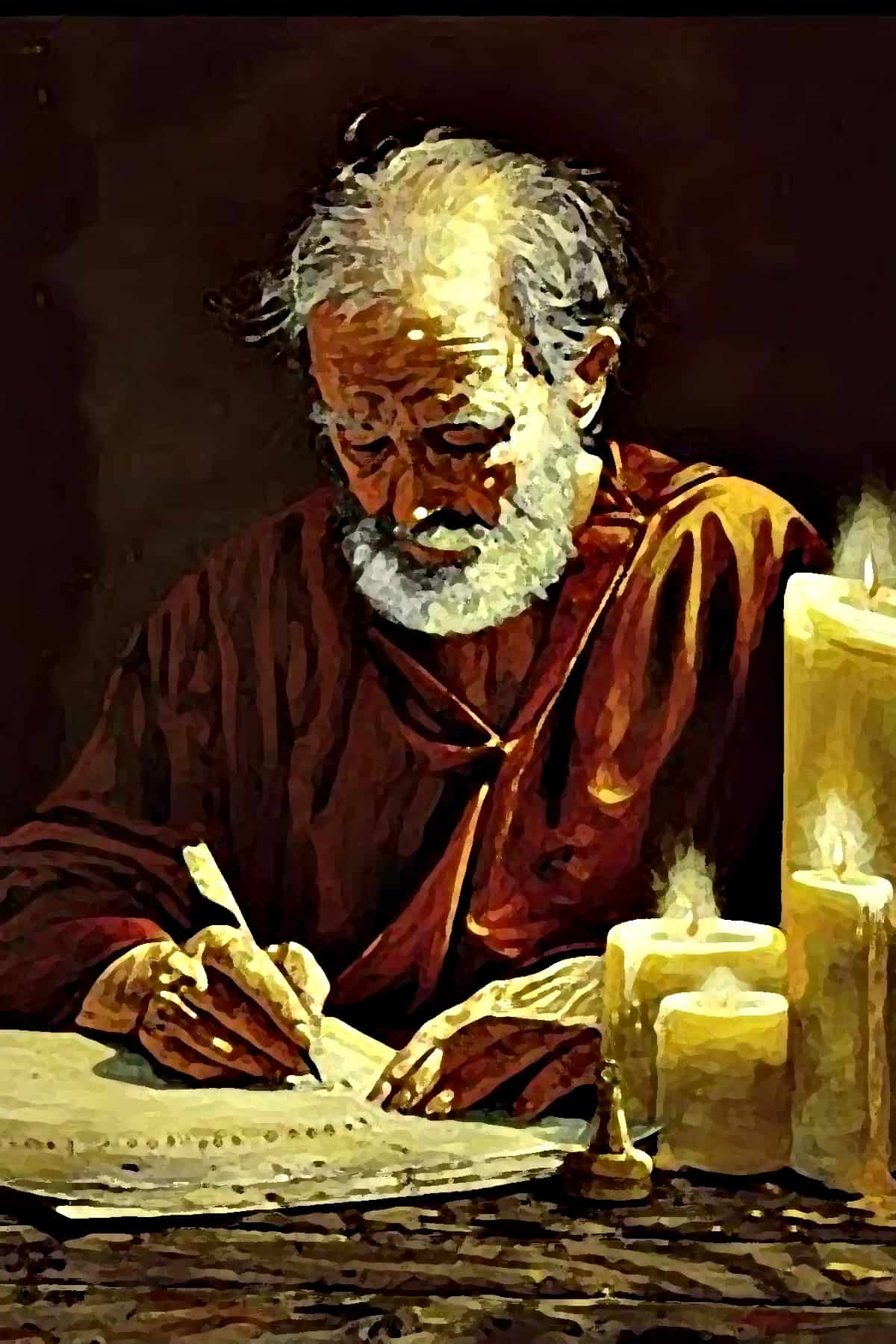
by netage | New Testament Tradition, General |
Theology is the study and interpretation of the Word of God. Keep in mind, that any interpretation by a theologian is influenced by his or her religious affiliation. A Catholic theologian will have a different interpretation of the Holy Scriptures than a Lutheran or a Presbyterian or a member of any other denomination. This is especially the case when interpreting specific topics such as the meaning of Church, penance, the priesthood or salvation.
Theology is not about ministry or preaching. Theologians are scholars who focus on academic research and institutional interpretation as it applies to the Word of God.
There is no official religious doctrine on Antichrist. The term is loosely used to describe an impostor who challenges the divine identity and power of Jesus Christ.
Among the traditions concerning the last days, the belief of Antichrist has a special pastoral function to fulfill. It serves to arm the believing community to do battle with the compact forces of darkness, in the form in which they encounter them in their own age.
K. Frör
This second article focuses on the meaning of “Antichrist” in the First and Second Letters of John, the semantic content of which is linked to the Gospel of John and the creation narrative in Genesis. The goal is to reveal the relevance and meaning of key words to identify what the author says about Jesus’ humanity and divinity. Attributes that are negated by the Antichrist.
 The term Antichrist appears only in 1 and 2 John. It does not appear in Revelation to John, also known as Apocalypse of John. The word Antichrist, from the Greek antichristos, refers to an impostor with equal influence and power who stands as an adversary to Jesus Christ. In terms of biblical etymology, the word “apocalypse” is synonymous with “revelation”, and the word “Satan” is synonymous with “adversary”.
There is no scholarly consensus on the authorship of the First and Second Letters of John. However, it is agreed that the First Letter shares similar vocabulary, ideas, themes and style with the Gospel of John. All narratives attributed to John are dated to the end of the first century CE. John the Evangelist did not know Jesus personally. His written testimony relies on varied oral accounts and narratives describing the life of Jesus.
One John relates to “end of times”, or the “final hour”, not as a distant future but as an imminent threat to Christians and their community by a deceiver(s) or seducers(s) who claims that Jesus is not Christ, did not exist in the flesh, and is not the Son of the Father. These claims are made by individuals who were once members of the community and have since left, spreading false information about Christ’s humanity and divinity.
1 John 2:18 Children this is the final hour;
You have heard that the Antichrist is coming,
and now many Antichrists have already come;
from this we know that it is the final hour.
19 They have come from among us,
but they never really belong to us;
if they had belonged to us they would have stayed with us.
1 John 2:22 Who is the liar,
if not one who claims that Jesus is not the Christ?
This is the Antichrist,
who denies both the Father and Son.
1 John 4: 2 This is proof of the spirit of God:
any spirit which acknowledges Jesus Christ,
come in human nature, is from God,
3 and no spirit which fails to acknowledge Jesus is from God;
is the spirit of Antichrist,
whose coming you have heard;
he is already at large in the world,
2 John 7 There are many deceivers at large in the world, refusing to acknowledge Jesus Christ as coming in human nature. They are the Deceiver; they are the Antichrist.
The main point made by the Deceiver is that Jesus is neither not human or God. Thus, it is central to understand what the Evangelist means by Christ’s humanity. Let’s start with John’s first three verses which reveals key words about Christ’s essence of being. They are; beginning, hearing, seeing, touching, the Word of Life made visible.
1 John 1 Something which has existed since the beginning,
which we have heard, which we have seen with our own eyes,
which we watched and touched with our own hands,
the Word of Life ‒this is theme.
That life was made visible;
we saw it and we are giving our testimony,
declaring to you the eternal life,
which was present to the Father and has been revealed to us.
John explains the eternal of life embodied by Jesus Christ has existed since the creation of the world. God made this life visible by sending his Son, Jesus, in the flesh for us to see and hear. Specifically, “we have heard…seen… touched the” “Word of life… was made visible” is linked to “In the beginning was the Word” and “The Word became flesh” in the Gospel of John.
John 1:1-5 In the beginning was the Word:
the Word was with God and the Word was God.
2 He was with God in the beginning.
3 Through him all things came into being,
not one thing came into being except through him.
4 What has come into being in him was life,
life that was the light of men;
5 and light shines in darkness,
and darkness could not overpower it.
1:14 The Word became flesh,
he lived among us, and we saw his glory,
the glory that he has from the Father only Son of the Father,
full of grace and truth.
Jesus’ humanity is outlined by his presence among his disciples, his followers and the people he healed and raised from the dead. However, the most critical aspect of his humanity is identified as the Word became flesh. John highlights an often-overlooked aspect of Jesus’ humanity: Jesus spoke his message to his faithful. Without God’s creative essence to speak, the world would not have known the Son of God. As such, speech is a divine attribute that connects the beginning and the present. The Word IS eternal, and Jesus made the Word alive by his presence. Speech is what makes Jesus fully human and divine, without which his message of love could not be revealed.
In Genesis, God spoke creation into being. He created heaven and earth. And he made man with the dirt taken from earth’s soil, and “God blew the breath of life into his nostrils and man became a human being”. In Hebrew, the words for Spirit, breath and wind are synonymous, exemplifying the divine essence of human breath and life.
God created man and woman in his image and in his likeness. In Genesis 1:26, tselem is the Hebrew word for “image”, is loosely translated into shadow, or contours of a shadow. Demut is the Hebrew word for “likeness”, conveys a resemblance in terms of bloodline, akin to progeny or descendants, and, to a certain extent, procreation of human life.
God created Adam and Eve in his likeness with ability to hear his Word, speak, and procreate. Throughout the Old Testament, God spoke to his chosen people. He spoke to Adam and Eve, to Abraham, Moses and his prophets. Speech is God’s primal essence, without which he could not communicate his will to his people. Ultimately, God is made present by whomever reads and speaks His Words.
John’s perspective on Jesus’ humanity is that he came to this world in the flesh and could speak his Word to the people. This is revealed through the presence he shared with his followers, to whom he spoke his message of love, sharing and forgiveness.
John’s Antichrist is a person who was once a member of the Christian community but abandoned the congregation. After leaving, he and other renegades spread lies about Jesus, denying he came in the flesh or was the Son of God. The Deceiver spread falsehoods claiming Jesus is neither Christ nor the Lord, nor the human incarnation of the Word from the beginning. Denying his Word is eternal and sovereign.
1 John 1 Something which has existed since the beginning,
which we have heard, which we have seen with our own eyes,
which we watched and touched with our own hands,
the Word of Life ‒this is our theme.
by netage | New Testament Tradition, General, Spiritual Heritage |
Michael Rizzotti
 The word Gospel is a derivative of godspel, meaning “good tidings”. The original word in Greek meant “the good news” translated from the Hebrew word bissar, meaning “herald of good tidings” or “to bring the good news of salvation”.1
None of the authors of the Gospels knew or met Jesus. Their personal account of the life of Jesus is nonetheless a revelation of their own faith in Jesus Christ.
The narratives of the life of Jesus is made up of the three synoptic Gospels. These accounts are called synoptic because they share a common perspective; they are the Gospels of Matthew, Mark, and Luke. The fourth one, the Gospel of John, does not share the same chronology of Jesus’ life.2 Matthew and Luke have a richer material than Mark, and although they complement each other, they also differ in many important facts. The Gospels were in all likelihood written between ~60 and ~90 CE.
We will not debate here the synoptic problem of the parallels and incongruities between the texts. Instead we will focus on the fundamental themes and chronology of Jesus’ life.
In accordance with tradition, the Gospel of Matthew begins with the genealogy of Joseph, Jesus’ legal father. This most important theme of the Bible is carefully perpetuated in the first narrative. From Adam, to “the generations of Adam”, to Noah, to Shem, and to Abraham, etc…3 The evangelist establishes Joseph as the legal heir to the Fathers. Notwithstanding that Jesus is not Joseph’s biological son but his legal one.
Among the ancestors enumerated in the genealogy are the names of four women: Tamar, Rahab, Ruth, and Bathshebah (Uriah’s wife). One explanation for their presence in a patriarchal lineage is perhaps to make a connection between Mary’s virginal conception and the irregular nature of the union of these women with their own partners.4 For instance, Tamar took the initiative in her scandalous union with Judah. Rahab had been a prostitute but she nevertheless made it possible for Israel to enter the promised land. Ruth was responsible for an irregular union with Boaz without which there may not have been a Davidic line. And finally Uriah’s wife, Bethshebah, had an affair with David that resulted in the birth of Solomon.
In post-biblical Jewish piety, the circumstances surrounding these unconventional events were seen as the work of the Spirit of God. All these examples show the unfathomable and intriguing nature of God’s intervention in human affairs as a way to influence the course of history.
*
In Matthew, the dreams of Joseph are paralleled with Joseph (in Genesis) whose ability to read dreams brought his people into Egypt and saved them from famine. Joseph, in the New Testament, also has dreams where God tells him to flee to Egypt in order to save Jesus from the murderous hands of Herod. By bringing Jesus to Egypt, he providentially relives the experience of the people of Israel.5
The present essay relies on biblical typology as explained by Northrop Frye, namely, that writers of the Gospels literally connects signs, symbols and events in Jesus’ life with signs, symbols and events in the Old Testament.
Old Testament sequence:
Joseph’s dreams bring his people to Egypt and save them from famine
Moses escapes from the wicked hands of the Pharaoh.
Moses delivers his people out of Egypt to the promised land.
Moses wanders forty years in the desert.
New Testament sequence:
Joseph’s dreams bring his family to Egypt and save his child from Herod
Jesus escapes from the hands of the wicked Herod
Joseph leaves Egypt and comes back to Galilee
Jesus fasts forty days in the desert
As soon as the Pharaoh dies, Moses is able to return safely to Egypt. Likewise, Jesus is able to return to Nazareth as soon as Herod dies. Upon Jesus’ return from Egypt, he relives the Exodus and the coming to the promised land.
Moses’ untimely death unable him to see the promised land and the journey is completed by Joshua. The name Jesus is a nickname of Joshua. The analogy and symbolism underlined by the typologies are insightful.
The Evangelists describe the link between the Old tradition and the New. Moses didn’t live to see the promised land, Joshua did. Therefore, when Mary is told to call her son Jesus -Joshua- a new quest and expanse of the promised land begins.
In the beginning of his journey Jesus is first led away from Bethlehem, the city of David, the King of Jews, and brought back to Galilee, the land of the Gentiles. He takes up residence in Nazareth where he begins his mission and becomes known as Jesus the Nazarene. Here the Gospels have taken up the difficult task of reconciling the Old tradition with the New in announcing the “good news” to all the people, Jews and Gentiles alike.
Jesus’ identity is best related to in terms of his relationship with his God/Father and the world. He described himself as a spiritual physician, a shepherd to his people, a divinely authorized prophet. Foremost, Jesus calls himself the Son of man. This latter epithet may have been used by Jesus as a way to describe himself simply as someone in the quality of a human being. He also described his God simply as abba or “dear father”, or dad. In this sense the relationship between him and his Father is a very personal and intimate one.
*
During Pompey’s conquest of Jerusalem in 63 BCE, the priests ruled Israel. Whereas when Roman emperors Anthony and Octavian took over, the reign of Herod the Great began (37-4 BCE). Herod was known to be tyrannical yet competent. He was subservient to Rome but harsh and violent with his people. At his death he divided his kingdom among his three sons. Rome, however, did not confer upon them the title of king. The kingdom of Judaea and the title of ethnarch was bestowed to Archelaus. The kingdom of Galilee and Perea was given to Antipas, also known as Herod the tetrarch whom Jesus called “that fox”: the one who executed John the Baptist. And finally, the north-eastern territory of the Sea of Galilee, was given to Philip with the title of tetrarch also. Of all the three sons, Archelaus was most like his father, except that he was more violent and less competent. For that reason, representatives of the Jewish aristocracy went to Rome to complain about the despotic ruler hoping that Rome would allow them to reinstate a Jewish theocracy. Augustus recognized their plea and banished Archelaus from his office but put Judea under the status of a third-class province governed by a procurator appointed by Rome.
At that time, the territory of Judea, especially Jerusalem, was the center of Jewish worship. Jerusalem, more precisely its temple, was believed to be the heart of true Judaism. The territory outside it was considered to be unclean and impure. This was particularly the case of neighboring Galilee which was made up of a Jewish and non-Jewish population of Syrians and Greeks, still heavily influenced by Hellenism.6
The change in the political status of Judea also meant that it had to pay its taxes directly to Rome. This enraged a number of Jewish people because it was considered sacrilegious to pay tribute directly to a foreign and heathen ruler. To appease the Jews, and as a gesture of good will, Augustus decreed that synagogues were inviolable and Jews were to be exempt from appearing in court on their Sabbath.7
It was because of the foreign collection of these taxes that Judas the Galilean led a Jewish revolt against Rome in 6 CE. Although the uprising was firmly suppressed, the seeds of discontent were rooted among the radicals of the land. Rebellious ideals were further fomented by a group of Zealots that kept the spirit of revolt alive for the next two generations.
The peaceful coexistence between the procurators and the high priests went on more or less smoothly inasmuch as the high priests continued to pay the Roman representatives bribes to keep their office. It was a practice that accommodated the priests and enriched the procurators. It is not surprising that under these circumstances the high-priesthood had lost the respect of the population. Only the richest priestly families were able to retain their sacred office. Such was the case of Joseph Caiaphas (18-36 CE) who managed to keep his office despite the nomination of Poncius Pilate (26-36 CE). These arrangements, however, did not guarantee a good relationship between Rome and Judea.
It turned out that Poncius Pilate had an uncanny ability to offend Jewish susceptibility. On one occasion, in an act of deliberate spite, he had put a dedication to the Emperor on Herod’s palace. The Jewish elite was greatly insulted by it. They soon sent a deputation to Tiberius to complain about the emblem. They argued that the procurator had not put his name on the Jerusalem’s palace to honor him but simply to annoy them. Tiberius in a gesture of good will ordered the shields to be taken down.
Although Rome was firmly in control of Judea, it shared some of its power with the clerical elite as a peaceful accommodation. The Pharisees, the Sadducees, and the Essenes, were among the priestly schools of thought ─haeresis─ which began to flourish during the Hasmonean resistance (167-164 BC).
The Pharisees believed in the written laws of Moses, but contrary to the Sadducees and the Essenes, they also believed in the oral laws handed down to them by the Fathers. They believed in the resurrection of the body for the good soul, and eternal damnation for the wicked. The name Pharisees is derived from the Greek translation of the Hebrew perushim meaning separatists, deviants, or heretics. They were called so because these people were so scrupulous about the laws and rituals that they separated themselves from the less observant masses, the ‘ammei ha-arets.8
The Sadducees were the other major group of priests that flourished in Jerusalem during Jesus’ life. They claimed to be the direct descendants of Zadok, the high priest in Solomon’s temple. They were called tseduquim. Contrary to the Pharisees, they believed that only the written laws were to be observed. This brought the Pharisees and the Sadducees in bitter conflict. In addition, the Sadducees did not share the Pharisees’ belief in the immortality of the soul nor did they believe in the resurrection of the body. Despite all their differences, they managed to coexist and the two groups shared their priestly duties in the temple. The most notorious Sadducee is Caiaphas, the high priest who took part in Jesus’ trial.
The Pharisees had come to formulate a doctrine of the two realms: render unto Caesar what is Caesar’s and unto God what is God’s. In accordance to this doctrine the Pharisees tolerated that the people paid their taxes to Rome. It permitted a compromise in matters regarding the state, as long as it did not interfere with their religious affairs.
But the compromise was seen by the more radical groups as an act of treason. A group of these revolutionaries, called the Fourth Philosophy, gave the Romans and Jewish collaborators a hard time until they all committed suicide in the fortress of Masada in 73 CE.
Among the many priestly characteristics that are severely criticized by Jesus in the narrative is their scrupulous and hypocritical application of the law. The overwhelming preoccupation with purity and reward supplanted a simple and unadorned piety. The conscientious concern with legal requirements mostly void of any inward spiritual feelings transformed the ethical into the judicial: The moral and religious were replaced by the legal and formal. In other words, the Spirit of the law was replaced by the letter of the law and by endless argumentation and litigation.
Pharisees/scribes
sacred/law vs profane/common
pietists vs masses
pure vs impure
clean vs unclean
Every single aspect of the historical, political, economical, social, and religious context in which Jesus Christ lived and died is important. Every one of these factors help to understand the development of events that led to the culmination of Jesus Christ.
As we will see, the miracles are the clearest signs of Jesus’ earthly activity. They delineate whom Jesus privileged with his presence. The miracles are signs that separate those who were transformed by his message and those who opposed it. Among his opponents were the priests and the religious elite of Jerusalem.
The Gospels recount Jesus’ mission among the people, who for the most part were outcasts. The narratives show that he directed the attention on them by performing his miracles. The narratives describe these miracles as signs.9 The narratives also use the words mighty deeds, and manifestations of power. The term power here should be understood in the sense of Jesus’ active presence and power is shred with outcasts who have no rank or standing among the principalities and powers of this world. The miracles are meant to point out the significant social condition in which the outcasts live. In this context miracles circumscribe Jesus’ ministry.
In the Old Testament a sign is used as the invisible active power of God. The book of Genesis shows how numerous symbols of nature are used to emphasize the sacred events in history. Similarly, the circumcision, a sign of the covenant (Gen. 17:10), and the sign of blood on the door in Exodus heralds the Passover (Ex. 12:13). God uses signs to indicate symbols of inclusion into his realm of power.
Isa. 7:13 And he said , “Hear then, O house of David! Is it too little for you to weary men, that you weary my God also? Therefore the lord himself will give you a sign. Behold, a young woman (or virgin) shall conceive and bear a son and shall call his name Imman’u-el.”10
*
The first miracle related in the Gospels of Matthew and Luke is the virginal conception. The quote of Isaiah above is an important parallel that links the virginal birth of Jesus to the Old Testament. Throughout the narratives the Evangelists take a great deal of care in legitimizing Jesus as the Messiah prophesied in the Bible. The reason for such a concern becomes clearer as Jesus is confronted by accusations from the religious elite about his origins and authority. Not only does Jesus come from Galilee, the land of the aliens and heathens, but he arrogantly questions the honesty of the priesthood. They, in return, challenge the origin of his power to perform miracles since only God can perform miracles.11
We have talked about the miracles as signs that circumscribe Jesus’ message of faith. The physical account of the cures, the exorcisms, the raising of the dead, the multiplication of the breads, all point to a violation of the laws of nature. Since all four Evangelists, each in their own way, confirm the reality of the literal/physical aspect of the miracles in the narrative, it is impossible to fully elucidate their reality. Although the mystery involving their physical nature and origin may not be explained, these signs point to the whole purpose of Jesus’ ministry rather than the mysterious origin of his powers. In this sense, he uses the miracles to direct the attention toward a certain category of people, who for the most part, are segregated by society. His aim is to circumscribe the alien and marginal side of the religious reality.
types of miracles
1) healing: the sick, lepers, handicapped
2) exorcisms: casting out demon and evil spirits
3) feeding the hungry and poor
4) raising the dead
5) calming the storm, changing the water into wine
who benefits from the miracles
1) the forgotten: the sick, the poor and the hungry
2) the outcasts: the lepers, the possessed
3) the helpless: the handicapped, the dead
4) the foreigners: Romans, strangers, pagans
5) the overshadowed: women, children
If we take a close look a the list above, we can illustrate beneficiaries as the powerless: the ignored and the forgotten of society.
On the opposite side, those who reject the miracles and condemn Jesus:
1) the Pharisees, the scribes, the Sadducees, the high priest Caiaphas
2) the elders (Lk. 11:52)
3) the crowds, and the cities (Mt. 8:34, 11:20-24)
4) the merchants in the temple
5) the Roman procurator
This list characterizes the people in political, religious or economic position of power . If we look into this classification more closely, we can detect the whole spectrum of power and hierarchy in society:
the spiritual: the high priest, Sadducees, the Pharisees
the intellectual: the Pharisees, the scribes, the lawyers
the economical: the high priest, the merchants
the political: the Roman procurator, the high priest, the crowd, the Zealots.
Hence a division appears as follows:
established institutions vs emerging gatherings/assemblies/churches
*
From the beginning, Jesus’ religious authority is questioned by the skeptics, setting apart those who believe and those who reject Jesus Christ. Drawing the boundaries of his Kingdom of God, Jesus’ realm is set up against the worldly powers. The separation becomes even more evident as it culminates with his crucifixion. The progression of events that leads to Jesus’ death unfolds quickly. On the cross, except for a few loyal followers, he is abandoned by all.
As the drama unfolds, Jesus gathers numerous followers. At the same time he is confronted by an increasing number of foes. The dividing line between them becomes clearer. His message of love widens the gap between those who believe him and those who reject him. With the Sermon on the Mount, Jesus inaugurates a new law in which love is the only requisite. This new law transcends the old one, which further antagonizes the religious elite of Jerusalem.12
Although the Evangelists take great care in legitimizing Jesus as the Messiah, the priests of Jerusalem question his authority because of his Galilean origin. From the outset Jesus is opposed by the religious authority of the priesthood. They are offended by Jesus’ interpretation of the law. Furthermore, he performs miracles freely on the Sabbath, breaking the law. To that effect he answers them: “The Sabbath was made for man, not man for the Sabbath…”.13
But the priests also object to him because the Old Testament warns that only God can perform miracles. Hence, if a prophet performs “signs and wonders” he shall be put to death because the lord is testing the people to see if they are faithful to him.14
But a greater blasphemy than ignoring the Sabbath is the identity of Jesus himself. He declares himself the Son of God, “I and the Father are one”.15
Jn. 8:58 Jesus said to them, “Truly, truly, I say to you, before Abraham was, I am.”
10:34 “Is it not written in your law, `I said, you are gods’?”
Because of this, they want to stone him. Just like they wanted to stone the adulteress that Jesus saved from their hands. They also accuse him of being a demon and a Samaritan. In other words, they associate him with the outcasts, women/prostitutes, the foreigners, and the possessed.
The blasphemies seem to confirm the religious elite’s fears about Jesus. It also justifies their schemes to plot his death. Slowly, behind the scenes, a mischievous consensus is fomenting against him. Like Job, Jesus becomes the target of the political and religious authorities.
Mk. 3:6 The Pharisees went out, and immediately held counsel with the Hero’di-ans against him, how to destroy him. 16
*
He is not only rejected by the elite but by society as a whole.
During his passage in Gadarenes, Jesus is met by two wild demoniacs who ask him to cast their devils out and send them away among the herd of swine that could be seen close by. Jesus complies. As soon as he does, the whole herd is taken by a frenzy and jumps from a cliff into the sea to perish in the water below. With great consternation the herdsmen go to the city to report the event they just witnessed.
Mt. 8:34 And behold, all the city came out to meet Jesus; and when they saw him, they begged him to leave their neighborhood.
Not surprised by this Christ warns his disciple about society and hierarchy.
Jn. 15:18 If the world hates you, know that it has hated me before it hated you. If you were of the world, the world would love its own; but because you are not of the world, but I chose you out of the world, therefore the world hates you.
Did the crowd chase him away because he destroyed the herd, threatening their livelihood? Apparently, the city was not ready to pay the price with their livelihood to save two poor demoniacs.
Even Jerusalem, of all cities, is typified as an example:
Mt. 23:37 “O Jerusalem, Jerusalem, killing the prophets and stoning those who are sent to you!”
Several other cities like Nazareth are mentioned by Jesus as being blind to his message:
Mk. 6:4 “A prophet is not without honor, except in his own country, and among his own kin, and in his own house.”
He goes even further by saying that he has seen more faith in a Roman centurion than in anybody else in Israel. 17
But this, it seems, is only a prelude to what is going to happen later when the whole vengeful crowd in Jerusalem rallies against him and demands his death. The social makeup is seen as having a power of its own, obeying its own laws of inertia. As it turns out, the mob gathered at his trial will be Jesus’ final and fatal foe.
*
The word messiah means the anointed one or the one who is consecrated by anointing for a special function among the people of God. It originally was used to describe the consecration of a king. This ritual was widespread among the cultures of the ancient Near East.18 In Judaism this function is typified by Samuel’s anointing of Saul and later of David as the king of Judah and Israel. Kingship occupied an important place in the theology of Israel. The Davidic era is the golden age of Israel. It is the time when Israel lived at the zenith of its political and religious integrity; when it had complete control over its destiny.
The peace and prosperity of the kingdom of David came to an end with the Assyrian wars (745-721 BCE). The loss of the golden era inspired among its people a longing for a another Messiah. They sought a redeemer, an heir of David, who would bring an end to the misery of foreign occupation. It would enable the people to return from their exile.19
At the root of messianism is the religious and political quest for liberation. In times of great despair, the messianic expectations increase. Messianism became the expression of spiritual consolation for a paradise lost and the hope for the return of past glory.
The pursuit of freedom from foreign influence is at the root of the messianic promise of salvation. Results of recent ethnological studies show that various forms of messianism evolve from a disastrous repercussion of foreign domination and colonialism. The ambiguous feelings of seduction and revulsion toward foreign culture is always coupled by a radical polarization. It imprints ambivalent feelings of lord-victim.
The crisis, propelled by the presence of a foreign culture, threatens the structure of belief from without. Messianism is linked to a perceived threat to the indigenous culture. A fear of loss of religious integrity and collective identity. As a result, the movement revives hopes of messianic salvation that rekindle an idealized past. It instigates a return to these original ideals in their purest form in order to bolster a strong sense of identity. The anxiety provoked by acculturation encourages the radical belief of messianic redemption, often by revolutionary means, which triggers a radical antagonism to the domination of foreign cultures. The rebellion is usually instigated by the elite who perceive the threat as an immediate danger to their own survival. Messianic movements typically nourish mythical expressions of hope. They revert to powerful images of salvation that capture the spirit of the people. The threat of assimilation by the people is then perceived as a personal threat to their own identity and survival.20
The circumstances under which Christ -the Greek equivalent for the word messiah- makes his appearance in Jerusalem are singular. The narratives describe that Jesus accepts the triumphant procession in Jerusalem riding on a donkey like the son of David on Palm Sunday. As we know, his role is not a political one, but that of a spiritual Messiah announcing a kingdom that is not of this world.21
*
Throughout the Gospels, Jesus is determined not to be manipulated by any group. He stands firm on his own unique identity. He refuses to comply to the rules set by the priests. He declines to take up the cause of the nationalist Zealots. As he said, his mission is not of this world. He rejects Satan’s offer to indulge in the riches of the world. And he spurns the idea to exploit his powerful charisma for his personal economic or political gain. He stands firm on his grounds. He declares himself to be the Son of man and the Son of God.
He applies the same determination to his fate. He knows about his oncoming death. But he will not try to change the course of destiny, though he could at any time.
At his arrest, one after the other, his disciples abandon him to his captors. Apparently, they thought Jesus to be someone else:
Lk. 24:21 …we had hoped that he was the one to redeem Israel.
When Jesus is betrayed by Judas, he is brought in front of the Sanhedrin where he is finally confronted by his adversaries.22
Caiaphas, the Sadducee high priest, is present among the crowd of Pharisees and scribes who have already decided on Jesus’ death. But they have a problem: they must find a way to inculpate him. At his interrogation, Jesus is questioned about his identity. He is asked if he is the Son of God, he replies that he is. He also answers them that he is the Son of man who will be at the right hand of the Power.
Upon his reply, they accuse him of blasphemy and condemn him to death. Shortly after, Jesus is sent to the procurator Pilate, in whose hands rests the political and legal authority over these matters. He states to Jesus that he is being accused by the religious elite of fomenting a revolt against Rome by telling the people not to pay their taxes. He is also accused of proclaiming himself Christ, a king. To his questions Jesus replies:
Jn. 18:36 “My kingship is not of this world; if my kingship were of this world, my servants would fight, that I might not be handed over to the Jews; but my kingship is not from the world.” Pilate said to him, “So you are a king?” Jesus answered, “You say that I am a king. For this I was born, and for this I have come into the world, to bear witness to the truth. Every one who is of the truth hears my voice.” Pilate said to him, “What is truth?”
Seeing nothing wrong with Jesus, Pilate turns to the crowd and he asks them if they want to release Jesus, since it is a custom to free a prisoner during the Passover. Yet the mob demands that Barabbas, a known thief and probably a revolutionary, be released instead.
Here the parallel between Christ’s judgment and the sacrificial ritual in Leviticus 16 is compelling. The Old Testament text describes the directives for the Mosaic ritual of the Day of Atonement; to take among the flocks belonging to the people, two male goats. One to be chosen to be sacrificed as a sin-offering to Yahweh, the other as an atonement for Israel’s sins and to be set free in the wilderness as an offering to Azazel, the sins of the people having been symbolically laid upon it. Azazel is the name given to a being who opposes Yahweh. The Vulgate version of the Bible rendered the word Azazel into caper emissarius.23 Later, Luther translated the word into lediger bock meaning literally free-goat. Finally, the word was rendered into English as scapegoat: a victim who is innocently blamed or punished for the sins of others.24
The parallel suggests that Jesus is depicted as a human offering to Yahweh. While Barabbas -the name means son of the father– who is symbolized as carrying the sins of Israel, is set free to the foreign lands.
The crowds that chased him away are now gathered in Jerusalem to demand his death. They choose Barabbas rather than Christ. Jesus who promises the kingdom of God to the powerless is a danger to the established order of society. And Caiaphas, as its spokesman, explains why Christ should die:
Jn. 11:50 “You know nothing at all; you do not understand that it is expedient for you that one man should die for the people, and that the whole nation should not perish.”
It is better to sacrifice one person for the sake of the whole society. They perpetuate the false belief that a scapegoat will solve all their problems. Jesus becomes a pharmakos, the individual kept by the Greek community as a scapegoat to sacrifice in times of social crisis. But history shows that violence begets violence. The words spoken by Caiaphas are empty words since the temple and Jerusalem will finally be destroyed in 70 CE anyhow. Yet another reason why they seek his death stems from the power of his word. They think he is fomenting political and religious upheaval. They fear he is seeking to abrogate their power.
But Jesus’ prophetic words echo an ultimate truth when he adds:
Lk. 23:34 “Father, forgive them; for they know not what they do.”
Jesus’ crucifixion underlines the illusion of violence. Sacrifice and love are the only ways for human salvation.25
Although Jesus may be innocent of the crimes he is accused of, he is certainly not a victim. He freely agrees to his fate. He knows and understands the full extent of his decision. His consent is a crucial act of free will. He like Job, as an individual, is left alone against all the prejudice and powers of this world. He knows that the powers invested in the political, the social, the economical, and the religious, are present like a dark cloud over him. Jesus knows he has to endure his death so that his absence could be effective. So that his meaningful presence on earth may be resurrected by faith. Only then, can he be of benefit to all. Consequently, he tells his apostles that he must leave in order for his message to be fully understood:
Jn. 16:7 Nevertheless I tell you the truth: it is to your advantage that I go away.
Only then will they understand that he is the message of hope for the powerless as the beneficiaries of his kingdom, and not those who already control the powers in their own world.
Mt. 22:16 “Teacher, we know that you are true, and teach the way of God truthfully, and care for no man; for you do not regard the position of men.”
They know that the power of the word of God is stronger than any human institution. But Jesus clearly did not entice political and economical upheaval. He took great care to share the urgency of the message of love. He introduced a new law to replace the old. He inaugurated a kingdom where women, children, the poor, the sick, the outcasts, the handicapped, the estranged, the mentally disturbed, the alien, the stranger, and the slave, all have equal access to his kingdom.
*
Jesus Christ’s death might appear as an obstacle to his ongoing mission. A timely and tragic obstruction. Far from the truth. His death is precursory to an even greater medium for his message. While on earth he communicated the word of God to the people around him, after his death Jesus embodies a new role in his resurrected body. The risen Christ becomes the ultimate and eternal medium for his message, a personal image to which all have access.
Doctrines about death and resurrection have evolved and changed in the Old Testament. According to the Bible, man is not a being composed of a body and a soul but of a soul with the vitality of the flesh. There is no duality between body and soul. Man becomes a soul when he is born, and when he dies he is a dead soul. His soul comes directly from God.26 The word soul in Hebrew means literally a living being, an animated body. Consequently, the dead in Sheol are not the soul of the dead but shadows of beings. Accordingly, they are considered powerless and weak.27 They could not come back to life.
Job 7:9 …he who goes down to Sheol does not come up;
Eccles. 3:19 For the fate of the sons of men and the fate of beasts is the same; as one dies, so dies the other.
The concept evolved and became closely associated with the idea of the restoration of Israel. Particularly in times of historical distress. In Ezechiel, the resurrection of the dead bones did not imply a return from Sheol, but a return of the nation from the dead condition of exile.28
Further development of the concept occurred during the period of the Maccabeans where the belief in the resurrection is clearly expressed:
Dan. 12:2 And many of those who sleep in the dust of the earth shall awake, some to everlasting life, and some to shame and everlasting contempt.
Later, the chief proponents of the resurrection were the Pharisees. The resurrection was applicable only to a select few like Moses, David, and to the more pious elite of their congregation.
In Christianity, the resurrection of the body became the cornerstone of its faith.
*
The Gospels share basically the same material in respect to the discovery of the empty tomb by a group of women.29 In all of the accounts, the central figure is a woman called Mary Magdalene. She is the first person who perceives the resurrected body of Christ.
Her name is revealing. Mary was from Magdala -hence Magdalene- a city situated on the west bank of the Sea of Galilee, about 20 km north of Nazareth. The word also means tower or fortress.30
But what is most peculiar is the time at which she gains more prominence in the Gospels. The narrative recounts the presence of this group of women who have been following Jesus during the greater part of his public life but who have been overshadowed by the more predominant group of male disciples. Only here, and at a very crucial moment, are the women finally recognized as followers in the same manner as their male counterparts.31
We would like to introduce at this point the role of the metaphor in terms of symbolic significance:
John 10:9 I am the door ─gate
John 14:6 I am the way
It might be implied that Jesus uses the metaphor to reveal his message.
Mat 16:18 You are Peter, and on this rock I will build my community ─Church
Jesus tells Simon that he is a rock ─peter literally means rock─ and he will be known as the rock on which Jesus will build his community.
The last supper is where Jesus shares his last meal, breaks the bread and drinks from the sacred cup. The scene is the center of the whole Catholic faith. And the Eucharist is a sacrament that faithful Catholics partake in Church with the holy communion. At the Last Supper Jesus shares the bread and wine with his apostles and says these words.
Mark 14: 22-24 This is my body…This is my blood
The metaphor is a figure of speech that implies a shift in meaning and a spiritual code. A break in the normal use of language. Simultaneously breaking with the normal social conventions and religious practices. Simply put, the metaphorical interpretation of the Gospels could be considered as a keystone behind the last supper. What the cup holds is not wine but the metaphorical sacrificial blood.
Furthermore, if Simon is the metaphorical rock on which Jesus will build his Church, then Mary of Magdala, who was the first to witness the risen Lord, is to be considered the tower that will be built on that rock ─foundation. In addition, the name Madgal-eder also appears in Micah (4:8-10) and refers symbolically to a tower or stronghold of the flock. Mary Magdalene then, will stand on the rock as the stronghold for all future Christian communities.
The account also refers to the angels that appear to both male and female apostles. The apparition is also paralleled to the annunciation. Jesus’ birth in Mary’s womb is the counterpart to Mary’s presence in front of the empty tomb. Birth and death are privileged symbols of life and regeneration. Here, they become kindred to the resurrection of Christ.
Christ’s death also signifies the sudden emptiness in the followers’ lives. The physical absence of their Master leaves them powerless and lost. Yet as soon as the news of the empty tomb reaches them, they are filled with hope.
The message from the angels fulfills the prediction about his return:
Hos. 6:2 After two days he will revive us; on the third day he will raise us up, that we may live before him.
Jesus is the bodily proof that God is accessible to us. He was able to establish relationships with his followers. Jesus became the Word in order to communicate his will directly to the world.
With his resurrected body Jesus becomes the medium par excellence. His death is no longer an obstacle to his ongoing message. With his risen body Christ’s message is not limited by the boundaries of time or space. Although his death abruptly ends his physical presence on earth, the heavenly body is eternally present, accessible to all at all times.
Jesus’ resurrected body, however, is not the restoration of a previous condition in the flesh, but a transformation of a radical kind. Not to be confused with the decaying nature of the physical body. Christ’s resurrection is not a return to a former condition, but the passage to a totally new one. With his new condition he is given the title of Lord. A sovereign state free from the tyranny of the powers of the world that have persecuted, condemned and crucified Jesus. And as stated in Encyclical letter Mystici Corporis by Pius XII, the Church, or the assembly of believers, is the Body of Christ.
Paul in 1 Corinthians distinguishes the physical body from the spiritual body. The first is a body and mortal, the second has a body but is spiritual. He also correlates the body to the idea of image. Both are related to the identifiable essence of Jesus Christ.
1 Cor 15:49 Just as we have borne the image of the man of dust, we shall also bear the image of the man of heaven.
The image of this identifiable body is no longer indistinguishable among the crowd but lives above us, in heaven. His resurrected body becomes the mark of a new spiritual identity. And through his Ascension Jesus Christ, in his heavenly body, rises to the full view of all. It becomes the ultimate miracle, the greatest of all visible signs.
That he has risen from the dead is a victory over the state of remaining in the shadow of nothingness. Therefore, the former condition of the dead, described as the meaningless state of the shadows of the powerless, is transcended with the resurrection.
The presence of the angel standing outside the tomb is further evidence of the good news about Christ’s heavenly condition. The angels, from the Hebrew mal’akh which means messenger, are an additional link to the Old Testament. The angels were messengers of the Lord to Abraham, Isaac, Jacob, and Moses.32 Similarly, the angel becomes the medium of Christ the Lord to his followers.
*
Like Job, he was abandoned by all, even God. Defender of the outcasts, he dies like one himself. Both typify the innocent servant who suffers for the sake of truth. Job’s suffering enables him to see God, while Jesus dies to be the living presence of God.
Jesus Christ is the prototype of a new humanity.
Like Job, he is a scapegoat singled out by society. This isolation enables Job to have a vision of God he could not conceive before. On the other hand, Jesus is God because he gave his life for that truth. Love and knowledge about God is now accessible through him. His resurrected body is a visible sign, the door to his realm. It enables the powerless to have access to the power of God.
Although Jesus is loved by many, his adversaries are plenty. At the end, they overcome him. Even though he chastised the hypocrisy of the Pharisees, he did not condemn their religion. As much as he opposed the merchants in the temple, he did not oppose commerce. He complained about the unfaithfulness of the cities, but he did not repudiate social order. He simply proclaimed that the powers of this world have no jurisdiction over his realm. His people obey a different set of laws and are governed by the power of love.
Jn. 13:13 You call me Teacher and Lord; and you are right, for so I am. If I then, your Lord and Teacher, have washed your feet, you also ought to wash one another’s feet. For I have given you an example, that you also should do as I have done to you. Truly, truly, I say to you, a servant is not greater than his master; nor is he who is sent greater than he who sent him.
The real purpose of the miracle of the resurrection relies on teaching the message of love thy neighbor to all nations to be part of the Mystical Body of Christ; the Wholesome Church.
Mt. 28:18 And Jesus came and said to them, “All authority in heaven and on earth has been given to me. Go therefore and make disciples of all nations, baptizing them in the name of the Father and of the Son and of the Holy Spirit, teaching them to observe all that I have commanded you; and lo, I am with you always, to the close of the age.”
_______________
1 Isa. 40:9; 52:7; 61:1; etc.
2 Paul Feine, Johannes Behm, and reedited by Werner Georg Kummel, Introduction to the New Testament, New York, Abington Press, 1966.
3 Mt. 1:1-16; Gen. 5:1-31; 10:1-32; 11:10-31.
4 The second explanation, made popular by Luther, interprets the inclusion of these four women as the symbolic presence of foreigners -Gentiles or persons associated with Gentiles in Bethshibah’s case- in God’s plan.
5 Raymond E. Brown, The Birth of the Messiah, New York, Images Books, 1979.
6 Emil Schurer, A History of the Jewish People in the Time of Jesus, New York, Schocken Books, 1971.
7 F. F. Bruce, Israel And The Nations, Grand Rapids, Wm. B. Eerdmans Publishing Co., 1963.
8 In the New Testament the Pharisees are also identified as the scribes and the sages; Mat. 2:4; 21:15; 23:15. See Ellis Rivkin, What Crucified Jesus?, London, SCM Press Ltd, 1986.
9 J. T. Maertens, La Structure des Récits de Miracles dans les Synoptiques, in, Sciences Religieuses/ Religious Studies, 6/3, (1976-77), 253-266.
10 The young woman can also be rendered into “virgin”.
11 Deut. 13:1-11.
12 Mt. 5:1-48; Lk. 6:20-49.
13 Mk. 2:27.
14 Deut. 13:1-13.
15 Jn. 10:30.
16 The Herodians were political functionaries influential in the court of Herod Antipas.
17 Mt. 8:10.
18 In Is. 45:1, the persian king Cyrus is addressed by Yahweh as “his anointed”. See also; Jg. 9:8,15; 1 Sam. 10:1, 2Sam. 2:4; 5:3.
19 Is. 9:1-6; 2 Sam. 7:16; Is. 55:3-5.
20 The Islamic Revolution in Iran is a case in point. Here are some additional references on messianism: W. Muhlmann, Messianismes Révolutionnaires du Tièrs-Monde, Paris, Gallimard, 1968; G. Devereux, Ethnopsychanalyse Complémentariste, Paris, Flamarion, 1972, and by the same author, Essais D’Ethnopsychiatrie Générale, Paris, Gallimard, 1970; also the interesting book by, F. Laplantine, L’Ethnopsychiatrie, Paris, Editions Universitaires, Paris, 1973, and his other work, Les Trois Voix de l’Imaginaire, Paris, Editions Universitaires, 1974.
21 Mk. 14: 61-65; Dan. 7:13.
22 There is a parallel here between Judas his disciple and the historical Judas the Galilean, the notorious nationalist.
23 René Girard, The Scapegoat, Baltimore, The Johns Hopkins University Press, 1986.
24 The Tindale Oxford Dictionary.
25 “In future, all violence will reveal what Christ’s Passion revealed, the foolish genesis of bloodstained idols and the false gods of religion, politics, and ideologies. The murderers remain convinced of the worthiness of their sacrifices. They, too, know not what they do and we must forgive them. The time has come for us to forgive one another. If we wait any longer there will not be time enough”. In Rene Girard’s, The Scapegoat, Baltimore, The Johns Hopkins University Press, 1986, 212.
26 Gen. 2:7; Num. 23:10.
27 Isa. 14:9-11; 26:14; Ps. 88; Job 26:5.
28 Ezek. 37:1-14.
29 The message is directed to Mary who is described in the narrative as the woman from whom Jesus had cast out seven demons (Lk. 8:2). We can make another parallel with Proverbs 9:13-18 where the dead condition and the crazy woman may be linked here with Mary Magdalene.
30 Jean Daniélou, La Résurrection, Paris, Seuil, 1969, 11.
31 Lk. 8:2-4; Mk. 15:40-41.
32 Gen. 18:1; 24:7; 31:11; Ex. 3:2.
by netage | New Testament Tradition, Spiritual Heritage |
 In addition to his twelve disciples Jesus had a group of devoted women followers. Mary Magdalene stands out by the number of times her name is mentioned in the Gospels. She’s the first among all the disciples to acknowledge the resurrected body of Christ. Throughout history her image has been popular in art, celebrated by gnostic advocates and recently praised by the magisterium. To this day there is no theological or academic consensus on her identity. Since the turn of this millennium, tailwinds are stirring up her Spirit. Her role in spreading the Good News is at last recognized, conferring upon her a rightful status similar to Peter. The disciple who was once called Simon whom Jesus gave the metaphorical name of rock. Similarly, Mary’s surname of Magdalene has an etymology that is linked to the Hebrew word migdal, meaning tower. The literary device that the narratives apply to Simon is here applied to Mary. Both are metaphorical attributes: Simon as rock and Mary as tower. The Gospels reveal that Jesus uses parables and metaphors in his teachings. They are central to his message. As such, how essential are literary devices to revelation and the underlying dynamic of the “truth”?
Mary Magdalene is mentioned more times than any other disciple except Peter. The sum would be greater if one takes into account the number of occasions her identity has been obscured by misrepresentation. In the eight times that a list of women is cited, on every occasion Mary Magdalene is named first. Only at the crucifixion is Mary the mother of Jesus mentioned first and Mary Magdalene last. Mary whose womb gave birth to Jesus is present at his death, whereas it is Mary Magdalene who finds the empty tomb who is witness to the risen Christ.
Although these women remained in the background they nonetheless provided financial support to Jesus and his mission. All four Gospels describe a group of women that accompanied Jesus until his last week and were present at his crucifixion. They alone remained until the end, whereas the male disciples fled.
Before I get into Mary Magdalene and the significance of metaphor in establishing her identity, I would like to say a few words about the historical context of the narratives.
The setting: the Gospels
The hero: Mary Magdalene
The quest: the dynamic of “truth”
The adversary: materialism and literal sense of the Word
The mentor: metaphor
The outcome: the tower of the flock (1)
The Gospels vary in their description of an enigmatic female follower of Jesus. Three synoptic Gospels, namely Matthew, Mark and Luke, share a common perspective and chronology of Jesus’ ministry. However, Luke is a bit of a devil’s advocate in his description of a woman’s anointing of Jesus. The event in Mark and Matthew takes place in Bethany in Simon’s house before the Passover. In Luke, the scene is in a different city, in a Pharisee’s house at another time. As for the fourth Gospel of John, the text only shares a similar chronology of Jesus’ mission in these events: The baptism of Jesus by John the Baptist, the multiplications of loaves and fishes, the crucifixion, the anointing of Jesus, and Mary Magdalene’s presence at the empty tomb. In Luke and John, Mary anoints the Lord’s feet. In Matthew’s and Mark’s she pours the fragrant oil over his head. Although the woman at the anointing scene remains unnamed in Matthew, Marc and Luke, in John she is described as Mary the sister of Lazarus and Martha from the town of Bethany.
The Gospel of Mark is the oldest text, written between 65-75 CE. Whereas Matthew and Luke are dated approximately between 80-90 CE. The Gospel of John was written circa 90-100 CE. Mark relies mostly on oral tradition for his source and inspiration. Matthew and Luke have two common sources; Mark and “Q” ‒ from the German Quelle meaning source. Matthew is more descriptive than Mark whereas Luke’s version is more embellished and at times confounding. Although Matthew and Luke complement each other, they differ in many factual details. There is no academic consensus on the identity of the authors. None of the Evangelists knew or met Jesus.
The accounts were likely written in Antioch, Syria and Ephesus, Turkey, outside the confines of Judea, and for the most part after the destruction of the Second Temple in 70 AD. In a period where Greek culture ‒Hellenism‒ was dominant in the Greco-Roman empire. The extent of the cultural influence of Hellenism is reflected by Greek gods that were adopted by the Romans as their own. They were given Latin names and made part of their pantheon.
The Gospels were likely written by Jewish men who were knowledgeable of holy scriptures. This is evidenced by their extensive references to the Septuagint ‒ a Greek translation of Hebrew texts, known as the Old Testament in its canonical compilation. The texts use a wide range of literary devices to convey their view of events. The authors were likely spiritual leaders in their respective communities. They shared their lives and celebrated religious practices with Jews and Gentiles alike. They lived by Jesus’ all-embracing commandment of love your neighbor like yourself and obeyed the instruction to teach the Good News to all nations.
The texts were written in Koine, a Greek dialect that became the dominant language in the Mediterranean and the Middle-East after the conquests of Alexander the Great. It is assumed that Greek rather than Hebrew was chosen because it was the lingua franca of its time. And because the Evangelists lived in a cultural environment populated by Greek speaking Jews and Gentiles. Perhaps, these texts were written in Koine as a way to avoid Roman suspicion in the aftermath of the Jewish rebellion and the destruction of Jerusalem. Another reason might be that reading and writing were closely guarded skills and privileges held by Jewish priestly dynasties and scribes.
In the aftermath of the destruction of Jerusalem the political environment changed. Jewish people who were not imprisoned, enslaved or executed fled the city to varied communities of the Diaspora. Those who remained in Judea were under tighter Roman control and monitored for any sign of insurrection. In general, Jewish religious practices were tolerated by the authorities as long as it did not cause any public disturbance. The priestly orders that were affiliated with the Temple were dispersed and dwindled in importance. Surveillance of the Jewish population in the empire increased. Any text or letters addressed to varied churches carried by messengers were likely confiscated by Roman patrols and checked for any sign of rebellion. The irony is that parables and metaphors were used to deflect any misapprehension that the message of the Good News was politically motivated. Jesus chides and explains to his disciples that only enlightened few understand the meaning of his words.
After the crucifixion of their beloved teacher and the destruction of Jerusalem, worshipers could no longer rely on the priesthood of the Temple for religious guidance. Political circumstances shifted the worship to a theology connected to the Jewish experience of exile. Centered on the principle that God does not only reside in the Holy of Holies located in the Temple but is symbolized by the chariot of God. The movable presence of Yahweh, accessible to whom he chooses for his mission.
The Jewish people of the Diaspora more than ever required spiritual direction and hope. To many, Jesus the Nazarene was considered an outsider chastised by the priestly orders of Jerusalem. As such he represented a spiritual model in a post Second Temple era for many Jewish people who heard his message. During his mission, Jesus directed his attention to people who suffered as outcasts, who yearned for hope, integration and salvation. Jesus healed people who suffered a loss: He cured the blind, the deaf and the paralyzed. He brought back to life the dead. He praises the alien like the Samaritan and the occupier like the Roman centurion on their faith. And Jesus welcomed women as his followers. He praised Mary Magdalene for anointing him, foretelling she would play a key role in the aftermath of his death.
Magdalene, Migdal
There is no scholarly consensus as to the origin of the surname Magdalene. The magisterium’s position is that the name refers to a place named Magdala. A word derived from the Hebrew word migdal. As a result certain versions of the New Testament translate Mary’s surname of Magdala, implying that her name is connected to the city of her origin located on the shores of the Sea of Galilee.
The assumption inspired a deep-seated conviction about a connection between the city of Magdala and Mary. However, this relation may not be entirely factual as it does not reflect historical data and the geography of Palestine of the time. Such a place on the banks of the Sea of Galilee no longer existed at the time of Jesus. Writings by Flavius Josephus (~37-100 CE), an historian and author of the The Jewish War, who lived during that era, does not mention a city known as Magdala/Migdal. Instead the site is referred as Taricheae, a prosperous city known for its production of salted fish. In addition the Greek geographer Strabo (64 BCE – 24 CE) in his Geography of Palestine describes the city of Taricheae without any mention of a town named Madgala. Nonetheless, the city later became known as Magdala and led to the support for the popular conviction about Mary’s surname.
Confounding as it may be, recent archaeological findings at the location of Magdala revealed the existence of an ancient city called Migdal Nunia, meaning tower of the fish. A structure that consists of a lower basin built out of rocks. The vessel was filled with water where fish were kept after an abundant fishing expedition.
The name Migdal or Migdol in Hebrew means tower. Other translations render it as fortress, stronghold or watchtower. The word is derived from the root gaddal meaning growing up, and to become great or important; figuratively implying pride and authority. In Exodus (14:2), Migdol is the location of an encampment near where Moses crossed the Sea of Reeds. In Jeremiah it refers to a chastised Jewish colony in Egypt. In many other instances Migdal indicates a tower in conjunction with a geographical location: Midgal-Gad the tower of Gad and Midgal-Eder to tower of Eder. In Joshua (19:38) Migdal-El signifies the Tower of God. And in Micah the term is associated with flock:
Mc 4: 8 And you, O tower of the flock,
hill of the daughter of Zion,
to you shall it come,
the former dominion shall come,
kingship for the daughter of Jerusalem.
Seven Evils Spirits
In 1969, shortly after the conclusion of Vatican II, the Catholic Church officially disclosed that the long held view that identified Mary Magdalene as a prostitute was not based on any factual or scriptural evidence. Cleared of being a prostitute she is nonetheless mostly remembered as a sinner and the woman whom Jesus cast out seven evil spirits, even though the cure’s description consist of two phrases. Mark (16:9) simply states from whom Jesus had cast out seven demons. Whereas Luke (8:2) mentions briefly that; Mary surnamed Magdalene, from whom seven demons had gone out. This event and the mischaracterization of her as a prostitute overshadowed her more important role in the spreading of the Good News.
Luke describes Mary Magdalene as a sinner. This description likely led to her being depicted in the West as a prostitute. However, sin in the Old Testament does not necessarily convey moral or carnal debauchery. Sin originally meant to miss the mark, to do evil against somebody, especially Yahweh. Sin above all is related to revolt, offense and contempt, especially in violation of the covenant: It is mostly related to idolatry.
The cure of evil spirits is often referred to as exorcism. The term is misleading as it conjures up images of wild and harmful possessions portrayed by the media. This idea of possession does not convey what the original meaning of casting out evil spirits may have been about. It consisted in a process to cleanse a person of unclean spirits in order to allow he or she to be accepted in a community or an inner circle of followers. Evil spirits are also described by the Greek word demons. The term refers to spirits that hover between terrestrial world and the realm of the gods and are not necessarily harmful. Demons in those days did not represent cinematographic images of horrific and dreadful possessions.
Possession of evil spirits was a condition perceived by most devout Jews of the time, including Jesus and his disciples, as unclean and impure. A condition that must be kept out of reach in order to avoid contagion. It conforms to the practice of an orthodox believer in setting himself apart from Gentiles and non-compliant Jews by a strict application of holy instructions, separating what is clean vs unclean, pure vs impure. The instructions dictate how one eats, who he shares meals or who he associates with, who he could touch or who can touch him: the woman he could marry, when to have sex, and what type of sex; how to farm; what type of animals he could eat, and how to kill them, etc.
Back then a wife was man’s property. A woman was typically identified as a sister, a wife or as a mother of some man. Because of Mary’s status and her behavior, she breaks established religious customs of her time. Being unmarried at a late age was viewed with distrust. And her single status might have been at the origin of the suspicion of her evil possession. She is wealthy as noted by the very expensive perfume she uses on Jesus. She throws herself at Jesus’ feet, she touched him, violating religious practices, displaying a wild nature and strong minded character. And most daring of all, she anoints Jesus: An act full of significance and daring.
Jesus’ message of love your neighbor like yourself supersedes all commandments and instructions. It is applied to everybody, including women. Was Jesus’ casting out Mary’s evil spirits a process of removing all restrictions and biases regarding a woman becoming a close follower in an observant Jewish context? Luke (10:39) describes Mary of Bethany listening to Jesus’s teachings instead of helping her sister Martha preparing the meal for the guests. This indicates that she is more interested in absorbing Jesus’ words and becoming a disciple than behaving according to prescribed rules of her time. During the first century of Judaism it was unusual for a woman to sit down and listen to a Rabbuni, meaning teacher in Aramaic. More so for a teacher to accept a woman as a disciple.
The Anointing
The anointing of Jesus is described in all four Gospels. This in itself is a significant event. Nonetheless, each version recounts what happened in varied details. Overall the scene depicts a woman holding in her arms an alabaster vial containing very expensive perfume walking in a room filled with dinner guests. She moves toward Jesus and kneels in front of him. She pours the costly nard over Jesus’ feet and then rubs them. By some accounts the value of the perfume is estimated to be worth as much as one year’s wages. She then wipes his feet with her long lush hair. She does this in full view of Jesus’ disciples and guests in a show of utter submission and love. She deliberately chooses to make the anointing an act of public display.
Lk 7:36 One of the Pharisees invited him to a meal. When he arrived at the Pharisee’s house and place at the table, suddenly a woman came in, who had a bad name in town. She had heard he was dining with the Pharisee and had brought with her an alabaster jar of ointment. She waited behind him at his feet, weeping, and her tears fell on his feet, and she wiped them away with her hair; then she covered his feet with kisses and anointed them with ointment.
By her actions she recognized Jesus as her Lord and teacher. The scene has a significant symbolic reference in terms of the anointing of Jesus as Messiah. The disciples are scandalized by such an act of devotion and symbolism. They question why so much money should be spent frivolously instead of feeding the poor. Plus, it is considered a violation of religious practice for a woman to touch an unmarried man. Nonetheless, Jesus tells them to leave her alone, because she has done a good work.
In the Old Testament the ritual of anointing relates to pouring scented oil over a person’s head as a sign of divine election to a position of power. Biblical examples depict the ritual being performed on high priests or kings. The Hebrew word for “the anointed one” is Mashiaẖ. It is translated in Greek into Christ and the term was rendered as Messiah in English. King David is a befitting example of Mashiaẖ. As a young man he killed Goliath and grew to become a successful military leader who united the kingdoms of Israel and Judah. He was a poet, a good orator and a musician. As a result of his military skills and political maneuvering he rose in ranks and was anointed king by prophet Samuel. Hebrew prophets regard Kind David as the ancestor of a future Mashiaẖ.
The translation of Hebrew texts into Greek represents a cultural departure from the original religious experiences lived by the Jewish people; especially for Gentiles who were introduced to the Holy scriptures and who did not share the historical background as a people. This also applies to the translation of the Bible in numerous other languages. The term Mashiaẖ does not convey the same meaning for Jewish people as its translation into Christ/Messiah does for Christians. For the Jewish people the term has a religious, historical and geopolitical meaning. For Christians, the word Christ relates more to Savior. And is connected to the commandment of love your neighbor with the mission to teach the Good News to all nations, underlying a universal manner of being as the core of its message.
Mary’s anointing has a symbolic reference to Jesus as a spiritual Messiah and Savior. In retrospect, Mary’s actions show a sign of prophetic insight. Christians a few centuries later would, with the conversion of Emperor Constantine, take over Rome and spread their message to the whole empire and beyond reaching all nations without the help of an army, tax collection or central government.
*
In Matthew, Mark and Luke the identity of the woman at the anointing scene is unnamed. This is a mystery, especially considering that the event is reported in all four Gospels, all of which describe the behavior of a person filled with symbolic significance. There is one exemption. John does reveal her identity: She is Mary from the town of Bethany, a woman he describes as Mary Magdalene who is present at the tomb.
Jesus says this about his anointing: Let her alone, in order that she may keep it for the day of My burial. He is giving us a clue by revealing a connection between the woman at his anointing and Mary Magdalene with fragrant oil kept in preparation for his burial. Hence, the unnamed woman in Matthew, Mark and Luke and referred to as Mary of Bethany in John, is hypothetically the same person. (2) She is Mary from the town of Bethany also known as Mary with the metaphorical attribute of Migdal.
Jesus’ fate unraveled shortly after his last supper. He was betrayed by one of his followers, abandoned by his disciples, and arrested by the Roman occupying forces. He was denounced by the priests and judged and condemned by the mob under the supervision of Pontius Pilate, the Roman prefect. He was tortured, humiliated and forced to carry the instrument of his death. He was finally nailed to a cross as a violent display of the sanctioning power of the Empire. Finally, he was left to die between common criminals. Throughout his ordeal the only people that stood by his side were Mary the mother of Jesus, Mary Magdalene, Mary the mother of James, Joset and Salome.
In John’s version, Mary Magdalene finds an empty tomb and witnesses the appearance of Jesus whom she does not recognize and mistakes for a gardener. Mary asks the gardener if he took the body away? And if so, to tell her where he put it. Suddenly, Jesus calls out; “Mary”. And at the sound of her name she cries out “Rabbuni” in Aramaic. Mary Magdalene, a novice of Jesus’ teachings, has a revelation. She did not recognize Jesus at first because the risen Lord after his death is a different body.
Magdalene was the first to proclaim that Jesus has risen from the dead. She is the chosen messenger to spread the Good News. As it happens, the root word apostle in Greek means messenger. As a result on June 3rd 2016, by the express wish of Pope Francis, the Church gave Saint Mary Magdalene the same rank of Feast celebration that was given to the Apostles in the General Roman Calendar. Stating; the special mission of this woman should be underlined, she who is an example and model for all women in the Church. The Church also acknowledges the opinion of Rabanus Maurus and Saint Thomas Aquinas who called Mary Magdalene apostolorum apostola or the Apostle to the Apostles. Although Mary
Magdalene is considered a Saint by several Christian denominations, her status is pre-Congregational, meaning, she is a saint whose beatification or canonization occurred before the institution of the modern investigations performed by the Congregation for the Causes of Saints.
In mythology, the first to inaugurate a new reality is elevated in status and consecrated as a supernatural being, a deity or a saint. Myth is essentially a story that describes the events that are at the origin of a new reality created by civilizing people in the beginning of time. The Gospels recount the events that ushered a new era of Christianity, inaugurating a new time with the separation between Before Christ (BC) and After Death (AD). A secularized version of these acronyms are rendered as Before the Common Era (BCE) and Common Era (CE). To sum it up, myth records meaningful events of the world. These events evolve in a time beyond history, in a fuzzy boundary between the supernatural and the ordinary world, between mythology and history. In this respect Mary Magdalene being the first to witness the risen Christ plays a preeminent role in Christianity.
The Metaphor as Code
In order to be able to write in Koine the Evangelists must have been educated in Greek. Among the more noteworthy teachers of Classical Greek schools of thought is Aristotle, who’s writings cover a wide array of subjects including Rhetoric and Poetics. Rhetoric is the art of speaking or writing in an eloquent manner in order to convince and influence an audience. One essential component of both treatises is metaphor: A figure of speech that is as old as Greek literature and can be traced back to the writings of Homer. Metaphor consists in giving the thing a name that belongs to something else.
Metaphor is not the exclusivity of Greek literature, it is extensively used in Hebrew holy scriptures. The following are only a few samples:
Pr 18:10 The name of Yahweh is a strong tower;
the upright runs to it and is secure
The wealth of the rich forms a stronghold
a high wall, as the rich supposes
Ps 18: 2 Yahweh is my rock and my fortress,
my deliverer is my God
I take refuge in him, my rock,
my shield, my saving strength,
my stronghold, my place of refuge
Literary critic Northrop Frye is a guiding source when he states that: Within the Bible itself, all the values connected with the term “truth” can be reached only by passing through myth and metaphor. He is not alone in making the assessment. Literary theorist Kenneth Burke explains that literary devices like the metaphor have their role in the discovery and description of “the truth”. While mythologist Joseph Campbell sees the metaphor as a dynamic way of looking at narrative. During an interview Campbell asked an interviewer this question: What is a metaphor? Bemused he answered: My friend John runs very fast. People say he runs like a deer. There’s a metaphor. Campbell replied; That’s not a metaphor. A metaphor is: John is a deer.
This is what Jesus says:
Jn 10:9 I am the door/gate
Jn 14:6 I am the way
Jesus’ tells Simon that he is rock. He will be known as the foundation on which Jesus will build his community.
Mt 16:18 So now I say to you: You are Peter ‒ rock‒, and on this rock I will build my community. And the gates of the underworld can never overpower it.
During the Last Supper Jesus shares his last meal with his disciples. Jesus picks and holds a loaf of bread, cuts it into twelve pieces and shares it with his followers. He pours wine in a cup and shares it with his disciples and says.
Mk 14: 22 Take it, he said, this is my body…this is my blood
Each individual faithful makes up the assembly known as the Church, described by a Pope Pius XII papal in his encyclical Mystici Corporis: The Mystical Body of Christ. The cup of wine is Jesus’ blood, sacrificed for the life of the community after his death. The cup holds an additional symbolic attribute in terms of being a vessel: A physical object that holds a beverage for consumption. In this sense the mythical Holy Grail is only one material component in the metaphorical equation. The other, is the content of wine turned into blood as a symbol of Jesus’ sacrificial death to give life to his Mystical Body.
A metaphor is a figure of speech that consists in using a word~image to convey~embody something else. It is a break in the normal use of language, social conventions and religious practices. In the case of the Gospels, it is a shift in meaning and in being: A shift from a literal, material and visible condition into a metaphorical, spiritual and spiritual level. The whole process involves revelation; an unraveling a dynamic interaction between the material and the spiritual meaning of the Word.
Mk 8:18 Have you eyes and do not see, ears and do not hear?
The name Mary Magdalene, depending on the translation, is used at least twelve times in the Gospels. Similarly, the metaphorical use name of Simon/Peter/Rock, is used ~fifteen times in the Gospel of John. The narratives show that Jesus privileges the use of literary devices to reveal his message. Simply put, the metaphor is the door to the Good News. It enable us to see Mary as a metaphorical tower. In the same way Peter is a metaphorical rock. Furthermore, Simon’s surname represents a single element as opposed to a more elaborate structure defined by tower. The distinction suggests a more complex character of Mary Migdal.
Luke, who at times is confounding, is nonetheless helpful when he describes “Mary surnamed the Magdalene”, adding support to the idea that Migdal is a metaphorical attribute of tower. Similar to one that is given to John the Baptist, or James and John as the Sons of Thunder.
Lk 8:2 With him went the Twelve, as well as certain women who had been cured of evils spirits and ailments: Mary surnamed the Magdalene, from whom seven demons had gone out…
Furthermore, it is surmised that the term Migdal might also allude to tower of the fish made in connection to the ancient city of Midgal Nunia. Even though this city was known as Taricheae at the time of Jesus. It is presumed that Jewish people, as an act of defiance against the Roman occupier, did not call the city by its Latin name but continued to referred to it as Migdal. This type of rock basin holding fish were likely found in many other fishing towns around the sea of Galilee.
In another metaphorical example in Matthew 4:8 Jesus says he will make his disciples fishers of men. As it happens the Greek word for fish is ichthys. The word was converted into an acronym during the first century CE meaning; Jesus, Christ, Son of God, Savior, and was depicted by the symbol of a fish. Second-century theologian Tertulian explains: “we, little fishes, after the image of our ichthys, Jesus Christ, are born in the water”.
Christians were not the only ones using the image of a fish as a religious symbol. It was a common pagan symbol as well. As a result, Christians used the image in times of persecution in order to avoid attracting suspicion from the Roman authorities. It was customary for a believer to mark meeting places and tombs with the icon to differentiate followers from unbelievers. It was also used as a secret meeting code between Christians. One faithful would draw an upper arc and the other would complete the image by drawing the lower arc forming an image of a fish.
To conclude, Simon was named Peter to signify he was the foundation of the Church. Whereas, Mary surnamed Magdalene, is the first to recognize the resurrected body of Christ. According to a literary interpretation of the narratives she is Migdal, a symbolic tower, implying strength and vision. Perhaps alluding to tower of the fish, and as such she embodies the sacred vessel symbolized by the tower of the flock.
Mary Magdalene’s portrait can only be made with a patchwork of evidence found in varied Gospels. Her identity will be subject to continued scholarly scrutiny and debate. Nonetheless, literary devices are essential tools that provide clues in finding the truth about Mary’s identity.
Mk 14: 9 In truth I tell you, whenever throughout all the world the Good News is proclaimed, what she has done will be told as well, in remembrance of her.
________________________________________
(1) The original idea of the thematic sequence is taken from A.L. Greimas, Structural Semantics: An Attempt at a Method, Lincoln, University of Nebraska Press, 1983. I have introduced my own sequence which may not be endorsed or approved by the author.
(2) The Church’s position about Mary Magdalene’s identity is split between an old tradition dating back to Pope Gregory I (540-604 CE), who identified Mary Magdalene, the sister of Lazarus and Martha of the town of Bethany, and the woman who anointed Jesus as the same person. According to the Church this interpretation continued to influence western ecclesiastical authors, Christian art and liturgical texts relative to this Saint. However, the magisterium’s current position is that Mary Magdalene should not be confused with Mary the sister of Lazarus and Martha, from the town of Bethany
Bibliography:
Bourgeault Cynthia, The Meaning of Mary Magdalene, Boston, Shambhala, 2010
Burke Kenneth, Four Master Tropes, JSTOR.org
Chilton Bruce, Mary Magdalene, A Biography, New York, Doubleday, 2005
Frye Northrop, The Great Code, Toronto, Academic Press Canada, 1982
Frye Northrop, Words With Power, San Diego, Harcourt Brace Jovanovich, 1990
King Karen L., The Gospel of Mary of Magdala, Santa Rosa, Polebridge Press, 2003
Kirby John T., Aristotle on Metaphor, JSTOR.org
Ricoeur Paul, La Metaphor Vive, Paris, Seuil, 1975
Sabar Ariel, Unearthing the World of Jesus, Smithsonian.com
Starbird Margaret, Mary Magdalene, Bride in Exile, Rochester, Bear & Company, 2005
by netage | New Testament Tradition, Spiritual Heritage |
Michael Rizzotti
 No matter if one is religious or agnostic, Paul’s letters are compelling pieces of literature. Part confession, part exhortation, and part reprimand, his epistles are a gripping expression of a call to duty in the face of what the Apostle perceived to be an eminent end of days. Although the world did not cease to exist as he expected, the destruction of Jerusalem and its Second Temple eight years after his death in 70 AD, could very well be considered the end of the world for the Jewish people. The political context that led to Paul’s execution in Rome foreshadowed his dread about the future. To this day his landmark epistle to the Romans remains his most important legacy. Overall, his letters disclose a man set apart for a mission. His calling initiated an identity crisis directly related to his Jewish religious background as a man born in Tarsus, living in a Greek cultural environment, and subject to Roman political control. The context of Paul’s vocation reveals a religious disintegration and the unraveling dynamic of a spiritual experience.
The term religious typically implies an experience that is lived within the framework of a belief system, whereas the term spiritual relates to an experience that can also occur outside the boundaries of an established religion. Paul’s pharisaic background and calling make his experience both religious and spiritual in the sense that his calling shattered the boundaries of his religious beliefs set by tenets outlined in the Torah. With his vocation, Paul went beyond the instructions to reach into a spiritual realm outside his religious beliefs to embrace what he once perceived to be blasphemous and heresy.
Following his calling, Paul undertook to preach the Good News to the world. His travels included cities in Albania, Macedonia, Greece, Cyprus, parts of Turkey, Syria, Asia Minor, Arabia and Judea. On several occasions he visited Jerusalem where several of the Lord’s disciples lived, among them Peter and James, the brother of Jesus. His first journey took place three years after his revelation. On his last visit, approximately fifteen years later, he was arrested, imprisoned and transferred to Rome where he was executed five years later. Paul, the persecutor of Christian Jews, eventually became persecuted by conservative Jews and Christian Jews who did not share his views on the suspension of the law to accommodate Gentile converts.
In order to put Paul’s spiritual experience in proper perspective, it is necessary to describe his religious background and the cultural environment in which he lived. It is also important to emphasize the changes brought about by the translation of the Torah into Greek, a language in which Paul wrote his letters. This applies also to all the languages in which the Bible was translated over time. Important aspects of the original Hebrew words have been obscured from one language to another, and inevitably some of the original significance has been lost in the translation.
Saul, who is better known by his Latin name Paul, was born in Tarsus –south-central Turkey– between 1 and 5 AD. His birthplace was renowned for being a center of Greek culture. Like many other cities of that region, it was under military and political control of Rome. Nonetheless, Greek was a predominant language of that era.
During that period the Jewish population of the Diaspora was approximately 4.5 million, about 7% of the total population of the Roman empire. A majority of Jewish people lived outside Judea, mostly in territories located along the Mediterranean coast of North Africa and the Aegean coast, all the way to Italy and beyond. Paul’s family, like many other Jewish families, lived in voluntary exile, perhaps because Hellenistic rulers had granted Jews extensive rights, special privileges, and protection under the law.
At the time of Paul’s writing the literacy level in the Greco-Roman world was close to 20% of the urban population, whereas in Judea it was about 2 to 3% of the Jewish people. Being born and educated in an urban environment with higher literacy levels might explain why his letters were written in Koine, or common Greek. Traditionally, reading and writing were a closely guarded trade by priestly dynasties and scribes of Israel. It was a family craft that was kept from generation to generation. As a rule, priests interpreted and managed the religious instructions of the law, whereas scribes acted as consultants and accountants for the ruling class. In some cases priestly orders also acted as scribes and performed all the related functions for the rulers.
Another explanation why Paul wrote in Koine is that the Septuagint, the Greek translation of the Torah, was widely used during his lifetime. According to tradition the Septuagint had its origin in Alexandria, Egypt. It was sponsored by King Ptolemy II (287-47 BC), who had recently established the library of Alexandria. The king was persuaded by his chief librarian to include a copy of the Jewish sacred text in the library. Over time the Septuagint became popular among a growing Jewish population of the Diaspora who were inevitably influenced by Hellenism. This is exemplified by the Epistles and Gospels written in Koine.
Paul’s letters are unique in many respects. They are the oldest Christian writings and predate the oldest Gospel of Mark by 20 years. His epistles are among very few documents written by a historical New Testament individual. Although his letters are compelling pieces of literature, they don’t stand up to rhetorical standard. Paul used a dialect similar to one spoken by Hellenistic Jews of the time. His writing reveals he was not concerned with being eloquent. He did not use the canons of rhetoric and did not give credit to reason, the basic philosophical foundation of Hellenism. The text is comprised of different styles crammed together and best described as letters meant to be read aloud by Paul’s emissary to varied assemblies of believers. His composition represented Paul’s own cultural background and his unique way of expressing himself.
Not all epistles bearing his name were written by Paul. Scholarly consensus attributes the following documents to his authorship: First and Second Letters to the Corinthians, Galatians, Philippians, Philemon and Romans. Other letters are called Deutero-Pauline, meaning they were written under his name. For the sake of authenticity, the list above will be used as the source of this essay, the reason being that it is hard enough to determine an accurate portrait of Paul without having documents that contradict important events or confuse his theological teachings. A case in point is the Book of Acts written by Luke some forty years later. The book is colorful, full of anecdotes, yet in many instances contradicts or omits some historical facts about the apostle.
Except for the letter to Philemon addressed to a friend, the epistles are centered on pastoral matters dealing with varied churches that have their location as title. Unlike the Gospels, Paul is not preoccupied with describing the chronological life of Jesus or his sayings. Their content varies from giving thanks, to words of support, to criticism or reprimand, and are mostly concerned with expressing his thoughts on the justification through faith in Christ Jesus. His letters outline his interpretation of the law, sin, love, death and the resurrection of the body of Christ as the Church.
The Apostle Paul was a crucial player in the foundation of Christianity. His militant work made him the second most important figure after Jesus Christ. And although he never met Jesus, he did meet Peter, the apostle that the Lord chose as leader of his Church, and James, the brother of Jesus in Jerusalem. As a result, Paul heard first hand their testimony about Jesus’ message.
Saul was raised in the matter of the law as a Pharisee. At the outset he was educated in the school of thought that relied on the written and oral traditions of the Torah, a belief system based on the liturgy and rituals that now constitute Rabbinic Judaism. According to his letters, Paul persecuted Jews who were preaching Jesus’ message, and on some occasions he did so violently. He was actively involved in trying to destroy the early church. As a Pharisee he simply perceived Christian Jews as violating Mosaic Law. He persecuted both Jews and Gentiles alike for proclaiming that Jesus was the Messiah and preaching that Jesus was crucified and buried; on the third day was resurrected from the dead and sat at the right hand of God. Christian Jews were also targeted for breaking bread with uncircumcised Gentile converts.
The irony is that on several occasions the Gospels describe Jesus being confronted by Pharisees. They claim that Jesus does not have the authority to forgive sins, and that he should not be eating with sinners. He was chastised for healing a follower on a Sabbath. On one occasion Pharisees confronted him by saying that the law of Moses requires that an adulteress be stoned, to which Jesus replies that he who is without sin throw the first stone.
PAUL’S CALLING
One day, on his way to Damascus, presumably in order to persecute Christian Jews, Paul’s religious conviction is shattered to the core. His faith is irrevocably altered. His letters do not give any details of what exactly happened, except that Christ appeared to him in the same fashion as he did to the disciples. All we know is that it brought a radical change in his life. His religious experience compelled Paul into having a diametrically opposed view of Christ Jesus and the Jews and Gentiles who proclaimed his message.
What caused Saul’s change? Did he break down, compelled by the message of love thy neighbor made by the people he persecuted? Did he submit to the presence of the body of Christ embodied by Jesus’ followers? Whatever the reason, his experience unleashed a religious disintegration that compelled him to preach the Good News of the resurrected body of Christ.
His calling unravels a drastic change in his religious beliefs. The law that once was responsible for the persecution of Christian Jews is lifted. Christians and Gentiles are now to be part of the Church as one body in Christ. With his calling Paul the Pharisee opens his heart to all who have faith in the Lord Jesus Christ. Hence, whoever has faith is saved: men, women, Jews, Gentiles, circumcised and uncircumcised, slaves, free men and members of all nations.
Because of his preaching the Gospel, Paul suffered persecution and adverse conditions throughout his mission:
2 Cor 11:23 Are they servants of Christ? I know I sound like a madman, but I have served him far more! I have worked harder, been put in prison more often, been whipped times without number, and faced death again and again. Five different times the Jewish leaders gave me thirty-nine lashes. Three times I was beaten with rods. Once I was stoned. Three times I was shipwrecked. Once I spent a whole night and a day adrift at sea. I have traveled on many long journeys. I have faced danger from rivers and from robbers. I have faced danger from my own people, the Jews, as well as from the Gentiles. I have faced danger in the cities, in the deserts, and on the seas. And I have faced danger from men who claim to be believers but are not. I have worked hard and long, enduring many sleepless nights. I have been hungry and thirsty and have often gone without food. I have shivered in the cold, without enough clothing to keep me warm…
There is a significant difference between the original meaning of many Hebrew words, their Greek translation and today’s significance. As a result it is important to clarify some of the concepts as Paul understood them. This is especially the case of faith, sin, death and Christ, etc, that don’t have the same spiritual resonance today as it did when he wrote them.
Rom 3: 22 God’s saving justice given through faith in Jesus Christ to all who believe.
In a current Christian mindset, faith is a belief that God exists, that we trust that he will do what he says he will do. It also means we trust the tenets of our religious belief system to be true. In this instance, faith places trust in God or on the system we have faith in. The original meaning of the Hebrew word emunah, translated into faith, implies support, in the sense that it does not only rely on the premise that God is present and will act, but emphasizes the individual’s action in support of God and his commandments. As such, faith is an unfailing duty of reciprocity which exists between contracting parties. It is a covenant involving a personal commitment by the faithful and generating a wholesome ̶ shalom ̶ manner of being with the Divine. This support emanates from the believer as much as from God, reflecting a personal relationship with the Lord. The distinction is important in order to understand Paul’s calling of being one in Christ.
* * * *
Gal 1:15 But when God, who had set me apart even from the time when I was in my mother’s womb, called me through his grace, and chose to reveal his Son in me so that I should preach him to the Gentiles…
The Hebrew word grace does not signify elegance and mercy but describes the establishment of a new order of things. It implies a similar sense as the original Hebrew word, meaning the strategic order of setting up a tent in an encampment that separates the members living within with strangers living without.
Rom 5:12 When Adam sinned, sin entered the world. Adam’s sin brought death, so death spread to everyone, for everyone sinned.
As a consequence of his persecution of Christians, Paul equates the Law with sin and death. The root of sin is not related to sexual behavior but is centered on idolatry that enslaves people by diverting man’s support of God and his commandments. It relates to power schemes that interfere with an individual’s close relationship with God: Popular idols and subliminal gods that are set against the true God. Consequently, the wage of sin is death does not mean the physical decay of the flesh but the estrangement from a close relationship with the Divine. The result is an alienation that shatters an individual’s integrity in respect to who one is, his/her personal calling, and his/her role in history: in Christian terms, salvation.
In Genesis, God commanded Adam and Eve not to eat the fruit in the middle of the garden or they would die. The story reveals that Eve listened to the serpent that tempted her by saying that by eating the fruit they would be like gods knowing good and evil and would not die. Adam’s sin stems from listening to Eve and eating the forbidden fruit rather than obeying God’s commandment, an offense that resulted in their expulsion from the Garden of Eden. The transgression initiated an alienation from God’s presence, a loss of Adam’s holiness that introduced sin and a spiritual death into the world. According to Paul, Jesus’ mission on earth redeemed Adam’s sin by restoring God’s presence with his own death and resurrection. Jesus was exalted at the right-hand side of God and restored a divine holiness among all who believe. For Paul, sinfulness is the condition of being devoid of faith in Christ who died to restore a reconciliation with God.
Paul uses the same expressions of Lord and God used in the Old Testament. He refers to Jesus as Lord and Christ. The latter is the Latin translation of the Greek Christos meaning messiah. The word Christ does not share the same original significance with the Hebrew mashiach. The term signifies “the anointed one” related to the Jewish practice of the anointing with oil of a king, a sovereign who is a descendant of King David, one who is anticipated to be a great political and military leader of Israel. Mashiach is linguistically, politically, and religiously distinct from the Greek Christos, translated into savior ̶ and more closely related to moshiah. The translation sets the term outside the theological and political jurisdiction of Israel. Saul most likely knew the difference between the two words. However, the scope of his calling demanded that he include Christian Jews and Gentiles who were living outside the political realm of Israel into the body of Christ.
There are many instances where God sets apart people in the Bible. We have very few examples of an actual self consecration. Paul is an exception. God sets Saul apart for a mission to reveal his Son in Paul.
Rom 1:1 Paul, a servant of Christ Jesus, called to be an apostle and set apart for the gospel of God the gospel he promised before and through his prophets in the Holy Scriptures.
There are two separate issues to note from the quotes above. The first: Paul is setting himself apart. The second: the apostle uses a link of Holy Scriptures to justify the unwritten Gospel of Jesus Christ.
Paul separates himself and commits his life to Christ. The action of setting apart constitutes a consecration, making someone holy. The separation sets boundaries with the profane, the common and the unclean. It is the action of separation that bestows upon a person or object a quality of being holy or sacred. It is not an intrinsic quality of a person or an object in itself.
Paul at the outset believes in the sacred instructions of the Torah. He abides by the exclusive rules of the Holy Scriptures. As a result he opposes Christian Jews who go against God’s commandments. As such he persecuted whoever violated the law whom he considered unclean. Prior to his calling Paul believed in the exclusive rule of the written code consisting of a strict separation between those who abide by the instructions and those who violated them.
After his calling, the law is no longer necessary and is associated with sin because it is an obstacle to the message of love thy neighbor that includes Gentiles. The exclusive nature of the Jewish law prior to the Christ event is lifted. It is supplanted by an all-inclusive commandment of love, generating a wholly manner of being that includes Jews, Gentiles, circumcised and uncircumcised, slaves, free men, women and members of all nations: God’s holy people.
Rom 13: 8 For to love the other person is to fulfill the law.
However, the Jewish law is not abolished. It is encompassed by the commandment of love thy neighbor. If you love your God and neighbor as yourself, you will fulfill law and will not break any of the commandments. As a result, love covers two separate but interacting manners of being consisting of being set apart as a Pharisee, and being one in Christ. It generates an interaction between being exclusively ruled by the written code and by being called into the profane world that was once opposed. It is a movement from an exclusive application of the law to the all inclusive commandment of love.
Among all of Paul’s epistles, Romans stand out as his theological testament: It is addressed to Gentile converts he never met, to a church he did not organize, and a city he never set foot in. In the letter he introduces himself and announces his long planned visit to the church in Rome. He informs its members of his project to continue his mission to Spain. He commends Phoebe who will most likely read Paul’s letter to the assembly. He gives thanks to his friends and fellow-workers, among them, Aquila and Priscilla on whom he relied for updates about the congregation. Paul explains that he had to put off his trip on many occasions because of a duty he had to carry out first, the completion of which was a collection of money meant as an offering to the mother church on the occasion of his second visit to Jerusalem. He also confesses that he viewed his journey with some apprehension, concerned that the members of the church would not welcome his visit or accept his offering. He asks the congregation to pray for the success of his mission.
The apostle introduces to the Roman assembly basic theological principles of the Holy Scripture, many of which we have outlined. He uses the example of Abraham and God’s covenant to justify his premise that circumcision is preferable but not necessary because Abraham’s justification by faith occurred prior to his circumcision. Abraham’s covenant secured a promise to all descendants and consecrated the Patriarch as the father of many nations not only to those who rely on the law and who are circumcised but to all who have faith.
PAUL’S TRIPS TO THE MOTHER CHURCH
His first of two journeys to Jerusalem proved to be crucial for the unity of the early church, even though Paul did not expect to be welcomed with open arms. Members of the mother church had reasons to view Paul with suspicion, foremost because he used to persecute Jewish converts with notable zeal. Also, the Apostle was considered to be too much of a Hellenist. The Apostle knew his teachings would be questioned by Jesus’ disciples who were more conservative Jewish Christians, particularly James, the brother of Jesus. Among the more contentious issues is Paul’s belief on the suspension of the law to accommodate Gentile converts.
Although the members of the mother church believed that the law, including circumcision, should be required of all new Christian converts, the meeting ended with a tacit compromise which allowed Paul’s interpretation of the Gospel to be more tolerant toward the Gentiles. However, after the meeting, both sides stuck to their original beliefs. Paul did not change his mind that the church he was building was God’s new creation in which there are neither Jews nor Gentiles but one body in Christ.
Gal. 2:9 For God, who was at work in Peter as an apostle to the circumcised, was also at work in me as an apostle to the Gentiles.
Paul’s calling and mission made him many enemies among the Christian Jews as well as the religious Jews who viewed his teachings as a violation of the law. He stood out as a controversial figure and a source of trouble. In 57 AD he was arrested in Jerusalem. He was most likely denounced to the local authorities by religious conservatives during a period when the city was rife with unrest. His arrest took place only a few years prior to the Jewish-Roman wars in 63-73 AD. Coincidentally, like Jesus, Paul’s incursion in Jerusalem would lead to his arrest and death, a convenient scapegoat sacrificed at the altar of political turmoil. Two years after being taken into custody he was transferred to Rome. He was executed under the reign of Emperor Nero in 62 AD.
SPIRITUAL DYNAMIC
In my essays, The Book of Job, I outline a theory of an interaction between the sacred and the profane. I attempt to show a spiritual dynamic generated by a fuzzy principle defined as the wholly other: a lexical ambiguity that implies solely or exclusively in terms of separate but also signifies completely or entirely as a totality. The dynamic takes place in a sphere in which two distinct entities of the holy and profane interact and transcend each other. The process dissipates any religious boundaries into an all inclusive totality establishing equilibrium between the conflicting outlooks.
Keep in mind that the Book of Job is an ancient work of fiction whereas Paul’s calling is a personal account written in his own words. His journey reveals a path from one mode of existence to a wholesome manner of being. It reconciles his Jewish religious background and his Hellenistic cultural environment in which he was born and lived.
Paul lives through an experience that moves him from an exclusive reliance on God’s commandments into a profane world of Christ and the Gentiles. In the process he transcends the law’s confinement. He lives through both realities; the Holy Scriptures and his calling to the commandment of love. He moves from one order things to a wholly other way of being.
At the outset, Saul as a Pharisee believed in the exclusive application of the law and opposed Christian Jews who did not abide by it. He viewed Christians as unclean, to be chastised. With his encounter with the Christ, his opposition is lifted and he embraces what he once negated. In essence, Paul’s faith lies in a struggle between the law and Christ’s message of love. He overcomes the confines of the written code with the divine power of compassion. His mission henceforth is to preach to all Christian Jews and Gentiles as being part of the holy people.
A similar spiritual dynamic is illustrated by Jesus Christ: Jesus the son of man, a title that simply means the profane nature of ordinary human being and the resurrected body of Christ as Lord and sovereign being.
Gen. 32:28 Your name shall no more be called Jacob, but Israel, for you have striven with God and with men, and have prevailed.
Paul’s calling, like Jacob’s, involves a struggle, one that must be undertaken in order for the dynamic to unfold. It is only after Jacob has striven with God ̶ or his angel ̶ that he became known as Israel. The ensuing battle with the Lord engendered a new religious identity. Like Jacob, Paul struggled with the Gospel and Christ took over.
1 Cor 13:7 Love bears all things, believes all things, hopes all things, endures all things.
For Paul, love bears all things. He is no longer divided by the demands of the law that led him to segregate both Christian Jews and Gentiles. He reconciles being a Pharisee living in a Greek cultural environment embracing all who have faith in the commandment of love.
Rom 13:9 You must love your neighbor as yourself.
The meaning of neighbor does not only imply any urban individuals living next to each other. In the context of Paul’s travels to preach, neighbor is whoever one sets up camp next to: men, women, Jews, Gentiles, circumcised and uncircumcised, slaves, free men and members of all nations.
1 Cor 13:13 As it is, these remain: faith, hope and love, the three of them; and the greatest of them is love.
Paul’s spiritual journey is referred to as a universal manner of being for the simple reason that the central driving force of his message is love. It is considered to be a principle that is readily accepted as being universal. The term universal has been used instead of the synonym catholic because today it is associated with a religious denomination. It no longer conveys its original significance of katholikos ̶ throughout the whole, or universal ̶ as it was used during the Greek classical period. The term was also popular with the earlier Christian writers who used it in its non-ecclesiastical sense.
Love is a powerful force that shakes us and moves us, a drive that helps us see beyond the barriers of prejudice, doctrine and dogma. It opens our hearts to a possibility of making us wholesome by settling internal and external conflicts. Moreover, love unites and reconciles the individual with self, family, friends, community, homeland and the universe.
Paul’s words and actions make him an exceptional man not only because of his contribution to religion and civilization. But because his message is universal and immortal, one that reaches out to members of all nations.
by netage | New Testament Tradition, Ideology & Religion, Spiritual Heritage |
 The resurrection of Jesus Christ is one of Christianity’s most central creed. It is also one that is subject to literal as well as spiritual interpretations. The contention between the two stems from a lexical ambiguity of the term “body”. A word that in respect to spiritual salvation, signifies a group of believers; an assembly, hence the Church, rather than the anatomy, the flesh. The Good News proclaimed by Paul and the Apostles reveals that despite the crucifixion, the Lord has risen and is present among his believers. The cross is the symbol of tyranny of this world that consists of the political, legal and priestly institutions that have judged and condemned Jesus for claiming to be the Son of God and the Messiah. Thus, the Good News proclaims that although the worldly powers attempted to dispose of Jesus by putting him to death, he was exalted and risen from the dead. With his passion and resurrection of the mystical body of Jesus Christ, the living Church is henceforth sovereign and risen above the tyranny of this world.
For just as each of us has one body with many members, and these members do not all have the same function, so in Christ we, though many, form one body, and each member belongs to all the others. (Rom 12:4)
What is conveyed by certain words in the Bible is different from their ordinary, everyday use. Many of the terms used in the Old and New Testaments have a distinct and specifically Biblical connotation. This is especially true of the meaning of body, death and the resurrection. Consequently, it is essential to put the original meaning of some of terminology in proper perspective. The expression “Good News”, which is synonymous with “Gospel,” is also used here as it conveys a better mental representation of what the Apostles and the first Christians meant about the message of the risen Lord, the Church as the resurrected body of Jesus Christ.
Apostle Paul
Apostle Paul was a determinant figure in the spreading of the Good News. His militant work made him the second most important figure in Christendom after Jesus Christ. Moreover, his epistles are the oldest documents relating to the development of the early church. In his letters, he outlines the basic tenets of the resurrection of the body of Christ. Although he has never met Jesus, he did meet Peter the apostle that the Lord chose as leader of his Church. As a result, Paul heard Peter’s testimony of Jesus’ message firsthand. Nonetheless, Paul is a controversial figure. Some blame him for a fateful opposition between Jews and Christians; others contend that too much emphasis has been given to Paul instead of Jesus Christ. Regardless, Paul was Christianity’s most persuasive and crucial organizer. Without him, Christianity would not be what it is today.
Saul, who is also called Paul, was born between 1 and 5 A.D. in Tarsus, a city in south-central Turkey renowned for being a center of Greek culture comparable to Athens. He was an orthodox rabbi and according to his letters, he was a Pharisee. The book of Acts reveals he was a Roman citizen, but some scholars question the assertion. He was raised and educated according to the strict rules of Rabbinical law. There is no explanation on his part as to why he wrote his epistles in Greek. Nevertheless, his exhortations – meant to be read aloud – reveal a traditional Jewish, rather than Hellenistic mindset.
According to his letters, Paul persecuted Jews who were proclaiming Jesus’ message and was actively involved in trying to destroy the early Church. As a result, Christian Jews were either beaten or chastised according to the law. Paul doesn’t give any details about his persecution and the level of violence, except that he was driven by Pharisaical zeal in defense of his ancestral tradition. He simply perceived Christian Jews as violating Jewish law.
The irony is that, on several occasions, the Gospels describe Jesus being confronted by Pharisees, who claimed that Jesus did not have the authority to forgive sins and that he should not be eating with sinners. He was also admonished for healing a follower on a Sabbath. On one occasion, Pharisees confronted him by saying that the law of Moses requires that an adulteress be stoned, to which Jesus replied that “he who is without sin throw the first stone.” (John 8:7)
One day on his way to Damascus – presumably in order to persecute Jews who believed in Christ – Paul heard a mysterious voice calling him and was shaken to the ground by a vision of Jesus. He gave no details of what exactly happened. Nonetheless, the event brought a radical change in his life. This religious experience compelled Paul into having a diametrical view of Christ Jesus and the Jews who believed in him and as a result, he submitted to the revelation of “Christ and I are one” and in “One body in Christ.”
From the outset, Paul was educated in the school of thought that relied on the oral and written tradition of the Torah, or instructions, a belief system based on the liturgy and rituals that constitutes rabbinic Judaism. As a result, he opposed Jews who believed in Jesus whom he perceived to be violating the law. His calling unraveled a shift where the law that was responsible for his persecution was no longer necessary. With Jesus’ message of “love thy neighbor like yourself” (Mark 12:31), Paul the Pharisee opened his heart to all followers of Christ: Men, women, Jews, Gentiles, circumcised and uncircumcised, slaves, free men, and members of all nations. Hence the term “neighbor” is no longer limited to a group of chosen people but to all who submit to the commandment of love.
As it is, these remain: faith, hope and love, the three of them; and the greatest of
them is love. (1 Cor 13:13)
As a consequence of his persecution of Christians, Paul equates the law with sin and death. For the apostle, sin is the condition of being devoid of faith in Jesus Christ, who died for our sins. It is linked to Adam’s original sin that resulted in being cast out of God’s presence, ensuing in a spiritual death. Whereas, with His mission and presence on earth, Jesus redeems Adam’s sin by restoring God’s presence among the believers.
When Adam sinned, sin entered the world. Adam’s sin brought death, so death spread to everyone, for everyone sinned. (Rom 5:12)
In Genesis, God commanded Adam and Eve to not eat the fruit in the middle of the garden or they would die. The story reveals that Eve listened to the serpent who tempted her by promising that, if they ate the fruit, Adam and Eve would be like gods knowing good and evil and that they would live forever and would not die. Adam’s sin stems from listening to Eve and eating the forbidden fruit rather than obeying God’s commandment. The betrayal resulted in their expulsion from the Garden of Eden and incurred an estrangement from God’s presence and dominion. Paul equates this original alienation from God to a spiritual death – a death that is redeemed by the Son of God’s presence on earth among the people who have faith.
The Gospels
The Gospels of Matthew, Mark, Luke and John were written between ~60 A.D. and 90 A.D. after the destruction of the Temple of Jerusalem. The Gospels of Matthew, Mark and Luke are considered synoptic because they share a similar chronology of the life of Jesus. Mark, the oldest gospel, was written approximately 20 years after Paul’s epistle to the Thessalonians. The Gospel of John was written the latest, circa 90 A.D., with a chronology and style all of its own. None of the authors knew or met Jesus. The narratives are recollections of oral testimonies of Jesus’ mission. The authors were likely all Jews. They took great care of linking the Old Testament to the messianic legitimacy of Jesus. All of the text was written in Greek and share a similar allegorical style in respect to their use of metaphors, parables, signs and miracles.
The synoptic Gospels share a similar chronology of the last supper, the passion and resurrection. The accounts use the same metaphors to describe Jesus’ central message of his body. During the last supper, Jesus breaks the bread, drinks the wine and shares it with his disciples and says:
Take and eat; this is my body
Drink from it; this is my blood (Matt 26-28)
In terms of literary criticism, the metaphor is a figure of speech. It inaugurates a shift away from the normal use of language. It is an exile from a former way of being in respect of communication, community and communion. The metaphor is used as a code to reveal the spiritual meaning of the Word. And implies a new symbolic reality in terms of religious ritual practices.
Breaking a loaf of bread and sharing with all the disciples constitutes parts of one body. This institutes a living Church comprised of Jesus and his disciples. Jesus giving the commandment to do the same in his memory and preach his message to all. The same goes for the sharing from one cup of wine that becomes the blood of the new covenant. Thus the Good News proclaims that all are welcome to partake in the breaking and eating of the bread in remembrance of Jesus Christ.
In the same way, after supper he took the cup, saying, “This cup is the new covenant in my blood; do this, whenever you drink it, in remembrance of me. Cor 11:25
Although the Gospel of John does not have a last supper scene, he does confirm the importance of the metaphor in order to understand the Good News.
I am the gate ─ door (John 10:9)
I am the way (John 14:6)
Jesus told his disciple Simon that he would be known as Peter (literally meaning rock) on which he would build his living community, his Church. This is an additional confirmation and an allegorical allusion that the metaphor holds a vital role in understanding the meaning of the Word.
You are Peter, and on this rock I will build my community ─ Church. (Matt 16:18)
The Passion
Jesus’ fate unraveled shortly after his last supper. He was betrayed by one of his followers, abandoned by his disciples, and arrested by the Roman occupying forces. He was denounced by the priests and the mob in Jerusalem and judged and condemned by the crowd under the supervision of Pontius Pilate, the Roman prefect. He was tortured, humiliated and forced to carry the instrument of his death. He was finally nailed to a cross as a violent display of the sanctioning power of the Empire. Finally, he was left to die between common criminals. Throughout his ordeal the only people that stood by his side were Mary of Magdala, the mother of James, Joset and Salome in the books of Matthew and Mark, and Jesus’ mother in the book of John.
During Jesus’ ministry, a number of women followed Jesus but typically remained in the background of the twelve male apostles. These women, among them Mary of Magdala, provided financial support to Jesus’ ministry. Early on, Jesus cured Mary of Magdala of possession of seven demons (possession was a term used to imply an illness for which there was no known explanation or cure.) In the eight times that a list of women is mentioned in the Gospels, on every occasion Mary of Magdala is named first. All in all, she is mentioned more times than any other disciple.
There is no scholarly consensus as to the origin of the surname Magdala. The Church’s position is that it refers to a place named Magdal (Migdal in Hebrew and Magdala in Aramaic), meaning tower or fortress. However, such a place on the banks of the Sea of Galilee no longer existed at the time of Jesus. Nonetheless, the surname Magdala should be viewed as a metaphor and symbolic attribute in terms of fortitude similar to John, who was also known as John the Baptist, or Simon, who was given the metaphorical name of “rock” by Jesus.
Mary of Magdala is not only mentioned in the synoptic Gospels but is also present in the book of John. All four accounts describe women that accompanied Jesus during his last week and were present at the crucifixion. They alone remained until the end, whereas the male disciples fled. Foremost, these female followers were the first to witness that Jesus’ body was no longer in the tomb.
It was Mary of Magdala who discovered the empty tomb and was the first to witness the risen Christ. She was also the first to proclaim that Jesus had risen from the dead, a messenger to the Good News. As it happens, the root word apostle in Greek means “messenger.” Consequently, the narratives bestow the attribute of apostle to Mary of Magdala and the other women.
The Gospels describe Simon as the metaphorical rock on which Jesus builds his Church. Mary of Magdala, who was the first to witness the risen Lord, is alluded to in the narratives as the metaphorical tower proclaiming the Good News of the resurrected body of Christ. In addition, the name Madgal-eder also appears in Micah 4:8-10 and refers to a symbolical “tower” or “stronghold of the flock,” a biblical link that infers that Mary of Magdala is a symbolic stronghold of the church.
*
Paul’s letters reveal that Jesus appeared to him in the same way he appeared to the Apostles following his crucifixion. The appearance is described as establishing a communication and a spiritual union between the risen Christ and his followers. In this sense, Jesus does not re-assume his physical life on earth but he is present with his disciples who are living witnesses and members of his risen body. His resurrected body rising up above the tyranny of the ruling system of this world.
So will it be with the resurrection of the dead. The body that is sown is perishable, it is raised imperishable; it is sown in dishonor, it is raised in glory; it is sown in weakness, it is raised in power; it is sown a natural body, it is raised a spiritual body. (Cor 15:42)
Sovereignty & Tyranny
Paul and the Gospels proclaim that the Son of God has inaugurated a new covenant, one that consists of the inclusion of Jesus’ commandment of love. Consequently, the old meaning of neighbor is supplanted and expanded to include not only a chosen people but all who have faith in the resurrected body of Christ: Men, women, Jews and Gentiles, circumcised and uncircumcised and people of all nations, and members of all walks of life; the disfranchised, the outcasts, the powerless and the poor.
The Good News proclaims that Jesus Christ was raised from the dead and that he was exalted as Lord/sovereign. With his resurrection, the Lord granted a sovereign birthright to all who have faith, a birthright that bypasses one established by a worldly order and its institutions. However, his messianic message is not to be understood as political but as spiritual. It does not challenge any political system. It is a body that lives in but is not of this world.
The Epistle to the Romans were meant to be read to Christians living in Rome. Although Paul had planned to visit the congregation/church personally, he never made it willingly. He was arrested in Jerusalem in 56 A.D. likely for sedition. He finally ended up being extradited and sent to prison in the capital. Paul’s letter planted the Good News at the center of the empire. His exhortations seen as a challenge to the spiritual legitimacy of the ruling order, in all likelihood led to Paul and Peter being executed in Rome. History shows that the Roman empire eventually collapsed. It was unable to destroy the living church in its midst. And although the tyranny of a worldly power can put Christians to death, it is incapable of eradicating the Good News of the Sovereignty of the Body of Christ.
We look for the resurrection of the dead,
and the life of the world to come
Amen
Nicene creed
by netage | New Testament Tradition, Spiritual Heritage |
Michael A Rizzotti
 The Holy Trinity is the most fascinating but also the most misunderstood of all theological doctrines. It’s an unfortunate situation, because the Trinity may hold the key to understanding an important facet of the dynamic dimension inherent in all religious experience.1
The first principle of the doctrine stipulates that the Trinity is an absolute mystery. Its revelation is only possible with the help of two spiritual activities: love and knowledge. With love, one is open to the fullest to life’s mystery. Through love, we may live the Trinity, although we may not be able to express its mystery. With knowledge, life could be experienced with the greatest of insight. Yet words and symbols may be inadequate to describe the whole reality of the Trinity. Its mystery is only accessible through God’s self-communication, which is a process of everlasting realization; herein lies the mystery.2
The Old Testament does not contain a doctrine of the Trinity per se, even though, in retrospect, it may appear to confirm it. For instance, the name Elohim implies a divine plurality. Furthermore, the Lord appears to Abraham under the guise of three men who tell the skeptical patriarch that his wife Sarah will bear a son despite her advanced age.3
The Bible says that there is one God, yet God is not alone. He created man in his image in order to communicate his creation to him. In the same fashion, he created woman so that man would not be solitary. Therefore, God needs an interlocutor with whom to talk. As the narratives show, God chose to speak to Moses and his prophets. Yahweh reveals himself to whomever he chooses in order to establish a relationship with his people throughout history.
With the Gospels, the Trinity is inaugurated. The narratives recount the story of Jesus who speaks of his Father, but also of the Holy Spirit. This development introduced an alternate dimension to the reality of God.
Throughout the centuries, the Church developed the doctrine apologetically. Most of it has been developed during the first fifteen centuries of the Church’s history. It has remained basically the same for the last five hundred years.
Not until late in the fourth century did the Church’s teaching begin to take shape.4 The fundamental tenets developed by the magisterium define the Trinity as an absolute mystery and believe that one God exists in three persons: they are equal, co-eternal and omnipotent.5 God is one divine nature, one essence, and one substance. In the Trinity, the three persons are distinct from one another. The Father has no principle of origin. The Son is born from the substance of the Father. The Spirit is not begotten, but proceeds from the Father and the Son, from one principle, in one single spiration; e.g., action of breathing.
As the definition above shows, the Trinity is a complex doctrine, rendered even more difficult by the elaborate lexicon developed by the magisterium over the ages. Yet, in order to understand any of its basic tenets, one must first comprehend a fundamental concept, that of person.
In the Old Testament, the word person -nepes in Hebrew- has a broad range of meanings which includes: living being, soul, breath. In several instances, it is similar to adam.6 The New Testament uses the Greek translation of the word anthropos which has basically the same meaning. In the course of history, the Church developed the concept of person gradually to reflect the more complex definitions of the Incarnation and the Trinity.
Foremost, the word person is not used in the psychological sense of independent center of consciousness or personal center of action.7 The persons of the Trinity, in these terms, would imply three states of consciousness with three free wills, which is not only misleading but incorrect. The persons of the Trinity are not three different centers of activity.
Person is not understood as a separate physical entity, but more as Karl Rahner describes it, as a “distinct manner of being”. Therefore, each of the three persons is not separate, they are selfless and complementary, where God is one essence and one absolute self-presence. There are not three consciousness either, but rather one spiritual and absolute reality that subsists in a threefold manner of being.8
The concept of person, although somewhat confusing and vague, is nevertheless necessary. It is useful because it allows us to fathom the idea of relationship, from which communication stems. More precisely God’s dynamic self-communication. In this sense, the three persons are fully and totally open to each other as a unity, as One God.
If we replace the word person by modes of being, as suggested by Karl Barth, or, distinct manners of being, as proposed by Karl Rahner, we gain clarity in respect to the three-ness of God, but lose in terms of the dynamic tri-unity inherent in one God. The image of person is retained because it is easier to envision God in terms of a person rather than a mode of being or a distinct manner of being.9
Therefore, the person exists only in terms of relationships. Personality exists only as inter-personality. In the Old Testament, the person exists foremost in relations of the I-Thou-we kind.10 The case in point is the relationship between God, Moses, and the people of Israel as revealed in the Bible. However, the relationship expounded by Martin Buber is characteristic of the Old Testament’s theological tradition of God’s paternal majesty, emphasizing the otherness of God, whereas the concept of the Trinity, as expounded in the New Testament, is Christological. It presents the relation as of the me-you-we type. Jesus, as the God incarnate, reached out to the profane realm: the here and now. His relationship with the world is transformed into a more mundane kind. As a result, he breaks the master/servant relationship between God and his creation, between the land-lord and his servant.11
*
Jn. 1:1 In the beginning was the Word,
and the Word was with God,
and the Word was God.
He was in the beginning with God;
all things were made through him,
and without him was not anything made that was made.
In him was life,
and the life was the light of men.
The light shines in the darkness,
and the darkness has not overcome it. 12
In the New Testament, communication of the Word is only possible through a medium of which Jesus is the prototype. The unfathomable presence of God’s spoken Word in Genesis becomes incarnate in the Son through the life given by the Spirit in Mary.
God literally spoke the world into existence. Without the Word, God could not be heard or known. Man and woman are created in his image and bear witness to his Word and creation, emphasizing the possibility of a relationship between the Word and the hearer.13
Furthermore, God shares his knowledge and his love through the Word in a twofold manner. God reveals himself through the “economic” Trinity, which discloses itself in history, and through the “immanent” Trinity, which inspires the Spirit of the Word to the hearer.14
In essence, the “economic” and “immanent” Trinity are one dynamic reality breathing life into each other. The “immanent” Trinity could not subsist without the “economic” Trinity, and vice versa. Similar in fashion to the Spirit, as the breath and the wind that is breathed in and out, reflecting the inner and outer mystery of God.
Mt. 28:19 “Go therefore and make disciples of all nations, baptizing them in the name of the Father and and of the Son and of the Holy Spirit…”15
The sacred triad: the sacred
We have already outlined the three principles of the religious experience in terms of the sacred, the profane, and the wholly other. At this point, we will parallel their definitions in analogy to the Trinity.
It is practically impossible to talk about the sacred without referring to the profane, since the identity of the first depends on its dynamic opposition/relation to the second.
sacred vs profane
God vs Satan
holy vs common
pure vs impure
clean vs unclean
This dynamic opposition is the realm of religion. At this point, we must clarify that the lived experience of the religious must be distinguished from the interpretation of the experience. While the experience of the sacred is unique, the expression of that experience belongs to the field of language that relates the experience with the use of words and symbols, either spoken or written.16
Individuals experience the sacred everyday in varied forms: through the ecstasy of love, a revelation, nirvana, or even a UFO sighting. Although we may not understand or agree with a person’s interpretation of his or her sacred experience, we cannot deny that he or she lived an extra-ordinary happening. His or her personal experience is unique, unfathomable, and even ineffable; i.e., language may not be an adequate medium to communicate that experience.
An example may be helpful. Everybody has experienced a dream at one time or another in their sleep. And each person’s dream is unique. When the dreamer relates his or her dream, he or she does so with the help of language. However, language cannot accurately translate the dream which involves the total visual and participative experience of the dreamer. Consequently, it would be better to say that a person lives a dream. In relating his or her dream, the dreamer makes a linguistic account which is different than the original experience itself. In linguistics, the language of the dream is the object-language, whereas the account is a metalanguage. If a psychoanalyst, for instance, becomes involved with the interpretation of the dream, he or she is left only with an account of the dream of which the dreamer is the mediator. As such, the interpretation rendered through language is an obstacle to the full experience and full content of the dream.
In the study of the sacred, we are faced with a similar problem. We can only interpret the expression of the sacred, never its unique experience since we deal only with words and symbols that relate to the sacred. Language only reveals one aspect of religious experience, albeit an important one. Nevertheless, by exploring the manifestations of the sacred, we gain insight into the fundamental composition of the religion phenomenon as it manifests itself in language.
*
The word sacred is the Latin translation of the term sacer. The Romans used the word to describe what was under their gods’ jurisdiction. When they referred to the sacrum, it implied the location where a ritual was performed; namely, the temple. The sacred place was also intrinsically tied to the cult. Both, place and cult, were closely circumscribed and distinct from the outside space called the profanum. The profane literally means the space outside the temple. Hence, profanare meant to bring the object of sacrifice out of the temple, transgressing the boundary between the sacred and the profane.
The Bible uses mostly the word holy -in Hebrew qadosh– instead of sacred which has a similar meaning.17 The temple, but especially the Holy of Holies, is separate from the common space. Similarly, the ritual performed in the temple distinguishes the sacred from the profane activity outside it.
Priests are especially privileged persons who can be designated as sacred. Jerusalem, but more specifically, the temple of Jerusalem, was the sacred place par excellence and the center of the world, as the Holy of Holies was at the center of the temple and the ark was at the center of the Holy of Holies.18
*
Ex. 3:1 Now Moses was keeping the flock of his father-in-law, Jethro, the priest of Mid’ian; and he led his flock to the west side of the wilderness, and came to Horeb, the mountain of God. And the angel of the lord appeared to him in a flame of fire out of the midst of a bush; and he looked, and lo, the bush was burning, yet it was not consumed. And Moses said, “I will turn aside and see this great sight, why the bush is not burnt.” When the lord saw that he turned aside to see, God called to him out of the bush , “Moses, Moses !” And he said, “Here am I.” Then he said, “Do not come near; put off your shoes from your feet, for the place on which you are standing is holy ground.” And he said. “I am the God of your father, the God of Abraham, the God of Isaac, and the God of Jacob.” And Moses hid his face, for he was afraid to look at God.
The passage above reveals a central aspect of the sacred. The place where the hierophany occurs is described as the mountain of God. As we have outlined, the mountain is a privileged place where the sacred appears. It is a universal symbol found in the most important mythologies of the world. It is where heaven and earth meets.
The appearance of the angel of the Lord announces the coming of a hierophany. Moses’ sighting confirms a mysterious event, although it is yet without meaning. God’s words finally reveal the purpose of the apparition. At the outset, God sets the boundaries between the holy and the common ground. The holy imposes a distance, a buffer zone if you will, that separates the divine from the human, the extra-ordinary from the ordinary, the sacred from the profane.
the holy vs the common
Israel vs outsiders 19
priests vs ordinary men
The power of the holy, which is Yahweh’s exclusivity, is bestowed upon Moses, his spokesman. Moses is the only one to whom Yahweh reveals his name. Yet, by the same token, the people of Israel are also consecrated by Yahweh as a holy people and a holy nation.20 Yahweh’s identity and the identity of his people are consecrated and set apart from other gods and other people.
Lev. 20:26 You shall be holy to me; for I the lord am holy, and have separated you from the peoples, that you should be mine.
The origin of the sacred is described in the text as stemming from the center flowing toward its periphery.21 The whole process emanates around the holy at the center of which Yahweh’s words are the source of everything. In order of importance, Yahweh is the holy one, followed by Moses as the prophet, then the priests, and finally the people, all into one single entity: Israel. The holy people becomes a social and religious entity which is set apart by Yahweh. He is holy, and so is Israel. God is separated from other gods and Israel is set apart from other people to become the matrix of their religious identity.
Hence, only Yahweh’s words enable him to reveal the holy. Without his words, his will could not be known. It goes without saying that the spoken word cannot be separated from the written word, since the Bible is a literary work. Without the written word the experience of the holy would not have been preserved. The Bible is the medium that is used to propagate the story of Israel. Without the priests and scribes that have written and preserved the sacred heritage it would have been lost forever.
*
Mt. 17:1 And after six days Jesus took with him Peter and James and John his brother, and led them up a high mountain apart. And he was transfigured before them, and his face shone like the sun, and his garments became white as light. And behold, there appeared to them Moses and Eli’jah, talking with him. And Peter said to Jesus, “Lord, it is well that we are here; if you wish, I will make three booths here, one for you and one for Moses and one for Eli’jah”. He was still speaking, when lo, a bright cloud overshadowed them, and a voice from the cloud said, “This is my beloved Son, with whom I am well pleased; listen to him.” When the disciples heard this, they fell on their faces, and were filled with awe. But Jesus came and touched them saying, “Rise, and have no fear.” And when they lifted up their eyes, they saw no one but Jesus only.
In Matthew, Mark, and Luke the account of the transfiguration is almost identical.22 The parallels with the text in Exodus are striking. The similarities are abundant: the mountain as a sacred place, the holy ground that sets boundaries apart, Jesus’ face that shines like the sun, the voice of God which is heard from nowhere, the awe, and the fear. Similar also is God’s manifestations of power displayed in the thundering, the lightning, and the fire shared with the hierophanies on Mount Sinai and on Mount Carmel. 23
Furthermore, Jesus is seen talking with Moses and Elijah. His association with the two biblical heroes is presumably meant to associate and connect Jesus with two of the most powerful and charismatic personalities of the Old Testament.
As we go further, the similarities begin to fade. The most notable difference being the appellation of Jesus as the Son of God. This affiliation shatters and redefines the biblical concept of the holy.
Except where Moses is Yahweh’s mouth, none of the Patriarchs are identified with the Word of God. They are significantly his prophets, his people, in other words, they are God’s instruments. None of them were called his sons. And although the idea of affiliation is prominent in the Old Testament, as typified by the title God of your fathers, the relation is meant to confer the idea of the sovereignty and authority of the patriarchal lineage rather than that of son-ship. Furthermore, the Gospels inaugurate the Son of God as the holy.
Ex. 3:14: (Yahweh) I am who I am
Jn. 8:58: (Jesus) Before Abraham was, I am 24
Therefore, Jesus shares the exclusivity of God’s sacred identity/presence. As a human being he becomes a visible and identifiable image of God. As such, he transcends the first and second commandments given by Yahweh. And, by performing miracles on the Sabbath, he transgresses yet another commandment. As a result, Jesus becomes a law onto himself. He breaks the boundaries of the sacred’s exclusivity.25
Jn. 17:19 And for their sake I consecrate myself, that they also may be consecrated in truth.
The profane
As we have mentioned earlier, the profane is closely related to the sacred. The very existence of the sacred thrives on it.
The Latin word profane literally means pro, outside, and fanum, temple. The sacred and the profane are separated into two distinct arenas. Foremost, the sacred protects its own exclusive area of control from which the profane is excluded. This exclusion is the essential characteristic of the profane. Hence the profane is described as the other reality. It is a vague and common reality outside the realm of the sacred in sharp contrast to its compelling and powerful identity.
In the Old Testament narratives the word profane shares some similarities with the Latin etymology. Its most frequent use is in the verbs to defile and to pollute. It is also used to imply the opposite of holy, as ritually unclean or impure. However, the profane is generally translated into common, especially in connection to being apart from the holy. To profane something holy is to make it common, ordinary, in stark opposition to the uniqueness of the holy. As the following examples show:
Ez. 42:20 It had a wall around it, five hundred cubits long and five hundred cubits broad, to make a separation between the holy and the common.
Ez. 44:23…and show them how to distinguish between the unclean and the clean.
The Gospels depict Jesus as abiding by the law, but sometimes he is also portrayed as challenging the law. Although he may appear at times to transgress the commandments, he does not condemn them. He does, however, castigate the hypocrisy of the priests that regulate the law. Foremost, Jesus is depicted as the prototype who inaugurates a new law.
His new rule supplants all other commandments: he says to love your God above anything else, but also to love your neighbor as yourself. The emphasis of the message is not the opposition between one God and other gods, but love. Jesus transcends the dichotomy between the holy and the common, yet he does not dull the distinction between the two. In fact, he inaugurates a new kingdom; ie, Christianity.
Mt. 22:21 “Render therefore to Caesar the things that are Caesar’s, and to God the things that are God’s.”
Jesus reverses the order of worldly things. What was profane is now sacred. He consecrates the common and makes it sacred, while he denounces the sacred hierarchies of the worldly powers.
Jesus’ realm is outside the reach of the worldly powers. His kingdom, however, is not inaugurated to overthrow the worldly system, since it is based on the power of love. His kingdom is not of this world either, but from a world yet to be created by faith and solidarity between the believers. It is a place for those who forsake their share of this world for a part in the other.
As he explains to his disciples, only those who understand the language of the parables have access to his kingdom. And Jesus is the door to another realm of meaning: from the physical to the spiritual, and from the literal to the metaphorical. In essence, the parable is nothing else than an allegorical story, which is nothing more than an extended metaphor.26 In the quote below, Jesus explains the meaning of such parables to his disciples, who themselves cannot yet understand:
MT. 13:10 Then the disciples came and said to him, “Why do you speak to them in parables?” And he answered them, “To you it has been given to know the secrets of the kingdom of heaven, but to them it has not been given. For to him who has will more be given, and he will have abundance; but from him who has not, even what he has will be taken away. This is why I speak to them in parables, because seeing they do not see, and hearing they do not hear, nor do they understand.”27
Jesus takes great care to point out that the key to his message will be lost by those caught up in the material aspect of the worldly existence. In the same manner as the true meaning of the message from the miracles is lost to the marvel and spectacle of the sign. The world would soon rather forget that Jesus cures the unclean, the outcasts and the excluded which society abhors and segregates. His miracles transgress the boundaries of the sacred and transcend them. By doing so, he shatters the structure of the sacred and the hierarchy on which society is built.
There is more to the profane than one might expect, even though the sacred consolidates all the attention on itself and dismisses the profane as a non-entity, as something remote and insignificant. We have seen that the profane is repudiated as the common, the ordinary, the hidden; it is decried as the other. And as such it is kept apart from the sacred hierarchy. The sacred tries to keep this other reality overshadowed and hidden so as to highlight its own power and play down the reality of the profane.
Even though the sacred deliberately tries to deprecate the profane, it is nonetheless a reality, a dynamic entity essential to the existence and the survival of the sacred experience.
As Jesus focuses on the profane reality of the poor, the sick, the prostitutes, the possessed, the foreigners, the Gentiles and the slaves, he points to a reality that is excluded from the Jewish religious world dominated by the priestly order. In spite of the religious authority of the priests, he elected the outcasts as the beneficiaries of his kingdom. He reveals that the other reality is the essence of his message of love which exposes the true purpose of religion. As a result, he broke the foundation of the old precepts of the religious structure and activated a new reality that transcends the old religious order.28
Yet the profane has a specific function in the realm of the religious: it is an adumbrated and hidden quality that symbolizes the unacknowledged side of reality.
Lk. 1:35 “The Holy Spirit will come upon you, and the power of the Most High will overshadow you; therefore the child to be born will be called holy, the Son of God.”
Here, Mary’s identity is overshadowed from the holy. Her role has been kept in the background so that Jesus can accomplish his mission. We have also seen how the segregation is characteristic of the profane; as the hidden, the other and the excluded reality. Mary, first as a mother and then as a woman, is excluded from the symbolic triad of procreation; e.g., the Father, the Son, and the Holy Spirit.
Even though the Holy Spirit is the only person that does not have a gender connotation, it does have numerous feminine attributes; ie, life-giving Love and the giver of life.29 In contrast to the affiliation of the Father and the Son, the identity of the Holy Spirit is, to say the least, overshadowed. Nevertheless, behind it lies the mystery of an-other hidden spiritual vitality.
The Holy Spirit is a profane representation of the giver of life.30
The wholly other
Emile Durkheim first introduced the dichotomy between sacred and profane in his book on “primitive” religion31. Several years later, a landmark work on the holy was published. It was written by Rudolf Otto.32 Unlike the sociological method of Durkheim, Otto was more preoccupied with the feeling aspect rather than the rational expression of the holy which he labeled the numinous. It is in this work that he first introduced the expression wholly other.33
Otto developed the concept because he perceived a need to expand the inventory of expressions to better describe the mysterium aspect of the holy. As he would explain: “…something of whose character we can feel, without being able to give it clear conceptual expression.”34 Concepts like supernatural and transcendent were usually used to define such a unique quality of the numinous.
As we will see, this concept is not only useful but indispensable. It helps to fully understand the whole religious experience. It becomes essential to show the whole interrelation and the transcendental link between the sacred and the profane into the wholly other.
Otto did not develop his idea of the wholly other as a logical result of the dynamics between the sacred and the profane. He defined the wholly other as what stands beyond the realm of the intelligible. The sphere where the divine manifests itself, namely, the unfathomable and the ineffable. First, the unfathomable suggests that one is unable to understand and express his feelings of awe in the face of the holy. Second, the ineffable implies that words are inadequate to explain such an experience. Better still, no known language is able to fully disclose the mysterium.
Unlike Otto, we are not so much concerned with the feeling as with the expressions of the holy as related by the narratives. We are less concerned with what Moses felt at the sight of the burning bush, than how the writers/editor have related the experience. The Holy Bible is full of accounts of such mysterious experiences. Consequently, it is possible to explore the symbolic nature of that experience through the account. In other words, the text is the data that allows us to analyze the holy in its systematic dynamic representation.35
*
Etymologically, the adverb wholly has two meanings. The first, an older sense derived from whole, means in its entirety, in full, the sum total, all of it: hence, inclusively. The second sense is implied by the word entirely, as to suggest the exclusion of others, solely: hence, exclusively. The terminology may appear ambiguous, and even contradictory at the outset, but it will become hopefully clearer as we go along. And, as we will see, it is rather insightful. The equivocalness of wholly fits exactly into the essence of the two-ness or twofold-ness of the sacred and the profane. Adding the word other to wholly we further expand the scope of its meaning.
>wholly other; is the mysterium because of a separation between the holy and the profane. It is represented by Yahweh the exclusively other and Moses standing at distance in awe and fear of God’s voice and his message.
<wholly other; the whole and the dynamic reality that is beyond the separation. It is Moses who hears the message and accepts God’s mission and becomes one with Yahweh, his commandments and his people as the inclusively other spiritual reality.
Only when the sacred opens up to and includes the profane does it ascend to the wholly other. When the separation is lifted between the holy and the profane it opens the way to experience the wholly other inclusive reality as shown by Moses’ acceptance and embracing of God’s message, commandments and mission.
In Exodus, the words of Yahweh preempt the sign of the burning bush as the source of the holy. It is Yahweh’s words that are at the center and from which he reveals his will. Yet Yahweh’s identity -image- remains obscure and exclusively other.
Whereas the profane reality and space are excluded from the holy, God separates the Holy ground from the profane, from the common. This realm of the other is the reality of the profane, comprised of such examples as Moses reluctance to accept God’s mission. Yet when he finally does, Moses become one with Yahweh, his commandments and his people. Yahweh is no longer an outside reality but One presence with Moses.
In the Gospels, the transfiguration reveals Jesus Christ at the center with God: “his face shone like the sun”. Again, God reveals his beloved Son to the world through his spoken Word.36 Here too, the voice of God comes from nowhere. The Word of God reveals that God is with us and that Jesus Christ, as his Son, is himself God and as such he shares a place at the center.37 This time, Jesus Christ’s identity is fully disclosed by his own physical body.
Jesus Christ as the Son of God is himself holy, but as the son of Mary he partakes in the profane reality of the human condition. Jesus’ twofold origin -that of God and man- embodies the whole spectrum of the religious reality and the two poles of a true spirituality: the sacred and the profane. This twofold unity transcends the exclusive holiness of God and reaches beyond the boundaries of his divine essence through his human nature and into the wholly other. Jesus Christ, as the wholly other, transcends the exclusivity of the holy into the inclusively whole spiritual reality: Divine and human. The wholly other is both holy/center and its outside profane reality. It is a totality, one single reality. It is expressed by the commandment of love thy neighbor like yourself.
Jesus~man – Christ~God
Hence, the profane reality becomes as important as the sacred in the spiritual experience. Only then can the dynamic interrelation between the sacred and the profane become alive in the wholly other and transcend the two distinct entities into one whole spiritual reality of being.
*
Christ, as God, is the mysterious holy center from which everything originates and everything flows. As God he is the center of power, as man, Jesus is the door to that power, the hope of the outsider. The Gospels dispel the notion that the profane reality of the impure and unclean should be excluded. It recounts that it should be embraced instead. Jesus dissipates the barriers and highlights what is at the heart of faith: the wholly other as the inclusiveness of love. He denounces the segregation of the powerful and their institutions. He reaches out to the forgotten and the segregated by society: the sick, the poor, the possessed, the foreigners, the women, the Gentiles, the sinners, the slaves.
Jesus inaugurates a law, that of love. Love as the total openness that blurs the boundaries between the sacred and the profane into the realm of the wholly other. His new command undoes the boundaries imposed by the sacred institutions. It exceeds the borders of the sacred and overflows into the profane world. The holy is no longer an exclusive arena accessible only to a limited few of the priestly hierarchy. What was out of reach becomes accessible to all who believe. With love one can bypass the sacred institutions and have access to God. The power of Jesus’ being opens the door to the wholly other realm.
Jesus Christ talked of two worlds. One that he identified with Caesar and the other with God. The two kingdoms, however, do not oppose each other in a political fashion.38 The kingdom of God that Jesus speaks about is not of this world. It is a place where the faith in the Word creates a world onto itself, outside the boundaries of time and space. It is proclaimed in the resurrected body of Christ as the Church of believers.
To conclude, the sacred triad and the Holy Trinity share some fundamental principles which can be illustrated as follows:
God the Father………the holy/the wholly other/the exclusive
Jesus Christ………….the wholly other/the whole and inclusive
the Holy Spirit………the profane/the overshadowed/the other reality
As outlined earlier, the Holy Spirit has no gender status, yet it is called the giver of life. Furthermore, the third person overshadows Mary’s identity. As such, the Holy Spirit conceals an-other reality, that of the profane reality of the Mother of God.
Lk. 1:35 The Holy Spirit will come upon you, and the power of the Most High will overshadow you; Therefore the child to be born will be called holy, the Son of God.
The narrative describes that the power of the Most High overshadows Mary as the Mother of Jesus, and as a woman. As we have said, it is in the nature of the sacred to overshadow the profane. We have also seen how the metaphors and attributes associated with Mary are closely associated with the Holy Spirit. The most prominent of which are related to life and procreation in terms of the giver of life.39 The Gospels describe how the unique intersession between the Holy Spirit and Mary results in the conception of Jesus Christ, the Son of God and the Son of man.40
Therein lies the mystery of Trinity in the dynamic relation of the Holy as Father, the profane Holy Spirit and the wholly other Son of God as three manners of being consubstantial with a fourth essence of One God into a wholly other dynamic spiritual reality.
____________________
1 In that respect I share Raimundo Panikkar’s view. See Raimundo Panikkar’s, The Trinity and the Religious of Man, New York, Orbis Books, 1973, 42.
2 Although I have studied Theology, I am not a theologian. I am not trying to develop a theory on the Trinity, I leave that to the theologians. I merely used the Trinity, which I believe to be the most important theological doctrine of Christianity, as an analogy to the sacred, the profane, and the wholly other.
3 Gen. 18:2f.
4 Doctrines on the Trinity have been developed during the Council of Nicaea (325 ad), the first Council of Constantinople (381 ad), the Eleventh Council of Toledo (675 ad), the Fourth Lateran Council (1215 ad), the Second Council of Lyons (1274 ad) and the Council of Florence (1439-45 ad). Other important documents that relate to the doctrine are the Apostles’ Creed, Nicene Creed, Athanasian Creed, and Paul VI’s Confession of Faith.
5 The magisterium dictates that God exists in three persons, subsistences, hypostases. These terms were used to distinguish the dual nature of Christ as divine and human. Karl Rahner, SJ, Divine Trinity, in Sacramentum Mundi v.6, Montreal, Palm Publishers, 1970, 295-303.
6 Gen. 46:18f; Ex. 1:5 etc.
7 In theological terms, person implies individuum vagum or vague being. Karl Rahner describes “person” as a “rational subsistent”; ie, a rational being existing substancially or really of or by itself. In trying to clarify the concept he alternatively uses “way of subsistence” or “distinct manner of subsisting”. Equivalent expressions have been proposed by Karl Barth who has suggested the words “modes of being”. They are mostly used to clarify the distinctness of each person while maintaining their unity in one God so to avoid the trap of tritheism. See Karl Rahner, SJ, The Trinity, New York, Herder & Herder, 1970, 111, and, Divine Trinity, in Sacramentum Mundi, Montreal, Palm Publishers, 1970, 295-308. Also, Karl Barth, Church Dogmatics vol.1, The Doctrine of the Word of God, Part One, Edingburgh, T & T Clark, 1975, 348 f.
8 A further analogy might be in order, although it might be viewed as too “modernistic”. At the time when conception actually occurs, there are three distinct genetic entities that coexist: the egg from the mother, the spermatozoid from the father, and the embryo, which become the child’s new genetic entity. We might say that the three genetic “persons” are distinct, yet they are one human being.
9 The magisterium further states that there are three distinct relations and properties in God. There is also a distinction between the essence of God and the relations that constitute the persons. The “relative” persons in God are not really distinct from the essence of God and, therefore, do not form a quaternity. In God, all is one, except where an opposition of relationship exists. Each of the divine persons is fully in each other, and each of them is one true God. The divine persons cannot be divided from one another, in being or in operation. They form only a single principle of action. Their activity is one and the same even though only the Logos became “man”.
10 See, Martin Buber, I and Thou, New York, Scribners, 1970.
11 In the English language the capital “I” implies a sense of majesty of the subject, characteristic of the Anglo-Saxon mentality, which is not present, say, in French or Italian.
12 Taken from The Jerusalem Bible. The word “overcome” is better rendered into understand or grasp.
13 See Karl Rahner’s, Hearers of the Word, Montreal, Palm Publishers, 1969, and, Luis Alonso Schokel’s , S.J., The Inspired Word, Montreal, Palm Publishers, 1965.
14 Additional clarification about the meaning of “economy” may be necessary. Originally, the word meant the
divine government of the world, until Voltaire and his contemporaries began using the word with its modern sense. A devout anticleric, he, in all probability, used the word as an act of defiance toward the Catholic Church. Since we are on this subject, something else comes to my mind. I have noticed the frequent use of the word “theology” by the economist John Kenneth Galbraith. Although I fail to understand the exact meaning he confers to the word, he may also be inaugurating a new use for it.
15 The scriptures tell us that the Son is sent by the Father, and the Spirit is sent by the Father and the Son. Ergo, the Father is the sender, the Son is the mediator, and the Holy Spirit is the receiver. Jn. 3:17; 6:57.
16 Of course the meaning of “language” encompasses much more. All forms of communication, linguistic or semiotic, could be categorized as such.
17 Assuming that the root qd means “to set apart”. There is also the possibility that the root qdsh, related to the Akkadian qadashu, means “to become pure”, and in that sense it has more of a ritualistic connotation. From the same root as the Hebrew word for holy -qdsh- the word qedesha is used to describe the prostitute consecrated to Astarte.
18The Sabbath also typifies the special time consecrated to Yahweh. Objects like the ark, the priests’ adornments, and certain animals, especially the sacrificial ones, are also prescribed as sacred.
19 Ex. 30:32,33.
20 Ex. 19:6; Isa. 62:12; Ezra 9:2.
21 Edward Shils, Center and Periphery, Chicago, University of Chicago Press, 1975, 17f.
22 Mk. 9:2-8; Lk. 9: 28-36.
23 Ex. 20:18; 1 Kings 18.
24 Jn. 8:24; 13:19.
25 The holy is at all times in danger of being misrepresented. The origin of the holy, as we have said, is Yahweh, not the persons, the places or the objects upon which is conferred a sacred quality. The nuance is important since it is Yahweh’s promise that is eternal while his prophets are mortal.
26 As the Dictionary of the French Academy explains, the allegory is nothing else than an extended metaphor: “La parabole est en quelque sorte une autre forme de l’allégorie et l’allégorie est une figure qui n’est autre chose qu’une métaphore prolongée” Dictionnaire de l’Académie, Paris, Hachette, 1932.
27 Also, Mk. 4:1-20; Lk. 8:10-15.
28 Segregation is an integral part of the system on which society is built. It appears to be a vital part of it. Society lives by the dynamic interaction between the integrated structure and the outcasts. Apparently, the survival of society is based on the outcasts as scapegoats. In other words, the sacred opposes the threat from the outer reality -the profane- which it does not understand and fears. See Michel Foucault, Madness and Civilization, New York, Pantheon Books, 1965.
29 The appellation of “life-giving Love” is taken from the Encyclical, Divinum Illud Munus, by Pope Leo XIII on the Holy Spirit, May 9th, 1897. While “the giver of life” is taken from the Encyclical Letter, Dominum et Vivificantem, by Pope John Paul II, on the Holy Spirit as well, given the day of the Pentacost May 18th, 1986.
30 This is true for most religions, since belief is amplified by the dynamic opposition to other cults. For more insight about the opposition of the sacred and the profane see Roger Caillois, L’Homme et le Sacre, Paris, Gallimard, 1939, and, Mircea Eliade, The Sacred and the Profane, New York, Harper & Row, 1959, and, Cosmos and History, New York, Harper & Row, 1959.
31 Emile Durkheim, The Elementary Forms of the Religious Life, New York, Free Press, 1965.
32 Rudolf Otto, The Idea of the Holy, London, Oxford University Press, 1923.
33 Idid. 25-30.
34 Ibid. 30.
35 I first began to develop the idea about the wholly other in my Masters thesis entitled: l’Interprétation Religieuse de l’Origine Mythique de la Nationalité: l’Inauguration de Monuments Nationaux (1840-1940), Montréal, Bibliothèque de l’ UQAM, 1978.
36 Mt. 17:1-8, Mk. 9:1-8; Lk. 9:28-36.
37 At Jesus’ baptism, God speaks through the heavens while the Holy Spirit is revealed by the dove descending on Christ, testifying to the reality of the three persons of the Trinity. Mt. 3:13-17; Mk. 1:9-11; Lk. 3:21-22; Jn. 1:32-34.
38 One might think of the “quasi-religion” typified by Marxism where the sterile antagonism of working class and ruling class just replaces one dictatorship by another.
39 The reference to “the giver of life”, in connection with Mary, is taken from the definition of the Dogma of the Assumption of Mary, by Pius XII, 11-12. See also Yves Congar, I Believe In The Holy Spirit, v. 1, New York, The Seabury Press, 1983, 163.
40 Catholics have always been loyal devotees of Mary. In many instances she usually plays a role occupied by the Paraclete. They attribute to her the titles and functions of comforter, advocate, the defender of the believers. But mostly she is worshiped as the Mother of God; the kind and gentle intercessor, the giver of life. Yves Congar states that “There is a deep relationship between Mary, the mother of God, and the Holy Spirit”. He further continues: “The part played in our upbringing by the Holy Spirit is that of mother -a mother who enables us to know our Father, God, and our brother, Jesus…the Holy Spirit has often been replaced in recent Catholic devotion by the Virgin Mary.”. He also points out the close link between the motherhood in God and the femininity of the Holy Spirit. See Yves Congar, I Believe in the Holy Spirit, New York, Seabury Press, 1983, vol.1, 164, and vol.3, 154-155.

 The term Antichrist appears only in 1 and 2 John. It does not appear in Revelation to John, also known as Apocalypse of John. The word Antichrist, from the Greek antichristos, refers to an impostor with equal influence and power who stands as an adversary to Jesus Christ. In terms of biblical etymology, the word “apocalypse” is synonymous with “revelation”, and the word “Satan” is synonymous with “adversary”.