by netage | General |
I’m an Italian-born US citizen. I currently live in southern California. I’m the only member of my family living in America. All of my relatives live in Italy. There is a rivalry that defines Italy. Northern Italians look down on southern inhabitants. With little effect, as southern Italians don’t look up to their northern compatriots. Even more culturally detached from the Italian peninsula are the Sicilians who don’t consider themselves Italian.
 Prior to becoming a US citizen I lived in Montreal, Canada, where I immigrated when I was five years old. Later, in my mid-thirties, I moved to Los Angeles where I found a similar attitude: Northern Californians look down on southern dwellers, especially citizens of Los Angeles.
When I was living in Montreal I noticed a similar characteristic about Canadians: They felt superior to Americans. This feeling was mostly shared among colonizing English-speaking Canadians, due in part to their hereditary loyalty to the British Crown. Until recently, Americans considered Canadians as well-mannered Liberals to the north. Attitudes have changed due to concerns that Ottawa is lax in controlling the flow of undocumented immigrants crossing the southern border and alleged traffic of fentanyl.
In the US, there is a historical resonance about north~south rivalry dating back to the Civil War. Today this rivalry could be described as the axis of San Francisco~Sacramento, Chicago and New York city looking down to south central America.
The word superior literally means to be situated above other things or beings. Feelings of superiority among people living in northern countries seem to confirm the definition of the word.
People who have lived any number of years in Europe might have noticed a similar rivalry and to some extent, animosity, between northern and southern countries: Northern Europeans look down at the southern, mostly Latin countries like France, Greece, Italy, Portugal and Spain. It’s somewhat of a consolation to realize that Latin people don’t look up to the northern inhabitants.
Northern countries are mostly Protestant whereas southern nations are mostly Catholic. Northern territories have colder weather and have a greater percentage of their economy based on heavy industry whereas southern areas have a warmer climate and typically have a greater percentage of their economy that relies on small family business, agriculture and tourism. Nordic climate is favorable for beer production and drinking whereas southern weather is better for wine making and drinking.
The war in Ukraine has damaged the cohesion of the European Union (EU). It also exposed an alarming dictatorial disposition coming from the leaders of the EU, with a growing warmongering coming mostly from the Nordic countries. An attitude that may increase the risk for a potential dissolution of their political union.
The current head of the EU commission is held by Ursula von der Leyen, a German. She was not elected to her position by the people of Europe. It remains a mystery, and should be a concern, who appointed her President of political power of Europe.
The current chief diplomat of the EU is Kaja Kallas. Her statements reveal that she is a vocal Russia-phobic. Not a good disposition for a diplomat. The fact that she has little access to powerful diplomatic circles will not be helpful to promote the standing of the EU in the world. Case in point, she is shunned by USA and China diplomatic delegations.
Ursula von der Leyen is German and Kaja Kallas is a citizen of Estonia. A northern country bordering Russia with a small population of ~1.4 million. These two political officials reveal a dominant political power of northern countries at the expense of the southern nations. A situation set to increase the tension between north and south.
Brussels, the capital of Belgium, is a showcase of the historical European political division. In many respects, the city is a dividing line between northern and southern Europe. The EU Parliament and NATO’s headquarters are both located in Brussels. A Dr. Jekyll and Mr. Hyde so to speak of the concentration of political and military power. Members of each institution know each other and mingle, generating a big interconnected bureaucratic fortress.
Belgium has a contentious past. The country is made up of two ethnic groups; a majority of Germanic-speaking Flemish to the north and of French-speaking Walloon to the south. Northern Belgium is mostly Protestant and the southern regions are mostly Catholic. During the 1970s and 1980s during a resurgence of linguistic, religious and economic tensions almost culminated in a civil war. That makes Brussels the likely center of a political devolution of the EU.
The plan to expand the EU’s membership and the expansion of NATO alliance to the north may prove to be fatally misguided. The EU’s elusive goal of toppling the Kremlin in order to take over Russia’s vast resources will likely turn out to be a big strategic mistake. And the potential collapse of Ukraine’s military will put added pressure on Europe’s Union.
In order to salvage a European cohesion, northern political leaders have proposed policies that include reducing the welfare state in order to replace it with a warfare state. These goals will only add a tax burden on a population and inevitably increase a resentment against their political leaders.
I will conclude with an exception to the rule. Argentina is located at the very bottom of South America. It nonetheless considers itself superior to most of the Spanish speaking countries located to the north.
by netage | Post-Modern Aspect of Myth, Ideology & Religion |
With this essay I venture into uncharted territory linking past and present fields of social sciences in order to solve a metaphysical puzzle. This relates to the nature of a subliminal person known as the corporation and how this artificial person was able to sponsor a surreptitious belief system. The following essay offers an hypothetical interpretation on how the corporation evolved into a deity and its doctrine into a quasi-religion.
*

Super-Inc
In the later days of the Roman Republic the word corporation was used in documents in the same sense as collegium. The term referred to a form of legal association consisting of at least three persons. The collegium was also described as a body –corpus habere. The corporation possessed the legal right to hold property in common. It shared a treasury and could sue or be sued. The property of the corporation was liable to be seized and sold for its debts.
The Roman concept of corporation was adopted by the early Christian churches as a legal form of protection in periods of persecution. It was mostly used as a legal means of holding and transferring the churches’ property. Corporations were later used by varied religious monastic orders. In the Middle Ages life was largely corporate, in the sense that religious institutions were defined by corporations of monks and friars. It was considered a secure way of protecting ecclesiastical property especially in times of feudal warfare. These corporations in the course of history survived and prospered.
The concept was improved with the introduction of “corporation sole” by English law, where a sole or single religious office holder could transfer the same position with identical powers to his successor.
Mussolini had been an active socialist member until he abandoned the idea of class struggle in favor of stati corporativi. A similar concept was promulgated by Pope Leo XIII in his encyclical Rerum Novarum in 1891. It was issued to counter the growing influence of socialism and class struggle. Instead, the Church promoted its own Catholic trade unions or “corporate bodies” as an alternative to class conflict into social system that integrated groups that shared social functions, acting in matters of common economic interest, all coordinated by the state. This was also defined as corporatism.
Mussolini’s change of heart made him appealing to a greater number of voters and powerful institutions. Under his leadership business owners, workers, trade unions, professionals, and other economic groups were organized into 22 associations—or guilds. They were given representation in a legislative body known as Camera dei Fasci e delle Corporazioni. The symbol of the fascio, or bundle, was meant to indicate the unifying strength of all the guilds and corporations. The unifying body helped to integrate a geographically fragmented and diverse Italy into one greater market area. The idealistic union led to a totalitarian political system known as fascism.
The Court does not wish to hear argument on the question [whether corporations are persons]. We are all of the opinion [that they are].
Chief Justice Waite, 1886
In the U.S. the corporation is defined as a person, more precisely as an artificial person. The idea of person has a dual and misleading meaning. The ambiguity is attributed to a deceptive confusion between artificial and natural person (a human being). Adding to the misunderstanding is the fact that the Latin origin of corporation is corpus or body. The word body in this sense does not mean a physiological organism commonly understood as a human body, but refers to a society or an association. In addition, the original Latin meaning for person is persona, a mask worn by an actor. One must keep in mind that the mask of a person, his or her personality, does not mean the essence of being, his or her soul.
The misconception around the meaning of person is exemplified by the oxymoron of corporate citizen. Although the corporation is defined as an artificial person, it cannot be a citizen. Citizenship is granted either by birth or through the process of citizenship, a ceremony that involves taking the oath of allegiance to the United States of America.
All persons born or naturalized in the United States, and subject to the jurisdiction thereof, are citizens of the United States and of the state wherein they reside. No state shall make or enforce any law which shall abridge the privileges or immunities of citizens of the United States; nor shall any state deprive any person of life, liberty, or property, without due process of law; nor deny to any person within its jurisdiction the equal protection of the laws.
The Fourteenth Amendment’s first article
The corporation is an association defined by civil law as an “artificial being”. The legal interpretation of the Constitution is that the corporation is a body “existing only in the contemplation of law”: Chief Justice Marshall of the Supreme Court describes the corporation as follows:
A corporation is an artificial being, invisible, intangible, and existing only in contemplation of law. Being the mere creature of law, it possesses only those properties which the charter of its creation confers upon it, either expressly or as incidental to its very existence. These are such as are supposed best calculated to effect the object for which it was created. Among the most important are immortality, and, if the expression may be allowed, individuality; properties by which a perpetual succession of many persons are considered as the same, and may act as a single individual. They enable a corporation to manage its own affairs, and to hold property without the perplexing intricacies, the hazardous and endless necessity of perpetual conveyances for the purpose of transmitting it from hand to hand. It is chiefly for the purpose of clothing bodies of men, in succession, with qualities and capacities, that corporations were invented, and are in use. By these means, a perpetual succession of individuals are capable of acting for the promotion of the particular object, like one immortal being.
The corporation defined as invisible, intangible and immortal, supersedes ordinary human attributes. This artificial person is larger than its constituent parts, with a power greater than the individuals comprising it. The body of corporations as we know it today surpasses many countries in power and wealth. Although corporations are identified with a variety of brands they nonetheless all have a similar legal definition, structure and accounting standards. This body of unfathomable artificial persons sharing a similar doctrine, has evolved into the “Investor State”.
A portrait emerges of a body that is invisible, immortal and endowed with supernatural qualities above and beyond ordinary qualities found in a human being. It has attributes that are typically associated with supernatural beings and deities. As such, this super-natural person has inspired a belief system that shares some unintended but similar attributes with religion.
Quasi-Religion
During a conference delivered at Columbia University in 1961, theologian Paul Tillich used the term quasi-religion to describe the encounter of world religions and the challenges of secularism faced by Christian churches. Paul Tillich was a theologian but also a philosopher. The definition of religion that follows is based on philosophy of religion, one that is more open and inclusive.
Religion is the state of being grasped by an ultimate concern, a concern which qualifies all other concerns as preliminary and which itself contains the answer to the question of the meaning of life. Therefore this concern is unconditionally serious and shows a willingness to sacrifice any finite concern which is in conflict with it. The predominant religious name for the content of such concern is God -a god or gods. In non-theistic religions divine qualities are ascribed to a sacred object or an all-pervading power or a highest principle such as the Brahma or the One. In secular quasi-religions the ultimate concern is directed towards objects like nation, science, a particular form or stage of society, or a highest ideal of humanity, which are then considered divine… Even the mutual relations of the religions proper are decisively influenced by the encounter of each of them with secularism, and one or more of the quasi-religions which are based upon secularism.
The term quasi-religion has been having a resurgence of popularity. It was used in an article in The Economist to describe people’s adulation for iPads. Since Tillich wrote his essay many other types of quasi-religions have emerged. Among the more surreptitious example is the subject of this essay.
Tillich further explains that the attribute quasi is meant to “indicate a genuine similarity, not intended, but based on points of identity” with religion. Some examples given by Tillich of secular quasi-religions are Nazism, fascism, communism and nationalism. He explains that the first two examples are “demoniacal” and “radicalized” forms of quasi-religion. They nonetheless reveal points of identity with religion by embracing a belief system that effectively functions like a religion, even though they are a shift away from what is typically understood as normal forms of religious expressions.
Burdened by unmanageable amounts of debt after World War I, and saddled by a lingering economic depression, Germany opted for militarism and conquest as a path to recovery. The birth place of Martin Luther became engulfed in a nationalistic fervor of “one state, one nation, one leader”. Germans surrendered their ancestral moral character and succumbed to a vision of a mythical superiority of the Aryan race. Nazis followed blindly a Fuhrer who promised an eschatological vision of a Third Reich as means of salvation encompassing the world and all history.
Italian fascism shared many aspects of Nazis ideology. Its anti-democratic political philosophy placed the corporate body above the individual. Both ideologies attributed a god like power to their leaders who preached redemption through political means. Every aspect of society was bundled into a system that did not tolerate any form of dissent. Both examples share a quasi-religious faith in a totalitarian state that effectively controlled all aspects of life.
The Fascist conception of life is a religious one, in which man is viewed in his immanent relation to a higher law, endowed with an objective will transcending the individual and raising him to conscious membership of a spiritual society. Those who perceive nothing beyond opportunistic considerations in the religious policy of the Fascist regime fail to realize that Fascism is not only a system of government but also and above all a system of thought.
Benito Mussolini
On the opposite side of the planet, Japan shared a similar political philosophy. Its people surrendered to a sacred devotion to the nation. The figure representing the empire of The Rising Sun was symbolized by the Emperor perceived as a deity endowed with divine powers.
The above examples show that economic recovery was accomplished through the arms industry, political militarization and war. It eventually led to the collapse of these political systems. However, the collapse did not destroy the corporations that took part in the militarization. After the war many major corporations survived and thrived.
Another example of quasi-religion given by Tillich is communism. This example reveals that the social aspect rather than the nation becomes a matter of ultimate concern. Marxist political doctrine promulgated myths of an idyllic classless society devoid of exploitation of the workers. This system was also based on the state effectively controlling all aspects of life of its citizens.
Fascism, Nazism, and communism share one thing in common. They were radical responses to the sweeping changes brought about by The Industrial Revolution and moneyed corporations. In retrospect, Nazi Germany, Fascist Italy and Japan reveal the excesses of munition industrialization that signaled the apotheosis of the modern era. Post WWII resulted in a metamorphosis in the basic components of modernity. During this period we begin to see a slow but steady shift away from a production based economy to a consumption oriented culture.
Secularism
Secularization began during the Enlightenment: A period where science and technology became the predominant driving forces behind the economic growth and development of the western world. They played a major role in providing answers and solutions to the problems of the world, a prerogative previously held by religion. This period came to be known as the modern era.
The Reformation, the Enlightenment and the advent of modernism inspired a greater role in individual responsibility for one’s personal economic salvation. This ethic of responsibility was outlined by Max Weber in his seminal work The Protestant Ethic and the Spirit of Capitalism. Individual moral responsibility and industry eventually resulted in The Industrial Revolution. Keeping in mind that secularism throughout the development of modernity had religious undertones influenced by centuries of Christian religious teachings.
Secularism is commonly understood as a decrease in church attendance and a declining role played by religion in society. Jacques Ellul explains that this idea about secularism is misleading and is the result of an improper assimilation of religion with Christianity, the consequence of Christendom having dominated the western cultures for many centuries. The author contends that secularization does not mean that the secular world is devoid of any religious dimension or that contemporary culture has rejected the sacred. He explains that in periods of cultural change the sacred proliferates elsewhere. Furthermore, Ellul dispels the notion that the sacred is an exclusive prerogative of Christianity or any particular religion.
The increase in urbanization and immigration during the second half of the twentieth century resulted in Christianity’s encounter of world religions. It exposed society to religious pluralism and secularism. An example to illustrate this type of shift of the sacred from being an exclusive prerogative of the Catholic Church to a profane sphere is the secularization of the French speaking population in Quebec during the nineteen sixties. This period reveals how sacred objects of devotion do not die but metamorphose into other forms of ultimate concern.
The québécois had been religiously sheltered by the Catholic Church and lived in relative cultural isolation for almost two centuries until the nineteen sixties. In less than a decade the majority of the people abandoned the Church leaving behind decades of priestly moral directives. Many of them took up the nationalist cause of the Independence of Quebec. The separation from Canada became a quasi-religious quest. For many, independence was perceived as a matter of ultimate concern.
The political upheaval in Quebec and the emancipation of its people coincided with the incursion of television in people’s living rooms. In a matter of years a new medium was implanted in all homes feeding viewers a culture made in New York and Hollywood. The québécois were no longer captives to the preaching of the Church. Secularization took hold of a predominantly French Catholic people. As a result, the priestly hierarchy was no longer viewed as the sole guardians of the sacred. The Church was dismissed as a dominant sacred organization and relegated as a religious institution like any other. A shift occurred in the power scheme of things.
A similar phenomenon occurred in the U.S. In the nineteen sixties America was still a predominantly Christian nation. Sunday was still observed as a day of prayer, of church going and of rest. The Lord’s Day was considered a religious holiday. In a few decades this would change. Eventually Sunday was phased out of the religious framework of the nation. The seventh day of rest was converted into a day of business as usual, enabling an additional day of consumer spending. December 25th was originally a pagan festival celebrating the winter solstice. It later became a celebration dedicated to the birth of Christ, although there is no historical data to support that Jesus was born on that day. Now Christmas has reverted back to a period of consumerism. The change shows that the sacred dedication of this holy-day has switched back and forth between different religious belief systems. A change was taking place in the religious fabric of America. Secularism was shifting the sacred allocation of time. The sacred was proliferating elsewhere.
The United States was undergoing a cultural transition. The country was changing from production based economy to a more consumption oriented culture. From a predominantly Christian country to a more open and secularized society. During that period, declining church attendance to traditional religious denominations was matched with conversion to evangelical churches. Some left the churches to embrace Buddhism, Islam, Hare Krishna, Jews for Jesus and other New Religious Movements (NRM). This transition was occurring in conjunction with the growing role played by the media in shaping culture at home and abroad.
Secularization also led to the appearance of various forms of quasi-religions. Some examples include, the Hollywood star system, the pop-rock stars phenomenon and the professional sports system. All endorsed by a consumer oriented culture propagated by the media.
The Medium Is the Message
Eisenhower was among the first presidents to use TV to address the nation. His televised farewell speech on The Military Industrial Complex was made during media’s growing influence over US’ economy, culture and politics. The paradox is that Eisenhower’s speech was televised. It might be inferred that the warning about a “misplaced” power was not only about a complex relationship between the military and the arms industry but about the nascent power of the media and how it would alter the character of the nation.
A few years after the speech Marshall McLuhan wrote: “This fact, characteristic of all media, means that the “content” of any medium is always another medium.” That is to say that behind TV is another medium and this other medium is a corporate entity embodied by the networks and corporate sponsors.
The fact merely underlines the point that “the medium is the message” because it is the medium that shapes and controls the scale and form of human association and action.
Marshall McLuhan
At the time of Eisenhower’s speech, the Big Three were still independent networks committed to independent journalism. In the sixties and seventies the U.S. press corps functioned closer to its ideals of skepticism toward power. Back then the networks were strictly in the business of providing news and television programming. Through mergers and acquisitions and the advent of Big Four the networks evolved into conglomerates more inclined to preach the corporation’s ultimate concern of privatization and maximization of profits.
In a postmodern era, corporate media has imposed itself as the provider of the good news. It displaced the priesthood as the mediator between the religious hierarchy and the believers and imposed itself as a technological medium to the people. It provided televised models of conduct setting new grounds for acceptable behavior. In time the media became the new opium to the masses, the gateway to an unlimited source of worldly gratification: A technological go-between between a sacred power source and the profane viewer.
The Sacred and the Profane
Tillich’s definition of religion is helpful to understand quasi-religion as it appears in secularized society. However, his definition does not disclose the full spectrum of a quasi or religious experience. Although Tillich links his idea of ultimate concern to the sacred, he does not elaborate on this most crucial principle.
Evidence of a spiritual dynamic between the sacred and the profane has been documented by scholars such as Emile Durkheim and Roger Caillois in the field of sociology of religion, Rudolf Otto and Gerardus Van der Leeuw, in the field of phenomenology of religion and Mircea Eliade in the field of history of religion, just to mention a few. These scholars revealed that the sacred/profane dynamic is present in many and perhaps most religions.
This long scholarly tradition of research on the sacred has been carried on by intellectuals like Jacques Ellul, known for his discourse on the proliferation of the sacred in culture. He explains that once a religion looses its predominance in society the sacred may disappear temporarily but only to reappear elsewhere in places one did not expect to see it flourish.
The concepts of the sacred and profane existed long before prominent scholars wrote about them. They were central to Roman religio. Contrary to popular belief, Romans were scrupulously religious people. Citizen undertook a priestly role corresponding to his level of authority and status. For instance, magistrates performed important civic rituals, whereas the paterfamiglias, the father of the family, performed domestic rituals and ceremonies. Romans did not have religious doctrines or dogmas to speak of. And they did not have a predominant priesthood. This lack of dogma and a powerful priestly hierarchy may explain why people do not perceive the Romans as being religious. As Ellul explains, the lack of strong and powerful priestly order does not exclude religiosity or the presence of the sacred.
The Romans introduced two important concepts to describe a dynamic inherent in religion: The sacred and the profane. Trebatius, a contemporary of Cicero defined it as, “all that is the property of the gods was sacer”. Sacred is not to be understood as a power possessed by a being or an object, but as a status attributed to them. Sacer was not a magical force but a juridical quality defined by property. Any violation of the gods’ property was met with dreadful divine wrath. Hence, the meaning of sacrilege was defined as the infringement of the gods’ property. Divine property, and by extension private property, was considered inviolable. It could be said that the gods also instituted and were guarantors of mortals’ property rights.
The opposite of sacer was profanus. Any sacred object that was ritually removed from the realm of the gods and moved to the sphere of the mortals was profane. Profanare meant “to bring out” the offering from where the sacrifice was performed. And profanum meant what was “in front of the temple precinct”. The temple being a location set apart by a wall and surrounded by a space available for profane use.
Different religions have varied sacred objects or holy beings. Anything can be sacred as long as there is a marked separation with the profane. This discriminating force establishes a systematic order of things: The rule that keeps the profane at a distance from intruding into the higher hierarchy of power.
There are two main spheres involving a spiritual dynamic of the sacred and the profane. This is best illustrated by the categories of sacred space and sacred time. Sacred space is a place of worship like a temple, a shrine or a stage. Outside the boundaries of the sacred space lies the profane, the believers or an audience. Whereas inside the sacred perimeters stand a holy place reserved for cultic purposes dedicated to a god or holy object, accessible only by a priest. The sacred space is dedicated to the celebration of rituals, rites of initiations and festivals. Sacred time constitutes the holidays that celebrate the sacred rituals distinguished from ordinary time. Sacred space and time integrate the individual to a group, set status and rank and provide order, meaning and harmony. Both principles establish boundaries and parameters between good and evil, pure and impure, member and non-member, holidays and ordinary time.
The most important principle in the dynamic between the sacred and the profane is a fuzzy opposition and a distance that the first imposes on the second. And as a rule, the sacred systematically discriminates against the profane located outside its jurisdiction, perceived as “other” and potentially chaos.
In a post-modern world the media plays a similar role of separating the stars and idols from the viewer. The same can be said about a rock concert and the separation between the stage and the fans. In a sport event the spatial separation is between the field, the players and the spectators. The game representing the opposition between a local team held as sacred by the fans and the opposing team considered as outsiders. The ultimate goal of the game consists in victory, and ultimately the quest of a world cup. In mythology a cup has an important symbolic significance. It is synonymous with bowl, chalice and Holy Grail.
A Quasi-Religious Medium
Since the mid twentieth century the implantation of TV in people’s living rooms has diverted the power of the word away from priesthood. It surreptitiously displaced the temple as the center for the propagation of identity and solace. The preacher is no longer the sole medium between the sacred and the believer, the single provider of the Gospel, i.e., the good news. The insertion of TV in people’s living rooms created a captive audience. It converted homes into postmodern sanctuaries. While outside the homes the theater replaced the temple as the purveyor of the supernatural. Churches were suddenly competing with malls for a faithful gathering. A fuzzy mutation was occurring in the sacred allocation of space and time.
In religion the priesthood acts as an intermediary, a mediator of sorts, between the sacred and the profane, a deity and the believers. The higher the priest’s status the closer he is to the holy, to the divine. As a ritual officer his role is to manage and enforce the separation between the sacred a profane. It also consists in the promulgation of doctrine and dogma implemented in rituals and varied religious practices, setting the boundaries between the pure and impure, good and evil and dictating rules of moral conduct.
Similarly in the star system, actors inaugurate new rules of conduct. Screen idols provide new models of behavior and changes in moral conduct to the masses. As such it challenges ethical standards and encroach on a function previously held by religion. Progressively a technological medium claimed control over viewers’ souls. Seeing is believing became a new mantra in a postmodern world, and material consumption its ultimate concern.
The media’s predominance in culture eventually evolved into an inconspicuous quasi-religious medium. This is evidenced by a separation between the screen and the viewer, analogous to separation involving the sacred and the profane. In a theater the separation is even more dramatic. The audience sits aligned facing one direction in total darkness surrounded by thundering sound. The viewer is immersed in a rapturous absorbing experience captivated by stars living in another worldly sphere inaccessible to ordinary mortals.
Media was instrumental in consecrating words of the common language, systematically copyrighting and subjecting idioms to legal protection. Logos and trademarks are cast as untouchable sacred symbols. Flashing bright lights on billboard elevated in visible fashion in central squares of New York, London, Tokyo and Hong Kong are signs of the ever prevalent quasi-religious shrines dedicated to a corporatist agenda and globalization.
Since the advent of the newsreel and silent movies, actors and actresses have been projected as inaccessible beings living in a separated sphere from the ordinary spectator. Part real and part unreal they are rendered immortal by video and film. Celebrities share a dual nature like super-heroes. They are part human and part supernatural rendered sacred by the medium. Stars live in a separate time zone distinct from ordinary time. When stars die they are rendered immortal by their cinematic roles.
In his book Les Stars, Edgar Morin explains that actors participate in both human and divine arenas, similar to Olympian pantheon of heroes, gods and goddesses. According to Morin the mythology of the stars is always in the making, non-categorical. It is part esthetic, part magical and part religious, never being completely one or the other. In Greek mythology, heroes are mortals that entertain a relationship with the gods and are in the process of deification. These mythical characters play an essential role in culture not unlike religion. Movie stars like Greek heroes live in two worlds: In a real world on one hand and in a perfectly edited self-enclosed and inviolable time capsule on the other.
Fans demand to know everything about their idols. Endless amounts of data are readily available for consumption about every aspect of the star’s intimate life. Marilyn Monroe’s personal life was scrutinized and her public life idolized. In American mythos she represents a contemporary version of the Greek goddess Aphrodite, renamed Venus by the Romans. The movie industry has been instrumental in immortalizing Charlton Heston as Moses. The media was influential in portraying Lady Di as a saint and as a sinner. In music, born this way, Lady Gaga is shown as an embodiment of a contemporary centaur, half motorcycle and half human.
Today many children are named after stars rather than saints or biblical figures. The love a fan feels for their idol is akin to devotion reserved for deities. It is not reciprocated. It is a one-way love, akin to worship. The fan is not jealous. He doesn’t mind sharing his idolized star with millions of other viewers. This type of love fills a deep human need for devotion previously reserved to saints and religious figures.
The Myth of Super-Inc
Super is a prefix meaning above; elevated in status and rank, higher up than the ordinary person, than the masses; i.e. above the law. The affix is used to represent supernatural beings, deities and super-heroes. These super beings share special powers not available to mortals. These powers include the ability to break and create new rules, supervise orderly management of the world, restore order and harmony when needed. And keep out alien elements from intruding and disrupting the harmony of an orderly belief system.
Several essays on super-heroes have been posted on this web site. Their content reveals several examples of mythical heroes. All have one thing in common. These characters have a dual personality, one mundane and the other supernatural. They alternate between public and secret identities, similar in fashion to the ambivalent meaning of person: One is natural and human and the other artificial and super-natural. Keeping in mind that corporations are created by human beings. The creation allows mere mortals to become part of an immortal entity bigger and more powerful than its constituent parts.
The following quote from Claude Levi-Strauss captures the surreptitious role myth plays in our cultures:
We are not, then, claiming to show how men think in myths, but how myths think themselves in men, an unknown to them.
Levi-Strauss infers that myth works in subtle and covert ways. Its symbolic significance undetected by the people who live by its scheming power. Analogies shown thus far reveal a myth-making process of a mysterious super person, one that is elusive and prevalent in our cultures, a character that has become global in stature. Since its creation this mythical person has overtaken its human creator and used its power to misplace the legitimate influence of the citizen in the government of human affairs.
To subject myth to criticism, to lay bare the symbolics of its process, is to engage in the most comprehensive criticism of a culture. Whereas to control the myths in which a culture believes —to govern its symbolism—is to control the hearts and minds of a people, to allow the criticism of myth is to dilute that power, to loosen sedimentations of thought and belief that may be harmful to a community or, positively, to reaffirm beliefs and values that are indeed helpful. The task of critical semiotic is not to replace one dogma by another, but simply to disclose the rules of the symbolic processes by which symbols become such —to place control on that control—leading, as Peirce suggests, to self-control.
The Semiotic of Myth, James Jakob Liszka
Corporate Crusade
On August 23rd 1971, Louis Powell, a corporate lawyer and board member of Phillip Morris, and future Supreme Court Justice, issued a confidential memo to his friends at the U.S. Chamber of Commerce. The memorandum was released in response to President Nixon’s signing of the National Environmental Policy Act that led to the creation of the Environmental Protection Agency. Shortly after, Congress passed amendments to the Clean Air Act. The legislation was enacted to protect the environment and set air pollution standards by the EPA. Powell viewed the new laws as an “attack on the American free enterprise system” not only by extremists of the left but by “perfectly respectable elements of society”.
Within two years of the release of the memo, the Chamber of Commerce formed a task force involving powerful business executives to organize a campaign targeting universities, the courts and the media. The media became the anointed medium for the propagation of corporate agenda, channeling the subliminal message of an artificial person. The intricate connection between the media, advertising and the star system materialized into a crusade preaching the gospel of the corporation.
This mythical person has overtaken many aspects of our lives. It has been set free to grow in a world unaware of its existence.
It’s the dark heart of Britain, the place where democracy goes to die, immensely powerful, equally unaccountable. But I doubt that one in 10 British people has any idea of what the Corporation of the City of London is and how it works… What is this thing? Ostensibly it’s the equivalent of a local council, responsible for a small area of London known as the Square Mile…The City of London is the only part of Britain over which parliament has no authority. In one respect at least the Corporation acts as the superior body: it imposes on the House of Commons a figure called the remembrancer: an official lobbyist who sits behind the Speaker’s chair and ensures that, whatever our elected representatives might think, the City’s rights and privileges are protected. The mayor of London’s mandate stops at the boundaries of the Square Mile.
George Monbiot, Guardian.co.uk
Powell’s memo inspired what William Simon defined in his book A Time for Truth, a “veritable crusade”, anointing CEOs as high priests of a quasi-religious movement. It established the grounds of the supremacy of the corporation as a sovereign body, whose ultimate concern is maximization of profits. Generating unlimited amounts of money geared toward the propagation of its doctrinal personhood.
A direct consequence of the crusade can be illustrated by a recent Supreme Court decision. Citizens United v. Federal Election Commission struck down limitations on “outside spending”, the money spent outside an official campaign. The verdict consecrates the power of money in the media, granting corporations greater access to free-speech. It makes it easier to fund “electioneering communications” and made it much harder for citizens to know who’s actually behind the political contributions.
The Supreme Justices ignored a warning made by Justice Rehnquist in First National Bank of Boston v. Bellotti in 1977, who explained that it is one thing to grant property rights to corporations but to grant political rights belonging exclusively to human beings “poses special dangers in the political sphere”.
by netage | Media, Internet and Spirituality, General |
Every year as winter sets in, people go through a yearly ritual called the Holidays. For some, Christmas is a celebration of the birth of Jesus, a religious event. For others, it’s a secular season of gift giving and receiving. For most, it’s a consumer driven event. Weeks prior December 25th mainstream media revives images of a mythical Santa Claus to set in motion a festive mood that will entice consumer spending. In most minds Santa Claus is an American icon rather than a fictional alteration of Saint Nicholas. A character conjured up by newspaper articles and advertising. As a result he has been known as a secular icon rather than a Saint. This beckons the question: How did this transformation of a Saint into a marketing ploy occur?
Christmas and 25 of December
 In 274 AD Emperor Aurelius decreed the celebration of Sol Invictus –Unconquered Sun, god patron of soldiers of the later Roman Empire– to be celebrated on December 25th. Less than a century later the Christian hierarchy had settled in Rome. And in 354 AD, in order to settle a growing dispute regarding Jesus’ birth date and foster peace among the increasingly diverse cultural backgrounds of Christian converts, Pope Liberius dedicated December 25th as the commemoration of the birth of Jesus. The Church had no factual evidence on the historical date of Jesus’ birth, nonetheless the magisterium decided that a reasonable way to displace the pagan celebration of Sol Invictus would be to replace it with the commemoration of the birth of the Son of God.
Enter Saint Nicholas
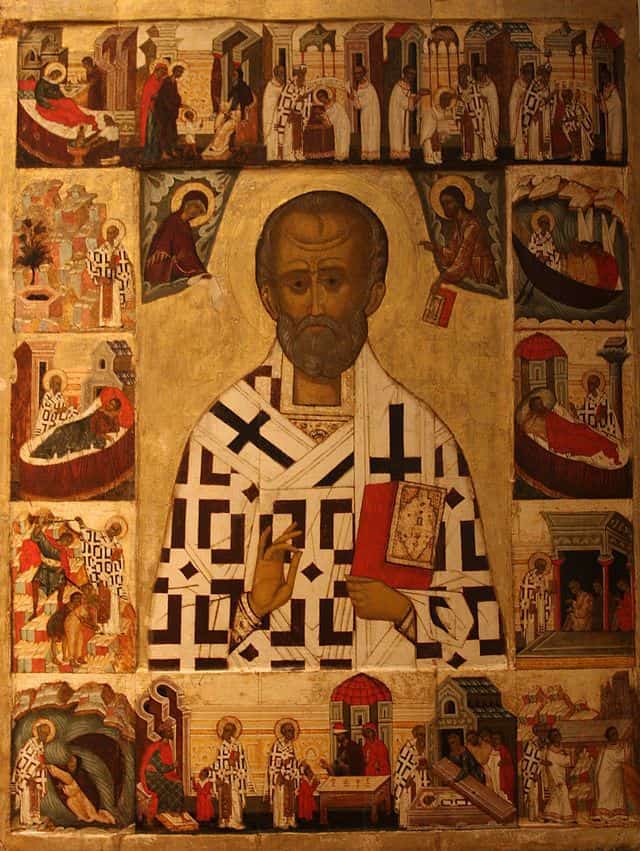
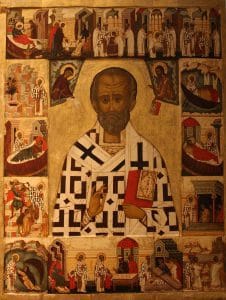
Saint Nicholas was the bishop of Myra during the 4th century AD. He was known for his kindness and generosity to children. One account of his life reveals that he gave gold coins as a marriage dowry to three girls in order to save them from prostitution. Legend also has it that he threw money from windows to poor children while remaining hidden. Regardless of his kindness, he was imprisoned during the most ruthless persecution of Christians by the Roman emperor Diocletian. He was later released from prison during the rule of Emperor Constantine. He is officially celebrated on December 6th, the day of his death. The Church documented several miracles that occurred during his life. And he was canonized and became a patron Saint of children.
Soon after Saint Nicholas’ death his reputation grew home and abroad. He was buried in Myra and by the 6th century the burial grounds became the site of a popular shrine. In 1087, a band of Italian sailors who heard stories about Saint Nicholas stole the Saint’s remains and brought them back to their home town of Bari. Once his remains were in Italy, the Saint’s popularity spread all over the country. A basilica was built to shelter Saint Nicholas’ relics and in time the shrine became one of most popular pilgrimage centers in the country.
A few years later a French knight named Charles Aubert traveling through Bari took a piece of the relic and brought it back home. The relic became a sanctuary and the site of the basilica of Saint-Nicholas Le Port near Nancy, France. From Bari, the celebrated protector of children made its way north. Over the next 700 years his cult would spread to Belgium, the Netherlands, Germany and beyond – so much so that a great part of Europe celebrated Saint Nicholas.
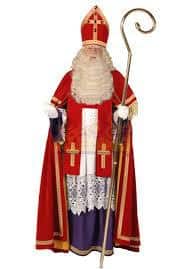
The Reformation put a hold to the saint’s devotion in Germany and throughout the Protestant world. Martin Luther did not look kindly on the domineering power of Rome and its veneration of saints. Nonetheless, the devotion to the saint persisted in the Netherlands. In order to circumvent Luther’s admonition, the saint became known as Sinterklaas, a man dressed in a long red robe with a white beard who brings gifts and candy to children on December 6th.
Sinterklaas and Santa Claus
Sinterklaas
Centuries later, a number of Dutch immigrants who sailed to the New World brought the devotion of their Saint with them. They landed on a location they named New Amsterdam. It did not take long before the prized piece of real estate was coveted by English-speaking settlers. In the aftermath of the Anglo-Dutch war, the city became known as New York. The varied nationalities established themselves in different neighborhoods and coexisted somewhat peacefully. The Dutch kept their cultural traditions, including the celebration of Sinterklaas. The English-speaking population took a liking to the patriarchal figure and adopted him. In time he became known in its English pronounced version of Santa Claus.
Christian faithful of the New World ended with two holidays dedicated to children in the same month; the first on December 6th dedicated to Saint Nicholas, and the second on December 25th celebrating the birth of Jesus. Americans, known for their propensity to simplify things, combined the two holidays into one: The celebration of a Saint and of the birth of Christ became a festivity dedicated to children and gift-giving.
In A History of New York, a book written by Washington Irving in 1809, Saint Nicholas was no longer depicted as “lanky bishop,” but portrayed as a portly bearded man who smokes a pipe with a peculiar habit of coming down chimneys. The book was meant to be a parody about the overindulgence of New York City inhabitants. Nonetheless, the account of a chubby character who was able descend a chimney ironically became part of Santa’s accepted behavior.
 On December 23, 1823, the Sentinel, a newspaper based in Troy, New York, printed a Christmas poem by Clement Clark Moore entitled, A Visit From St. Nicholas. The story depicted Saint Nick as a broad faced character, “chubby and plump, a right jolly old elf” dressed in white fur spotted with ash and soot. The poem introduced the idea of Santa traveling through the cold night skies in a sleigh pulled by eight reindeer. The American poem seemingly captured the imagination of readers and its popularity spread all over the country. Santa Claus was slowly overshadowing the story of an old Bishop riding on a cart pulled by an aging donkey.
 What Moore conjured up with words, Thomas Nast framed Santa’s image with sketches. Nast’s portraits of Father Christmas were seemingly inspired by New York writers and journalists rather than by a concern of reproducing a historic Saint. Over the years he added varied details of his own about St. Nick’s personal life, including that the he lived in the North Pole. From 1863 to the turn of the century, Nast’s depictions eventually established a framework of what Santa Claus would look like. One memorable print shows Santa depicted with children sitting on his knees enumerating their Christmas presents wish list.
During the course of the nineteenth century, Santa was depicted wearing costumes of varied colors. Prior to red, he was pictured in white, green and purple dress. In Nast’s first sketch, Santa was dressed in a patriotic star and stripes costume. In his later renditions the red suit was the preferred color, perhaps to keep with the tradition of Sinterklaas’ long red robe. However, Santa could hardly take care of business wearing a long robe, so the Americanized Father Christmas was dressed in a more sporty attire consisting of a short coat, bonnet, sizable belt and boots to face winter and sneak down chimneys.
Further contribution to imprint Santa’s image was introduced by Louis Prang with his Christmas postcards. Prang is known as the father of the Christmas card for starting this commercial tradition of buying and sending Christmas cards. This custom originated in England in 1874 and it spread to the United States a few years later. His first Christmas card was created in 1885 depicting Santa in a red costume.
A side note: The bodily contrast between the meager Saint and the portly Santa reflects that corpulence has been regarded throughout the ages as a sign of wealth and material abundance. In this regard, Santa reflected the US’ growing economic wealth, generosity and power.
 Then came the tradition of a live Santa in department stores. The custom was introduced in 1890 by James Edgar, a Massachusetts businessman who is credited with coming up with the idea of having a Santa impersonator attract customers to his store. This marketing tool was so successful that children from all over the state dragged their parents to see Santa in Edgar’s dry goods store.
The most memorable contribution to Santa’s image was made during the roaring 1920s. In order to promote drinking cold drinks in winter, the management of a famous cola drink hired an established advertising agency to begin a nationwide campaign by placing ads in popular magazines. The image of Santa that is most recognizable today is attributed to illustrations created by Haddon Sundblom who relied on Moore’s poem A Visit from St. Nicholas as an inspiration to draw his portraits. As it happens, red and white were the official colors of the famous soft drink company. Thereafter Santa has been portrayed as a jovial and plump father figure in red and white attire.
World War II
In 1939, the United States was still struggling to revive a stagnant economy that began with the great depression. The following years, young men of legal age were sent abroad to fight the dual evils of dictatorship and fascism while older men and women stayed at home to engineer and build an industrial powerhouse. The US and its allies’ victory created an economic prosperity that would last several decades and a recovery that also lifted the Old World out of its economic doldrums.
The American troops that landed on the shores of Italy and France pushed back the occupying forces into a final retreat. The victory gave way to a welcome reception to soldiers who freely shared their name brand supplies with the people: chewing gum, cigarettes, soft drinks, music, movies and Santa Claus. The war liberated a great part of Europe. And it just happens that the military also opened a new market for corporate America’s goods. For most Europeans, US soldiers were generous liberators carrying with them precious gifts; a relief from years of rations and starvation. However, not everybody felt the same way about their generosity.
On December 23, 1951, a priest set an effigy of Santa Claus on fire in front of the Cathedral of Dijon. The priest was venting his indignation toward a growing popularity of Santa Claus who he considered to be a poor travesty of an honorable Saint.
Secularization and the Sacred
The priest from Dijon might have been overly touchy about his religious devotion to the Saint. He might also have been alerted by the invasion of a foreign symbol representing globalization. He nonetheless embodied a concern about an irrevocable shift in the representation of the sacred in popular culture.
This process is referred to as secularization, which is commonly understood as a decrease in church attendance. A more apt description is when various elements of human life cease to be administered by religious institutions. Whereas, the historical definition of secularization is the confiscation of Churches property by the State or a sovereign for worldly ends. In other words, the priest was objecting to the transfer – or symbolic confiscation – of a religious figure being converted it into an idol for commercial purposes.
The transformation of Saint Nicholas was made possible with the help of media; newspaper articles, poems, books, postcards, sketches and advertising. Santa became a mythical icon conjured from a patchwork of different sources. As a result, he is no longer Saint Nicholas or Sinterklaas. He is an entirely different character transformed by media into a supernatural being whose mission is no longer to help children in distress but to be a corporate marketing agent.
Saint, Holy and Sacred
Sainthood is an official declaration by the Church in Rome stating that a deceased member of the congregation has attained a holy status and is elevated in heaven among other saints. To attain sainthood a person must be morally righteous and his good behavior corroborated by testimonies made by the people who knew the candidate.
The terms holy and sacred are synonym. The former is the preferred term used by the Judeo-Christian tradition. Both words mean; to set apart from the ordinary or common use. They have the same sense and function in most religious narratives and practices. The sacred today does not have the same traditional religious recognition as it did in the past, it nonetheless plays the same role in society, albeit subliminally.
In order to be considered sacred, a being or a thing needs to be set apart, separated and elevated above the ordinary or common use. In our day and age, global corporations stand out as the most powerful body to propagate its own doctrine in culture, the economy and in politics through corporate owned media. Today logos and trademarks have a similar sacred status as religious object did in the past. They are elevated by media in heaven, so to speak, to be highly visible symbols and set apart from common/ordinary use, sheltered and protected by law.
In a postmodern era, corporate media has imposed itself as the provider of the good news. It displaced the priesthood as the mediator between the sacred and the believers. As a result it provides mediated models of conduct setting new grounds for acceptable behavior, a role previously held by the priesthood who were theoretically concerned with preaching moral rules of conduct.
In time, the media became the gateway to an unlimited source of worldly gratification, a technological medium between an invisible power source to promote a new standard of amoral conduct. At the outset, believers used to congregate in churches to celebrate their Saint. Later they assembled in malls to meet Santa and shop. Currently viewers are segregated, captive to their preferred form of online media.
What is at stake is more than a transfer of the sacred for commercial purpose. It is a challenge to the traditional role played by the priesthood. Priests, ministers, mullah, rabbis and reverends are intermediaries between God and the faithful. They are human beings that interpret the Word of God and administer rites to facilitate access to the divine. In essence, they are a live medium opposed to a corporation that is defined as an artificial person.
What the changes in Santa Claus shows is that secularization has not eliminated the sacred. It merely shifted elsewhere to a different entity. One that is in control of media and through it culture, the economy and politics. As a result it shifted peoples’ alliance from a spiritual devotion to a Saint to a subliminal amoral artificial person.
by netage | Culture, Ideology and Religion, General |
Several books have been published about Google’s questionable business practices. Not many addressed how this overreach happened and what it means for the political landscape of the world going forward. Keeping in mind that this misrepresentation does not only apply to Google but to most global corporations.
One hypothesis about Google’s amoral activity is traced to the nature of moneyed corporation and its massive proliferation since the nineteenth century. Corporations today dominate the world’s economy. This domination has been instrumental in advancing a corporate doctrine that now permeates the policies of the West.
This doctrine in many respects runs counter, challenges and encroaches on the nature of human speech, human congregation and human civilization.
This belief system is defined in these terms: A corporation is an artificial person and as such it is an amoral entity with the sole purpose to be profitable for sake of its shareholders. There is no other prerogative than expansion, growth and profits. One must also take into account the misplaced identity of a corporation defined as a “U.S. Person” and as a lawful permanent resident.
When these corporations congregate in an organization like World Economic Forum (WEF) their aggregate market and monetary power allows them to prescribe and lobby policies that encroach and sidestep citizens’ benefits in favor of corporate interests.
 Since the nineteenth century moneyed corporations have seen their power increase and used it to influence government policies. During the past century corporations have embarked on a media campaign to promote the status of the consumer while overshadowing the state of the citizen. With the introduction of World Wide Web, the power of Big Tech has increased exponentially to such an extent that global corporations are challenging the legitimacy of nations-states and their respective constitutions.
Amoral Person
By amoral is meant neither moral or immoral, but lacking in moral capacity. Alphabet (GOOG) is a corporation, as such it has a legal definition of “artificial person” as opposed to a human being defined as “natural person”. The definition reflects a fundamental difference between an artificial person, as an amoral entity, and a human being who is born with a free will and a moral aptitude to choose between good and evil.
Sergey Brin and Larry Page have endorsed the company’s motto Don’t Be Evil because as individual human beings they have the ability to discern ‒and express‒ the difference between what is good and what is evil and make appropriate decisions. This human prerogative outlines the fundamental difference between a natural as opposed to an artificial person. The distinction is illustrated by what former Google’s CEO Eric Schmidt replied when asked how does a company like Google determine what is evil? He said: “Evil is whatever Sergey says is evil”.
When an individual becomes a shareholder of a moneyed corporation he or she abdicates his or her individual sovereignty as a moral being and becomes incorporated into an association that is defined by its charter. Consequently the greater the number of shareholders the greater the dilution of morality. The only concern of a moneyed corporation is to increase its market share and its stock valuation.
The Spoken and Written Word
An essential principle that defines a human being versus an artificial person is language.
Language re-produces —re-creates— reality. Society is only possible and only exists through language; and through language the individual.
Emile Benveniste, Problems in General Linguistics
Benveniste also describes how stories about the creation of the world relate the divine power of language. In Genesis 1:3, God literally uses his speech to create the world. Language is God’s primordial tool. Without it he could not reveal his existence, neither could he communicate to his people the world described in the Bible. It might be inferred that before the first words of Genesis are written there is nothingness, and before the order of syntax is put forth there is chaos.
Gen. 1:3 And God said…
In similar fashion, numerous ancient myths provide a good example of the creative power of the divine word. In ancient Egypt the god Ptah of Memphis, in a comparable fashion, created the world through his spoken word. While Sumerian myths describe how divinities first plan their creation by thinking, and then the world comes into being through the power of speech.
In the first verse of the Gospel of John, the apostle identifies Christ with the Word in the beginning. The verse is an important confirmation about the nature of language in God’s creative endeavor.
John 1:1 In the beginning was the Word: the Word was with God and the Word was God.
The point Benveniste is trying to make is that although language has a mysterious beginning, and for many a divine origin, it reflects the unique human faculty to communicate. More so, it is the ability to create and re-create the world we live in to enable the spread of our human cultural heritage; like mythology, religion, music, science, math, software codes and hypertext markup language, so on and so fort.
Corporations use language for advertising purposes to promote products and services to entice sales and generate profits. Ads are also used to modify behavior by converting people into loyal consumers. It’s safe to say that the language used in ads to portray a product does not reflect the real thing but is a make believe it’s a real thing. The product becomes a mediated artifact. The language of advertising has become the prevalent voice of mainstream media blurring the boundary between fact and fabrication promoting an artificial reality disconnected from the natural world.
Who Is Speaking and Says What?
At the SEC Registration Statement of Google’s IPO, Larry page in his Letter from the Founders wrote the following:
Don’t be evil. We believe strongly that in the long term, we will be better served—as shareholders and in all other ways—by a company that does good things for the world even if we forgo some short term gains. This is an important aspect of our culture and is broadly shared within the company…
We will live up to our “don’t be evil” principle by keeping user trust and not accepting payment for search results…
Larry Page spoke as a moral individual. It is assumed that he believed his intention to do good when he wrote the letter. However, a fundamental change occurred when Google was incorporated. The change alienated the two creators from their creation setting the stage for a divided self between moral individuals and an amoral association. Another change occurred with Google’s IPO. It widened its fiduciary duty to shareholders located all around the world making the corporation global in scope.
Once incorporated, Larry Page’s good intentions were no longer relevant. The motto became an emblem of Google’s amoral predicament. The corporate charter and the language of advertising took over leaving behind any moral prerogative previously held by the individuals who created the search engine.
Artificial Person
The meaning of person has been carefully manicured since the Robber Barons. The ensuing court battles since then have created a deceptive confusion about the definition of an elusive someone. In 1886 Chief Justice Waite cut the argument short in court when he ruled that corporations are legal persons. What he omitted to do was define what a person is.
The court does not wish to hear argument on the question [whether corporations are persons]. We are all of the opinion [that they are].
Chief Justice Morrison R. Waite
The original Latin meaning for person is persona, a mask worn by an actor. One must keep in mind that the mask is a prop that allows an actor to perform a theatrical impersonation. An actor does not embody himself as a human being but is a mediated character. The misunderstanding of what a person is also stems from the fact that the Latin meaning of corporation is corpus or body. The word body in this sense does not mean a physiological organism commonly understood as a human body, but a society or an association.
Here the person is one of the “things” about which we speak rather than itself a speaking subject… The person, therefore, remains on the side of the thing about which we speak rather than on the side of the speakers themselves who designate themselves in speaking.
Paul Ricoeur, Oneself As Another
Paul Ricoeur explains that a person is a “thing” that we speak about, not a “thing” that speaks back to us. By definition a person does not have the ability to partake in a conversation. And it might be inferred that an artificial person does not have the physiological capacity to speak. And as such it does not have the same First Amendment rights as “people” have. This characteristic is exemplified by the joke: I’ll believe a corporation is a person when they put one in jail.
Congress shall make no law respecting an establishment of religion, or prohibiting the free exercise thereof; or abridging the freedom of speech, or of the press, or the right of the people peaceably to assemble, and to petition the Government for a redress of grievances.
Furthermore, a corporation cannot procreate. This is illustrated by the oxymoron of corporate citizen. Citizenship is granted either by birth or through the process of citizenship, a ceremony that involves taking the pledge of allegiance to the United States of America.
All persons born or naturalized in the United States, and subject to the jurisdiction thereof, are citizens of the United States and of the state wherein they reside. No state shall make or enforce any law which shall abridge the privileges or immunities of citizens of the United States; nor shall any state deprive any person of life, liberty, or property, without due process of law; nor deny to any person within its jurisdiction the equal protection of the laws.
The Fourteenth Amendment: First Article
Sergey Brin was born in Moscow in 1973. Russia was still part of the United Soviet Socialist Republics (USSR). His family immigrated to the US in 1979. He later became a citizen. To become a US citizen Sergey had to recite the pledge of allegiance. As for Larry, it is assumed that in the course of his life he recited the pledge of allegiance to the flag, the symbol of the nation-state.
With Google’s IPO Larry Page and Sergey Brin’s stake in the company caused a change in their individual integrity. They became involved in two separate ruling systems. As citizens they are subject to laws enacted by the government of the people. And by being major shareholders of Alphabet they submit to rules defined by the rules of the market.
Many of us own shares in varied companies or mutual funds, have an IRA or ROTH account, or receive benefits from a pension fund that is invested in the stock market. Over the decades the overwhelming speculation in the stock market, made by a wide range of market players, has given corporations a dominating role in all aspects of our lives, especially in government.
Marshall McLuhan explained; it is the medium ‒the corporation is the medium of all economic activity‒ that shapes and controls the scale and form of human association and action. In other words, corporations were successful in promoting their doctrine on governments with the incursion of non-elected corporate appointees in crucial government positions. The intrusion has enabled the implementation of an alien corporate doctrine that is a direct challenge to the U.S. Constitution created by the Founding Fathers.
The conflicting influence is evidenced by a “pandemic” where global agencies, private institutions, corporate media, charitable foundations and NGOs ‒aligned as a body of global corporations‒ used the authority of government to imposed their medical agenda and remedy without an open, transparent and scientific debate. As it happens, the policies that have been enacted have favored stock evaluations of global corporations at the expense of the safety and health of the population at large.
A Divided Self
Google dominated the World Wide Web by comoditizing users’ private data. It distorted human communication with advertising and encroached on human rights in the process.
Educated citizenship today requires more than an understanding of government, which is just the tip of the iceberg of social organization. It also demands an understanding of the companies that influence our government and culture. The firms that order the Internet and direct the flow of capital have outsized influence in Washington.
Frank Pasquale, The Black Box Society
What lays ahead is a conflict between We The People as a mystical body versus a divided self U.S. Person representing global corporate interests rather than citizens.
By mystical is meant a people having a spiritual character by virtue of a union that transcends human comprehension. A union that includes people of different ethnic backgrounds, language, age and varied religious beliefs who are inspired and guided by the principles of Life, Liberty and the Pursuit of Happiness and by being connected to the land and their respective communities.
In contrast to a franchise economy that is estranged from the people and the location from which a corporation extract its profits.
Corporations, which should be the carefully restrained creatures of the law and the servants of the people, are fast becoming the people’s masters.
President Grover Cleveland
The warning President Grover Cleveland gave during the State of the Union Address on December 3rd, 1888, fell on deaf hears. As a result the Congress faces a battle to stop a global U.S. Person from taking over the whole body politic.
by netage | General |
By philosophy I mean the love of wisdom as it applies to understanding the spiritual synergy of language, namely the “Word” as narrative viewed in conjunction with speech that enables us to communicate our thoughts as an expression of our being. This process is outlined by linking John’s “Word in the beginning” to the creation texts of Genesis, whereby the Evangelist defines Antichrist as the negation of the divine essence of speech.
 In Antichrist: A Historical Perspective, I explain that Luther singled out the Pope as Antichrist who came to power due to the backing of his wealthy banking family. During his reign, The Pontiff emphasized the material, artistic and political operations of the Church at the expense the spiritual legacy established by Simon, the fisherman whom Jesus called the rock on which he built his living Church.
In Antichrist: Theological Perspective, John’s Antichrist is described as an apostate who has turned his back on a Christian community of which he was once part. Once he left the congregation, he denied the human nature of Christ and negated that Jesus was the Son of God. Both these principles are linked by the Evangelist to the creative power of the “Word in the beginning”.
To explain the process I’ll use a practical example:
When a person reads Genesis, he or she brings to life the inspired Word of God. This process involves the reader’s utterance of God’s creative activity in the beginning of the Bible.
God’s inspiration
writer/editor
˅
Word/text
˅
reader/speaker > God’s spoken words
This spiritual experience can be illustrated in the following terms: A copy of the Bible sits on a table. The book is a external and non-existent object without the presence of a reader. A person appears and picks up the Bible. He or she opens the book and begins to read Genesis. Words become alive as the reader utters the order of syntax and reproduces God’s creative activity. What was initially an external reality becomes an inspirational and a wholly external~internal spiritual experience, linking past and present with human speech.
Gen 1:1 In the beginning God created the heaven and the earth. 2 Now the earth was a formless void, there was darkness over the deep, with a divine wind sweeping over the waters. 3 And God said, “Let there be light,” and there was light.
Emile Benveniste pointed out that language reproduces reality. In Genesis, God’s creation and existence is reproduced by human speech. This process transcends time and space of words that were written in the beginning. It is important to note that language should not be confused with speech. The former is defined as a communication system, while the latter is a human capacity to reproduce a reality: A spiritual experience of divine being and presence.
God is a noun. What defines God or a deity is its attribute or verb. In Genesis 1:3 God speaks and creation is formed. God’s creation consists of words~symbols like light and darkness, day and night, days of the week, the naming of animals, of man and woman. These words are essential for the world of the Bible to exist.
In this sense creationists are correct. God did create the world of the Bible. However, Genesis does not mention particles, molecules, biological or astronomical evolution, which are all acknowledged by science and scientists. The Bible presents a reality distinct from the language of science.
It is important to note that during the time of Genesis’ writing, only priests and scribes were able to read or write. This was a closely guarded family skill. Interestingly, at the center of the Garden of Eden stands a prominent symbol of genealogy; a tree. This symbol represents the lineage of priests who were responsible for teaching their descendants how to read and write, making it a closely guarded skill.
Priests were the only ones with the ability and authority (note that the word authority comes from “author”) to read the Torah to the faithful. By reading and speaking God’s words to an audience they acted as a medium between God and the assembly of believers.
The invention of the printing press changed this dynamic by allowing any reader to become a medium. This promoted individualism, contemplation, prayer, meditation and the direct communication of God’s words and presence.
John 1:1 In the beginning was the Word, and the Word was with God, and the Word was God.
The emphasis here is not on the “Word” as noun, but on the verb “was” which suggests active speech in the beginning of creation. Through speech, the reader is able to read and speak the “Word”, thereby re-creating the presence and existence of God.
Additionally, the original meaning of inspiration is the action of inhaling or breathing in. Its also means the act of inspiring or enlightening the mind and soul. In a metaphysical and mystical sense, this means the human soul is a recipient God’s Spirit. And by expiring, the breathing out by using the vocal cords, words becomes speech, the ultimate means of communication. It is worth noting that in Hebrew the words spirit, breath and wind are synonymous. Furthermore, the Hebrew language is made up of only consonants without vowels. In other words, a speaker must breathe out the spirit to vocalize the vowels with the help of vocal cords in order to make a word comprehensible.
In conclusion, the Antichrist refers to the entity or being that denies the holy origin life and the divine source of human speech without which God could not communicate His will to his or her reader or hearer of the “Word”.

 Prior to becoming a US citizen I lived in Montreal, Canada, where I immigrated when I was five years old. Later, in my mid-thirties, I moved to Los Angeles where I found a similar attitude: Northern Californians look down on southern dwellers, especially citizens of Los Angeles.