by netage | New Testament Tradition, General |
Theology is the study and interpretation of the Word of God. Keep in mind, that any interpretation by a theologian is influenced by his or her religious affiliation. A Catholic theologian will have a different interpretation of the Holy Scriptures than a Lutheran or a Presbyterian or a member of any other denomination. This is especially the case when interpreting specific topics such as the meaning of Church, penance, the priesthood or salvation.
Theology is not about ministry or preaching. Theologians are scholars who focus on academic research and institutional interpretation as it applies to the Word of God.
There is no official religious doctrine on Antichrist. The term is loosely used to describe an impostor who challenges the divine identity and power of Jesus Christ.
Among the traditions concerning the last days, the belief of Antichrist has a special pastoral function to fulfill. It serves to arm the believing community to do battle with the compact forces of darkness, in the form in which they encounter them in their own age.
K. Frör
This second article focuses on the meaning of “Antichrist” in the First and Second Letters of John, the semantic content of which is linked to the Gospel of John and the creation narrative in Genesis. The goal is to reveal the relevance and meaning of key words to identify what the author says about Jesus’ humanity and divinity. Attributes that are negated by the Antichrist.
 The term Antichrist appears only in 1 and 2 John. It does not appear in Revelation to John, also known as Apocalypse of John. The word Antichrist, from the Greek antichristos, refers to an impostor with equal influence and power who stands as an adversary to Jesus Christ. In terms of biblical etymology, the word “apocalypse” is synonymous with “revelation”, and the word “Satan” is synonymous with “adversary”.
There is no scholarly consensus on the authorship of the First and Second Letters of John. However, it is agreed that the First Letter shares similar vocabulary, ideas, themes and style with the Gospel of John. All narratives attributed to John are dated to the end of the first century CE. John the Evangelist did not know Jesus personally. His written testimony relies on varied oral accounts and narratives describing the life of Jesus.
One John relates to “end of times”, or the “final hour”, not as a distant future but as an imminent threat to Christians and their community by a deceiver(s) or seducers(s) who claims that Jesus is not Christ, did not exist in the flesh, and is not the Son of the Father. These claims are made by individuals who were once members of the community and have since left, spreading false information about Christ’s humanity and divinity.
1 John 2:18 Children this is the final hour;
You have heard that the Antichrist is coming,
and now many Antichrists have already come;
from this we know that it is the final hour.
19 They have come from among us,
but they never really belong to us;
if they had belonged to us they would have stayed with us.
1 John 2:22 Who is the liar,
if not one who claims that Jesus is not the Christ?
This is the Antichrist,
who denies both the Father and Son.
1 John 4: 2 This is proof of the spirit of God:
any spirit which acknowledges Jesus Christ,
come in human nature, is from God,
3 and no spirit which fails to acknowledge Jesus is from God;
is the spirit of Antichrist,
whose coming you have heard;
he is already at large in the world,
2 John 7 There are many deceivers at large in the world, refusing to acknowledge Jesus Christ as coming in human nature. They are the Deceiver; they are the Antichrist.
The main point made by the Deceiver is that Jesus is neither not human or God. Thus, it is central to understand what the Evangelist means by Christ’s humanity. Let’s start with John’s first three verses which reveals key words about Christ’s essence of being. They are; beginning, hearing, seeing, touching, the Word of Life made visible.
1 John 1 Something which has existed since the beginning,
which we have heard, which we have seen with our own eyes,
which we watched and touched with our own hands,
the Word of Life ‒this is theme.
That life was made visible;
we saw it and we are giving our testimony,
declaring to you the eternal life,
which was present to the Father and has been revealed to us.
John explains the eternal of life embodied by Jesus Christ has existed since the creation of the world. God made this life visible by sending his Son, Jesus, in the flesh for us to see and hear. Specifically, “we have heard…seen… touched the” “Word of life… was made visible” is linked to “In the beginning was the Word” and “The Word became flesh” in the Gospel of John.
John 1:1-5 In the beginning was the Word:
the Word was with God and the Word was God.
2 He was with God in the beginning.
3 Through him all things came into being,
not one thing came into being except through him.
4 What has come into being in him was life,
life that was the light of men;
5 and light shines in darkness,
and darkness could not overpower it.
1:14 The Word became flesh,
he lived among us, and we saw his glory,
the glory that he has from the Father only Son of the Father,
full of grace and truth.
Jesus’ humanity is outlined by his presence among his disciples, his followers and the people he healed and raised from the dead. However, the most critical aspect of his humanity is identified as the Word became flesh. John highlights an often-overlooked aspect of Jesus’ humanity: Jesus spoke his message to his faithful. Without God’s creative essence to speak, the world would not have known the Son of God. As such, speech is a divine attribute that connects the beginning and the present. The Word IS eternal, and Jesus made the Word alive by his presence. Speech is what makes Jesus fully human and divine, without which his message of love could not be revealed.
In Genesis, God spoke creation into being. He created heaven and earth. And he made man with the dirt taken from earth’s soil, and “God blew the breath of life into his nostrils and man became a human being”. In Hebrew, the words for Spirit, breath and wind are synonymous, exemplifying the divine essence of human breath and life.
God created man and woman in his image and in his likeness. In Genesis 1:26, tselem is the Hebrew word for “image”, is loosely translated into shadow, or contours of a shadow. Demut is the Hebrew word for “likeness”, conveys a resemblance in terms of bloodline, akin to progeny or descendants, and, to a certain extent, procreation of human life.
God created Adam and Eve in his likeness with ability to hear his Word, speak, and procreate. Throughout the Old Testament, God spoke to his chosen people. He spoke to Adam and Eve, to Abraham, Moses and his prophets. Speech is God’s primal essence, without which he could not communicate his will to his people. Ultimately, God is made present by whomever reads and speaks His Words.
John’s perspective on Jesus’ humanity is that he came to this world in the flesh and could speak his Word to the people. This is revealed through the presence he shared with his followers, to whom he spoke his message of love, sharing and forgiveness.
John’s Antichrist is a person who was once a member of the Christian community but abandoned the congregation. After leaving, he and other renegades spread lies about Jesus, denying he came in the flesh or was the Son of God. The Deceiver spread falsehoods claiming Jesus is neither Christ nor the Lord, nor the human incarnation of the Word from the beginning. Denying his Word is eternal and sovereign.
1 John 1 Something which has existed since the beginning,
which we have heard, which we have seen with our own eyes,
which we watched and touched with our own hands,
the Word of Life ‒this is our theme.
by netage | General |
I’m turning 41, but I don’t feel like celebrating.
Our generation is running out of time to save the free Internet built for us by our fathers.
 What was once the promise of the free exchange of information is being turned into the ultimate tool of control.
Once-free countries are introducing dystopian measures such as digital IDs (UK), online age checks (Australia), and mass scanning of private messages (EU).
Germany is persecuting anyone who dares to criticize officials on the Internet. The UK is imprisoning thousands for their tweets. France is criminally investigating tech leaders who defend freedom and privacy.
A dark, dystopian world is approaching fast — while we’re asleep. Our generation risks going down in history as the last one that had freedoms — and allowed them to be taken away.
We’ve been fed a lie.
We’ve been made to believe that the greatest fight of our generation is to destroy everything our forefathers left us: tradition, privacy, sovereignty, the free market, and free speech.
By betraying the legacy of our ancestors, we’ve set ourselves on a path toward self-destruction — moral, intellectual, economic, and ultimately biological.
So no, I’m not going to celebrate today. I’m running out of time. We are running out of time.
by netage | General |
 Benito Mussolini, the founder of Fascism, was a man of the left not of the right. He was a journalist and a member of the Socialist International in Switzerland. He organized communist insurrections during World War I. He later was expelled from the socialist party for abandoning the party’s position on war neutrality.
In Italy, the former journalist and career politician, abandoned the idea of unions in favor of guilds. By doing so he got the support of the Church in Rome and the backing of Italian major corporate industries. As a result he was elected Prime Minister of Italy in 1922. Once in power he promoted a merger between state and corporate interests. His misguided alliance with Hitler eventually triggered the Second World War.
What we have today is an implicit alliance between entrenched political elites, NGOs, and bureaucratic institutions that have been captured by domestic and transnational corporate interests. They have joined hands to propagate a globalist agenda to undermine the sovereignty of nation-states of the world, including the United States.
by netage | Culture, Ideology and Religion, General |
I didn’t expect a religious topic like the Antichrist to make headlines, especially when raised by figures like podcaster Alex Jones or wealthy technocrat Peter Thiel. Their comments reignited my interest in a subject I had set aside years ago.
 This essay, the first of a three-part series, begins with Martin Luther’s use of the term “Antichrist.” The second part will explore the theological interpretation of the Antichrist as described in 1 John 2:18–23, 4:2–6, and 2 John 7. The final part will offer a philosophy of religion perspective on the elusive Deceiver.
When I began researching this topic, I struggled to connect John’s Antichrist to any contemporary evildoer. That changed with the COVID-19 government mandates, which allowed businesses, including liquor stores, to remain open while prohibiting Christians from congregating in churches. Church, meaning the assembly or congregation of believers, IS the mystical Body of Christ.
Martin Luther’s Antichrist
Several factors sparked the Protestant Reformation, including the invention of the printing press and the religious activism of Martin Luther (1483–1546). The printing press reduced costs and sped up the distribution of documents like Luther’s 95 Theses across northern Europe, playing a pivotal role in the Reformation’s spread. Other factors included ongoing conflicts among potentates within the Holy Roman Empire and the corruption of religious institutions.
Luther’s path to labeling the leader of the Papal States as Antichrist began with his objection to the sale of indulgences by Johannes Tetzel. His outrage flared when he learned that a Church emissary was collecting payments on behalf of sinners who died without completing penance in purgatory, as a prerequisite for entering heaven.
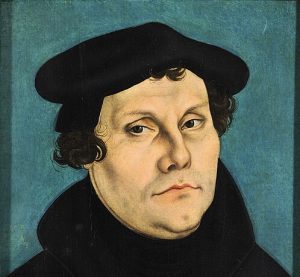 Born in Eisleben, a northern German town about 100 miles southeast of Berlin, Martin Luther was raised by hardworking parents who were strict disciplinarians. His father was a leaseholder of mines and smelters, intended for Martin to become a lawyer to support the family’s business. Luther enrolled in legal studies, but his life changed when he was jolted by thunderstorm and lightning that struck nearby. Martin later confessed he was terrified of dying without confessing his sins and spend eternal damnation in hell.
When I was terror-stricken and overwhelmed by the fear of impending death, I made an involuntary and forced vow. Help me St. Ann… I will become a Monk.
Soon after, Luther abandoned law school and joined an Augustinian monastery, much to his father’s disappointment. He later described his years of prayer, meditation, and Bible study at the monastery as the happiest of his life.
Like many Germans, Luther strictly adhered to rules. He had little tolerance for dishonesty or duplicity. Wholly devoted to Jesus Christ and His teachings. Luther in the course of his life was ordained a priest, learned Greek and Hebrew in addition to his fluency in Latin ‒the language of Europe’s religious and political elites. He subsequently earned an honorary doctorate in biblical studies. He also translated the entire Septuagint Bible into German.
When Luther learned of the indulgence sales, he publicly voiced his objections in his 95 Theses, which he nailed to the door of the Castle Church in Wittenberg. The 95 Theses, or observations, were intended to spark a theological debate with Church officials about the justification of paying a fee rather than making penance. The document unexpectedly ignited a movement that contributed to the disintegration of the Holy Roman Empire.
Theses 28
It is certain that when money clinks in the chest, avarice and greed increase, but the intercession of the Church depends on the will of God alone.
Like many of his countrymen Martin had a frank way of expressing his opinion. He held the view that being straightforward and honest was a quality to be proud of. However, some of the wording of his 95 Theses was perceived as an insult by the Church’s curia and an affront to the Pope’s authority. Luther had valid reasons to question the moral justification of indulgences, but his blunt language provoked indignation among clerics, who demanded action be taken against the arrogant monk. The Church invited Luther to Rome to defend his claims. He wisely declined, fearing arrest.
Instead, a Pope’s emissary was sent to Wittenberg, Germany, to set up a disputation with the religious apostate. Johannes Eck was a skilled and polished debater. He had the backing of Church leaders that held as true the Pope ruled by divine right. Luther, who couldn’t match his opponent rhetorical skill, fared poorly in the debate.
Upon returning to Rome, Eck urged Pope Leo X to take decisive action against the German heretic. Luther’s refusal to recant his writings prompted the Pope to issue a Papal Bull threatening excommunication. On December 10, 1520, Luther publicly burned the document at the gates of Wittenberg, leading to his excommunication in January 1521.
I am at a loss to know whether the Pope be Antichrist or his apostle.
His resolve strengthened when the Church burned two young Augustinian monks at the stake in Brussels. In defiance, Luther left the priesthood, married, and abandoned monastic attire for common or academic clothing. He began identifying himself as an Evangelical, no longer loyal to the Holy See.
He and his mission had the support of his mentor, Johann von Staupitz, as well as a good portion of the German population. And he gained the backing of the powerful Frederick the Wise. Many Germans resented the Papal States for collecting indulgences to fund the costly construction of St. Peter’s Basilica in Rome.
History portrays Johannes Tetzel as the main culprit in the indulgence controversy. As a matter of fact he was merely an emissary acting on behalf of Cardinal Albert of Brandenburg. The Cardinal had borrowed money to bribe his way into controlling more dioceses in Saxony, splitting the indulgence proceeds to repay his debt to the banking house of Fugger. The other half of the money to fund St. Peter’s Basilica in Rome.
Pope Leo X (1513–1521), born Giovanni di Lorenzo dè Medici, was the second son of Lorenzo the Magnificent, ruler of Florence. He was made a cardinal at early age of thirteen, his family ensured their influence in Rome and the Holy Roman Empire. After Leo’s death, his cousin Giulio dè Medici was a contender for the papacy, but Adrian VI (1522–1523), a Dutch humanist dedicated to Church reform, was elected Pope instead. His short reign was unpopular among Romans, who resented him as an outsider. He was the last non-Italian pope until John Paul II in 1978.
Clement VII (1523–1534), born Giulio dè Medici, became the second Medici pope. Orphaned after his father’s murder, he was raised by Lorenzo the Magnificent ,and subsequently declared legitimate by the Church. Both Leo X and Clement VII transformed Rome into a cultural and political center of Europe. Critics remarked they neglected the spiritual and moral duties of the papacy, contributing to the Holy Roman Empire’s decline.
Antichrist
In 1545, Luther published Papacy Institution of the Devil, linking the Antichrist to the Apocalypse. Although Revelation to John does not mention the Antichrist, Luther identified Satan as the chief agent at the End of Times. Throughout his struggle with Rome, Luther was preoccupied with an imminent end of the world. His battle with the Church arguably hastened the end of the Holy Roman Imperial world.
Theses 86
Why does not the Pope, whose riches today are ampler than those of the wealthiest of wealthy, build this one Basilica of St. Peter with his own money, rather than with that of poor people?
Luther associated Antichrist with greed and the pursuit of political power. He criticized the leader of the Papal States for prioritizing materialism—specifically the construction of St. Peter’s Basilica—over the spiritual salvation of Christians. He condemned pontiffs for their ties to Florence’s political and banking elites, who adorned the basilica with Renaissance art while neglecting spiritual duties.
Luther argued that the love of money had displaced a direct communication between individuals and God. Many Church sacraments, he believed, had become barriers to a personal relationship with Jesus Christ. Arguing that Christians are saved by faith alone. God’s presence being celebrated by the freedom of individual Christians to congregate as the mystical Body of Christ: And objecting to the confusion between to power of money and the power of the Word of God.
Bibliography:
Martin E. Marty, Martin Luther (Penguin Books, 2004)
Martin E. Marty, October 31 1517: Martin Luther and the Day that Change the World
(Paraclete Press, 2016)
Rudolf Pesch, Antichrist (Sacamentum Mundi, Palm Publishers, 1968)
by netage | General |
Quasi means sharing similar attributes even though at the outset any similarity was not intended.
A smart phone is a quasi totalitarian device, meaning its primary role is to accomplish a totality of functions for the user. Functions that were previously segregated in the past.
 With a smart phone a user can make a phone call, take a photo, surf the Internet, buy groceries, book a flight, make a payment, write, send and receive mail, watch the news or view a movie, read a book, check the time, the weather, check various elements of your health, use your phone as credit card or use it as a GPS navigational app, etc.
A few decades ago you needed a separate medium or source/venue to accomplish any of the tasks enumerated above. An individual used a telephone to make a call, a camera to a take photo, a TV to watch a program, a book to read a novel, a newspaper to read the news, a computer to surf the Net, and go to different stores to buy food or goods, etc…
The fact merely underlines the point that “the medium is the message” because it is the medium that shapes and controls the scale and form of human association and action.
Marshall McLuhan
If Marshall McLuhan’s analysis is right about the role of a medium in shaping and controlling “the scale and form of human association and action”, then a smart phone is potentially creating a totalitarian mindset with the user who is unknowingly submitting to a single medium, like Google, which is a global corporate entity, to control and manipulate all functions for an individual, generating a totalitarian system.
To what extent did a device like a smart phone become instrumental in creating what Michael Rectenwald describes as a totalitarian threat hovering our democratic institutions and government?
The most pressing matter facing advocates of liberty today is the prospect of the political and economic establishment completing the institution of a totalitarian state. There is no other way to read the multipronged approach and the political maneuverings that political operatives are taking to rule under “Biden.” I put “Biden” in quotation marks here because the current president of the United States is not a singular person named Joe Biden. It is a politburo consisting of party rulers and advisers, ruling by executive fiat, plus, as I’ll discuss, corporate-state apparatuses. Make no mistake, the power grab that is underway poses the most grievous threat to liberty in recent history.
The signals could not be any clearer. In addition to the swath of executive orders, clearly composed by politburo members and aimed at extending federal power, the political establishment has initiated a growing body of laws which would, if passed, consolidate uniparty rule for the foreseeable future…
An Historical Juncture, Michael Rectenwald
by netage | General |
As a lifelong researcher of comparative religion and mythology, I can’t help write about the similarities between President Emmanuel Macron and the main character in the myth Oedipus. His personal life and his rise to power reveal many traits akin to Sophocles’ Oedipus King.
President Macron is commonly known by his political detractors as presi-roi or petit Napoleon. The first term is a play on words meaning “president-king”, while the second expression implies “little emperor”.
In the play, Oedipus leaves his native city of Corinth to avoid a prophesy that he is destined to kill his father and marry his mother. The prophesy and his rise to power are the reason for a plague that ravages the city of Thebes which he rules as king.
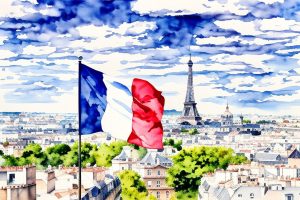 There are many interpretations of the play by literary critics. Some argue it’s about fear and compensation for a lowly birth. Others contend it’s the story of a scapegoat who is singled out for a city’s social ills. Most surmise it’s about a journey to avoid the truth about oneself and the inevitable tragic course of destiny.
My perspective is centered on the self-destructive quest for power. It’s about imposture portrayed by a hero who takes over the position of king. The impersonation ends in the demise of the hero who is held responsible for a plague that ravages his kingdom. Ultimately, Oedipus is an impostor who usurps his father’s identity and marries his mother to be king.
President King
Emmanuel Macron was born in 1977 in Amiens, France. A city located halfway between Paris to the south and the Belgium border to the north. Emmanuel met Brigitte Trogneux in 1993, a drama instructor at the Lycée La Providence, where he was a student. Macron at the time was ~15 years old. Brigitte was 25 years his senior, old enough to be his mother.
When Macron’s parents learned their 15 year-old son was having a romantic liaison with his drama teacher, they transferred him to Paris to save him from a relationship that could potentially harm his future and seal his fate. Nonetheless, Emmanuel and Brigitte eventually marry in Paris in 2007.
In Paris, he enrolls at the Institute of Political Studies in Paris and obtains a diploma in political science in 2001. Macron simultaneously undertakes a philosophy course at the Paris-Nanterre University with a focus on Machiavelli and Hegel.
After his graduation he is granted a one-year banking apprenticeship in the US sponsored by Rothschild & Cie.
In 2002 Macron enrolls at Ecole Nationale d’Administration (ENA). A prestigious postgraduate school to form senior government administrators. The degree is a prerequisite for a high-level civil servant career. He graduates in 2004 and lands a job at the Ministry of Finance.
In 2008 Macron quits his position at the ministry and accepts a job at Rothschild & Cie. Former students at the ENA are bound by an agreement to provide 10 years of civil service to the state. Due to his breach of the agreement, Macron paid 54,000 euros, equivalent to ~$72,000, of penalty to the institution.
In his new position at Rothschild & Cie. he is put in charge of refinancing the debt of Le Monde newspaper. He is later assigned the sale of Pfizer’s Wyeth Nutrition baby formula to Nestlé. A transaction that makes him a millionaire.
In 2016 Macron creates a political party called en Marche. The party’s platform is a shift away from established parties focused on a pro-European platform. The party’s launch unexpectedly benefits from huge corporate media coverage. And it comes under criticism for its obscure source of financial backing.
During his first presidential campaign he was referred to as the “media candidate”. Francois Fillion, a Gaullist, his main opponent and a favorite candidate to win, dropped out of the race as a result of a corruption media blitz against him. Macron finally ran against Marine Le Pen in the runoff and won the presidency.
Emmanuel Macron won a second term in 2022 against Marine Le Pen who was derided by corporate media as a “far right” and “hard right” candidate. A term widely used by Euro-centric trans-nationalist backers to describe patriotic and populist candidates and supporters; namely denigrate the French Constitution, the people and the nation as Sovereign.
During the 2024 European Parliamentary Election, Macron’s party got only 14.6% of the votes, 17 points behind Marine Le Pen’s party causing a loss of confidence in Macron and the National Assembly. As a result, Macron called for an early legislative election. His political coalition received only 20% of the votes landing in third place well behind Marine Le Pen’s Rassemblement National (RN).
France: A Model Nation-State
The French Revolution severed ties with the king and removed him as sovereign. The 1789 Preamble and the French Constitution of 1791 replaced the people and the nation as sovereign. Both texts were inspired by the American Declaration of Independence of 1776 that also cut ties with the British Crown.
From the nineteen century through the First World War, France stood at the height of its political, technological, cultural and economic power, a model nation-state of the world.
In 1880 French engineer Ferdinand de Lesseps began the construction of the Panama Canal. Lesseps was also responsible for another international breakthrough with the completion of the Suez Canal in 1869 that enhanced the global economy. The Panama project however, encountered a series of obstacles that hindered its completion: Financial mismanagement, delays due to constant rainfall, recurring landslides, and disease that resulted in labor shortages.
In 1889 Paris held its Exposition Universelle. The fair coincided with the centennial celebration of the French Revolution. On that occasion the organizers rejected a proposal to erect a 900 foot replica of the guillotine. A symbol that evoked shivers among the aristocracy of Europe. Instead, the Eiffel Tower was inaugurated showing off to the world a giant feat of French engineering
.
In 1896 Pierre Baron de Coubertin was a prime promoter of the reinstatement of the Olympic Games to celebrate individual competition among nation-states of the world. A celebration that originally took place in Athens, Greece, the birthplace of the first Olympic Games ~2,800 years ago.
France stood center stage in terms of world diplomacy. Leon Bourgeois, a politician and a Nobel Prize winner (1899), referred to as the “spiritual father” of the League of Nations, introduced the legal concept of Droit International. During his stay as Chairman of the French delegation at the Hague Peace Conference, he was responsible for the adoption of the Permanent Court of Arbitration that made agreements between nations legally binding in the court of law.
The Panama Canal was not completed as expected. The business project ran into financial and funding problems. The Compagnie Universelle du Canal Interocéanique filed for bankruptcy in 1889 amid a political scandal that shook the French establishment. The collapse revealed high-level corruption among politicians, administrators and promoters, resulting in vast amounts of money lost by ordinary investors.
The Panama Canal scandal was a forewarning about France’s political integrity and its future standing in the world. The talented yet controversial poet Charles Péguy, a non-practicing Christian, echoed citizens’ loss of confidence with the French ruling elite. He articulated a betrayal of a social republic upon which the nation was created. And lamented the loss of sovereignty of the people in favor of money interests that took over the Republic.
Charle Péguy died on September 5th, 1914, at the age of 41, at the Battle of Marnes. He sacrificed his life for his country and God. His life was cut short at the beginning of a war that would be devastating and eventually trigger World War II. His poems to this day are a longing for La Mystique Republicaine; a mystical body representing the sovereignty of the people as prescribed in the Constitution.
In 1904, under Theodore Roosevelt’s presidency, the US took over the Panama Canal. The project was completed in 1914, linking the Atlantic and Pacific oceans and reducing the cost of worldwide commercial shipping between east and west. The takeover introduced the US as the leading nation-state of the world.
France did not reclaim its international role in geopolitics until General de Gaulle’s 5th Republic in 1958 which reestablished the nation’s sovereignty by forging ahead as an independent country and made it a nuclear power. Under his leadership France was not formally part of NATO and moved away from the dominant Anglo-sphere of Washington DC and the Incorporated City of London.
The Constitution
Preambule Article 2
The aim of every political association is the preservation of the natural and imprescriptible rights of Man. These rights are Liberty, Property, Safety and Resistance to Oppression.
Préambule: Article 3
The principle of any Sovereignty lies primarily in the Nation. No corporate body, no individual may exercise any authority that does not expressly emanate from it.
5th Republic: On Sovereignty – Title 1
Article 2
The maxim of the Republic shall be “Liberty, Equality, Fraternity”.
The principle of the Republic shall be: government of the people, by the people and for the people.
Article 3
National sovereignty shall vest in the people, who shall exercise it through their representatives and by means of referendum.
No section of the people nor any individual may arrogate to itself, or to himself, the exercise thereof.
The initial point of contention about Macron’s imposture consist of his breach of contract he had as a civil servant in order to join a trans-national banking institution. A move that is duplicitous and a violation of Préambule article 3; “no corporate body, no individual may exercise any authority” other than to represent the sovereignty of the nation and the people.
Among other contentions is Macron’s party’s meteoric rise to power. His political party began with the name en marche (EM) standing for the first two letters of the candidate’s name. It was later renamed la République en marche and finally replaced with Renaissance. The name change implies a republic marching forward and away from the sovereignty of the nation toward a European Union comprised of a Commission with a non-elected president.
Some critics claimed the party was created out of nothing, “ex nihilo” following a corporate managerial model referred to as a “business firm party”. A party run in a cult-like, top-down manner, enforced by state control of corporate media, communication technologies and social media.
It is exemplified by the extraordinary media blitz surrounding the party’s creation and the obscure source of its financial backing. During the political campaign of 2017, a massive telemarketing campaign was undertaken that reached 6 million people by phone days before the elections, resulting in the most expensive French presidential campaign ever.
During his two terms, President Macron has shown a disregard for the constitutional rights of citizens. Displayed by the use of hi-tech surveillance of citizens’ communications and social media to control French people’s expression of legitimate grievances. And by how he forcibly dealt with the yellow jackets’ protests of legitimate concerns.
A former senior security aide to President Macron named Alexander Benalla was caught on camera disguised as a police officer beating a protester during a Paris demonstration in May 2018. Benalla had shaved his beard for the occasion in order to hide/disguise his identity. An investigations later revealed he received support from high-level government officials in the surveillance of protesters.
The label prési-roi given to Emmanuel Macron represents a blurry impersonation he plays in French politics. One role, as an elected representative of the people. The other role, as a wannabe king who stands above the constitution he has sworn to support and uphold. And finally as a petit-Napoleon as a politician who virtually projects himself as the imperial leader of the European Union.
Current conspiracy theories regarding his personal life, if proven correct, will likely reveal the full extent of the imposture. Of a man who metaphorically killed la patrie, the French word for fatherland, the nation and its Constitution.
* * *
Prior to being a play, the story was known in ancient Greece as a poem. And prior to its poetic format it was likely a myth recounted by storytellers to a gathering of devoted listeners.
The play setting: A man leaves his hometown of Corinth to escape a prophecy that predicts Oedipus will kill his father and marry his mother. His journey leads him to Thebes, where he outsmarts the Sphinx by correctly solving a riddle. His prowess saves the city from disaster. And the people of Thebes acclaim him as a hero. He marries widowed Jocasta, whose husband Laius has been murdered. Oedipus becomes king of Thebes.
*
The play begins with a high priest asking Oedipus to save Thebes from a ravaging plague. An investigation led by Jocasta’s brother, Creon, reveals the plague is the punishment for King Laius’ murder. Upon hearing the report from Creon, Oedipus swears he will seek out and kill the murderer.
To find the identity of the culprit he summons Tiresias, a famous seer. At first he refuses to reveal the name of the murderer. Then he yields and finally confesses that the killer is none other than Oedipus himself. Both the king and his court refuse to believe the seer. Outraged, Oedipus accuses Creon and Tiresias of corruption and of fomenting a plot against him.
Oedipus becomes alarmed and suspicious. He begins to ask questions. A messenger from Corinth informs him his father is dead and he was adopted. He should not worry.
Jocasta finally realizes that Oedipus is her son and her husband. She tells him to stop the search for truth. Oedipus does not listen. A herdsman appears on stage. He confirms Oedipus is Laius and Jocasta’s son, and he killed his father.
A servant announces to Oedipus that Jocasta killed herself. Oedipus appears on stage blinded by his own hands. He wanders in exile and mourns with his daughters. Creon takes over Thebes.

 The term Antichrist appears only in 1 and 2 John. It does not appear in Revelation to John, also known as Apocalypse of John. The word Antichrist, from the Greek antichristos, refers to an impostor with equal influence and power who stands as an adversary to Jesus Christ. In terms of biblical etymology, the word “apocalypse” is synonymous with “revelation”, and the word “Satan” is synonymous with “adversary”.