
I didn’t expect a religious topic like the Antichrist to make headlines, especially when raised by figures like podcaster Alex Jones or wealthy technocrat Peter Thiel. Their comments reignited my interest in a subject I had set aside years ago.
 This essay, the first of a three-part series, begins with Martin Luther’s use of the term “Antichrist.” The second part will explore the theological interpretation of the Antichrist as described in 1 John 2:18–23, 4:2–6, and 2 John 7. The final part will offer a philosophy of religion perspective on the elusive Deceiver.
When I began researching this topic, I struggled to connect John’s Antichrist to any contemporary evildoer. That changed with the COVID-19 government mandates, which allowed businesses, including liquor stores, to remain open while prohibiting Christians from congregating in churches. Church, meaning the assembly or congregation of believers, IS the mystical Body of Christ.
Martin Luther’s Antichrist
Several factors sparked the Protestant Reformation, including the invention of the printing press and the religious activism of Martin Luther (1483–1546). The printing press reduced costs and sped up the distribution of documents like Luther’s 95 Theses across northern Europe, playing a pivotal role in the Reformation’s spread. Other factors included ongoing conflicts among potentates within the Holy Roman Empire and the corruption of religious institutions.
Luther’s path to labeling the leader of the Papal States as Antichrist began with his objection to the sale of indulgences by Johannes Tetzel. His outrage flared when he learned that a Church emissary was collecting payments on behalf of sinners who died without completing penance in purgatory, as a prerequisite for entering heaven.
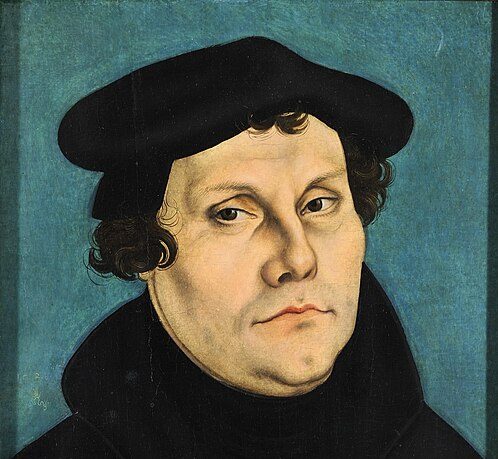 Born in Eisleben, a northern German town about 100 miles southeast of Berlin, Martin Luther was raised by hardworking parents who were strict disciplinarians. His father was a leaseholder of mines and smelters, intended for Martin to become a lawyer to support the family’s business. Luther enrolled in legal studies, but his life changed when he was jolted by thunderstorm and lightning that struck nearby. Martin later confessed he was terrified of dying without confessing his sins and spend eternal damnation in hell.
When I was terror-stricken and overwhelmed by the fear of impending death, I made an involuntary and forced vow. Help me St. Ann… I will become a Monk.
Soon after, Luther abandoned law school and joined an Augustinian monastery, much to his father’s disappointment. He later described his years of prayer, meditation, and Bible study at the monastery as the happiest of his life.
Like many Germans, Luther strictly adhered to rules. He had little tolerance for dishonesty or duplicity. Wholly devoted to Jesus Christ and His teachings. Luther in the course of his life was ordained a priest, learned Greek and Hebrew in addition to his fluency in Latin ‒the language of Europe’s religious and political elites. He subsequently earned an honorary doctorate in biblical studies. He also translated the entire Septuagint Bible into German.
When Luther learned of the indulgence sales, he publicly voiced his objections in his 95 Theses, which he nailed to the door of the Castle Church in Wittenberg. The 95 Theses, or observations, were intended to spark a theological debate with Church officials about the justification of paying a fee rather than making penance. The document unexpectedly ignited a movement that contributed to the disintegration of the Holy Roman Empire.
Theses 28
It is certain that when money clinks in the chest, avarice and greed increase, but the intercession of the Church depends on the will of God alone.
Like many of his countrymen Martin had a frank way of expressing his opinion. He held the view that being straightforward and honest was a quality to be proud of. However, some of the wording of his 95 Theses was perceived as an insult by the Church’s curia and an affront to the Pope’s authority. Luther had valid reasons to question the moral justification of indulgences, but his blunt language provoked indignation among clerics, who demanded action be taken against the arrogant monk. The Church invited Luther to Rome to defend his claims. He wisely declined, fearing arrest.
Instead, a Pope’s emissary was sent to Wittenberg, Germany, to set up a disputation with the religious apostate. Johannes Eck was a skilled and polished debater. He had the backing of Church leaders that held as true the Pope ruled by divine right. Luther, who couldn’t match his opponent rhetorical skill, fared poorly in the debate.
Upon returning to Rome, Eck urged Pope Leo X to take decisive action against the German heretic. Luther’s refusal to recant his writings prompted the Pope to issue a Papal Bull threatening excommunication. On December 10, 1520, Luther publicly burned the document at the gates of Wittenberg, leading to his excommunication in January 1521.
I am at a loss to know whether the Pope be Antichrist or his apostle.
His resolve strengthened when the Church burned two young Augustinian monks at the stake in Brussels. In defiance, Luther left the priesthood, married, and abandoned monastic attire for common or academic clothing. He began identifying himself as an Evangelical, no longer loyal to the Holy See.
He and his mission had the support of his mentor, Johann von Staupitz, as well as a good portion of the German population. And he gained the backing of the powerful Frederick the Wise. Many Germans resented the Papal States for collecting indulgences to fund the costly construction of St. Peter’s Basilica in Rome.
History portrays Johannes Tetzel as the main culprit in the indulgence controversy. As a matter of fact he was merely an emissary acting on behalf of Cardinal Albert of Brandenburg. The Cardinal had borrowed money to bribe his way into controlling more dioceses in Saxony, splitting the indulgence proceeds to repay his debt to the banking house of Fugger. The other half of the money to fund St. Peter’s Basilica in Rome.
Pope Leo X (1513–1521), born Giovanni di Lorenzo dè Medici, was the second son of Lorenzo the Magnificent, ruler of Florence. He was made a cardinal at early age of thirteen, his family ensured their influence in Rome and the Holy Roman Empire. After Leo’s death, his cousin Giulio dè Medici was a contender for the papacy, but Adrian VI (1522–1523), a Dutch humanist dedicated to Church reform, was elected Pope instead. His short reign was unpopular among Romans, who resented him as an outsider. He was the last non-Italian pope until John Paul II in 1978.
Clement VII (1523–1534), born Giulio dè Medici, became the second Medici pope. Orphaned after his father’s murder, he was raised by Lorenzo the Magnificent ,and subsequently declared legitimate by the Church. Both Leo X and Clement VII transformed Rome into a cultural and political center of Europe. Critics remarked they neglected the spiritual and moral duties of the papacy, contributing to the Holy Roman Empire’s decline.
Antichrist
In 1545, Luther published Papacy Institution of the Devil, linking the Antichrist to the Apocalypse. Although Revelation to John does not mention the Antichrist, Luther identified Satan as the chief agent at the End of Times. Throughout his struggle with Rome, Luther was preoccupied with an imminent end of the world. His battle with the Church arguably hastened the end of the Holy Roman Imperial world.
Theses 86
Why does not the Pope, whose riches today are ampler than those of the wealthiest of wealthy, build this one Basilica of St. Peter with his own money, rather than with that of poor people?
Luther associated Antichrist with greed and the pursuit of political power. He criticized the leader of the Papal States for prioritizing materialism—specifically the construction of St. Peter’s Basilica—over the spiritual salvation of Christians. He condemned pontiffs for their ties to Florence’s political and banking elites, who adorned the basilica with Renaissance art while neglecting spiritual duties.
Luther argued that the love of money had displaced a direct communication between individuals and God. Many Church sacraments, he believed, had become barriers to a personal relationship with Jesus Christ. Arguing that Christians are saved by faith alone. God’s presence being celebrated by the freedom of individual Christians to congregate as the mystical Body of Christ: And objecting to the confusion between to power of money and the power of the Word of God.
Bibliography:
Martin E. Marty, Martin Luther (Penguin Books, 2004)
Martin E. Marty, October 31 1517: Martin Luther and the Day that Change the World
(Paraclete Press, 2016)
Rudolf Pesch, Antichrist (Sacamentum Mundi, Palm Publishers, 1968)


I did not add these facts in the original article because I thought they would distract from the main purpose that is to identify Luther’s description of Antichrist. I bring up this information now because I believed it is relevant.
When Luther first addressed his grievances to Rome he made a distinction between the charisma of the Papal office as the spiritual successor to St. Peter, distinct from the Pope as the head of the Papal States, the administrative branch of the Church. As the struggle progressed Luther associated the Pope strictly with the head of the Papal States.
Luther to Pope Leo X: “Before God and all his creatures, I bear testimony that I neither did desire, nor do desire to touch or by intrigue to undermine the authority of the Roman Church and that of your holiness.”
To be fair, according to Church documents, the payment of indulgences were voluntary, not mandatory. However, the priests who preached the merits of indulgences did not make this voluntary option clear to the audience.
To conclude; the new technology of the printing press was instrumental in spreading Luther’s 95 Theses and the Protestant Reformation. According to Marshall McLuhan, this tool was also responsible for the spread of literacy, the rise of rationalism, nationalism, and the development of the Renaissance. But it was also responsible for unfolding of the devastating Thirty Rear War and centuries of deadly rivalry between Protestants and Catholics.